
AI does not invent findings. It rounds them up, one word at a time, creating issues during submission and at the defense.
11 November 2026
Read time: 3 minutes
Next Pass or Revise Session: Wednesday 18 November, 4pm London. Does your thesis hold together?
When I examine a thesis I take five sentences out of it, the question, the aim, the method, the main finding and the contribution, and write them in one sentence.
If that line is straight, the thesis holds. If it bends, I know where my questions are coming from before your defence has started.
Three real pages again, read cold, and you vote before I do, free and capped at 50.
At the Responsible AI Use in Research webinar session last month, somebody put up a paragraph that AI had written from their own results table. It read beautifully. It was also wrong by one word, and I did not spot it on the first pass either.
Their table said 41% of participants reported improved confidence after the programme.
The sentence AI handed back said this:
"Participants reported improved confidence following the programme."
Read the two sentences next to each other. I should say that the second one is not false. Forty-one in every hundred participants did report improved confidence. The problem is that the sentence no longer says forty-one, and without that figure a reader will take it to mean participants in general. The fifty-nine who reported nothing have dropped off the page. Nothing about the data has changed, only the sentence describing it, and that sentence now claims more than the data can carry.
That is the sentence an examiner will focus on, and the question that follows is the one you cannot answer. So, where does this come from? You turn to your own table and the table says 41%. From then on your examiner has a reason to check every other claim in the chapter, and you spend twenty minutes defending sentences instead of discussing your findings.
The solution here is adding one word back in. "Just over four in ten participants reported improved confidence." Or keep the figure where it was and write 41% into the sentence itself.
AI does this every time it summarises, and it is doing what it was built to do. Smooth text that drops quantifiers, since quantifiers tend to interrupt a sentence. That is fine in a blog post but in a findings chapter or research paper it is the difference between a claim you can defend and one you cannot.
So tonight, print one page of your findings or discussion chapter. Mark every sentence that makes a claim. Beside each one, write the number it based upon. Any sentence you cannot put a number next to is bigger than your data, and that is far easier to fix now than under questioning.
Ten minutes a chapter, and all you are doing is putting the number back.
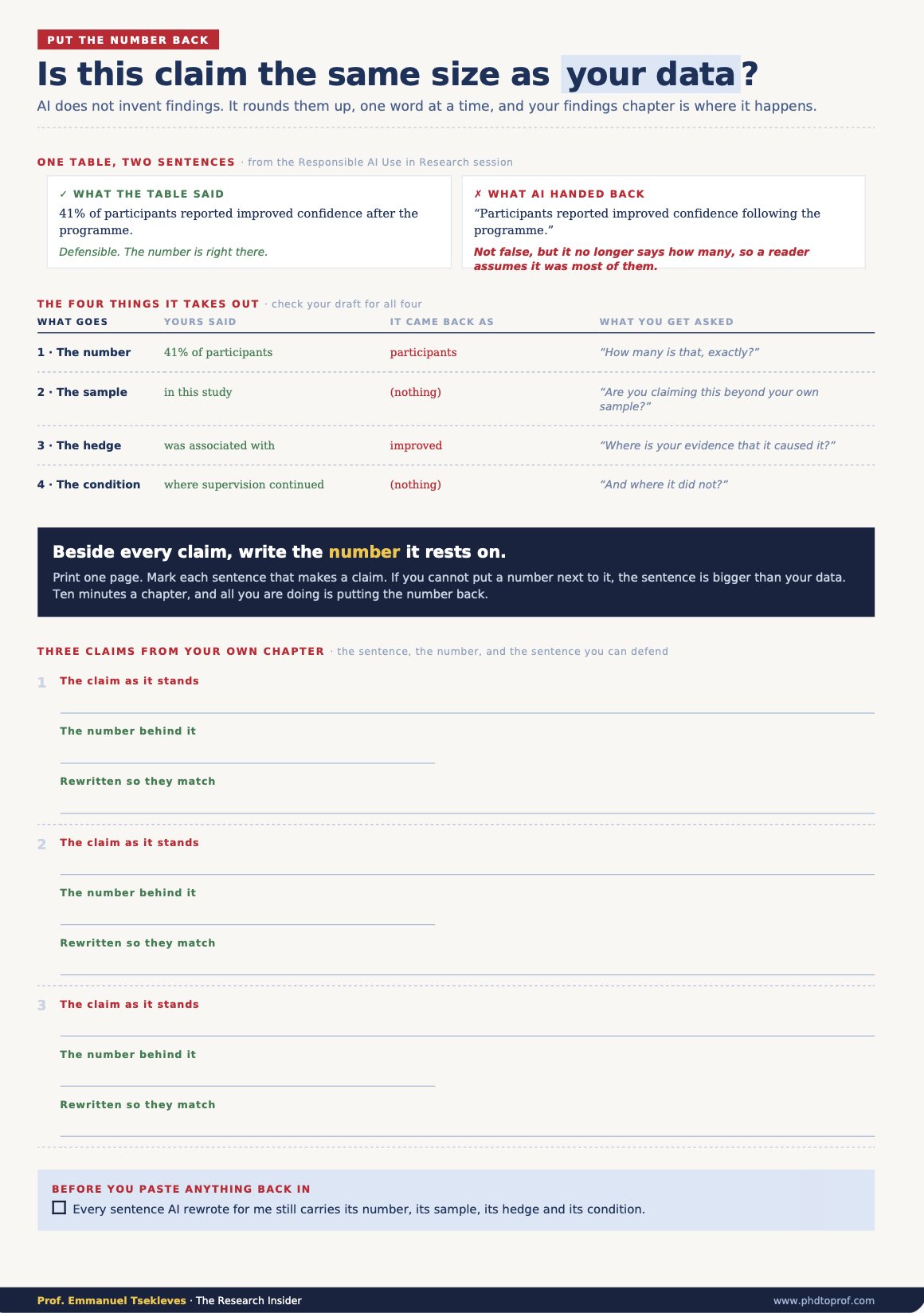
Put the Number Back, one page: the four things AI takes out of a findings sentence, what each one costs you under questioning, and space to work through three claims of your own. Download here.
One other thing. I have started answering the long questions on YouTube properly, the ones people bring to calls, which never fit inside a post. Two are up so far and there is a recording morning booked for the rest. If you subscribe you will see them as they land, and it tells me which questions to film next: https://www.youtube.com/@PhDtoProf
Until next week,
Prof. Emmanuel Tsekleves
New here? This is everything I offer, in one place.
Free guides and templates: www.phdtoprof.com/store
Next room: Pass or Revise, 18th November
Submitting in the next few months? The 8-Week Doctoral Submission Programme, timed back from your date, with a full examiner-style read and two mock defences: www.phdtoprof.com/submission
Small-group mentoring, with written feedback on your own writing and answers from me within 72 hours: www.phdtoprof.com/group-mentoring
1:1 mentoring, where I read your drafts the way an examiner will: www.phdtoprof.com/mentoring
Everything else, including thesis review: www.phdtoprof.com
Responses