
I read three real thesis pages to a room of 35 people last week. Two came back revise, and the worst of it was not on any single page.
28 October 2026
Read time: 8 minutes
Next Pass or Revise Session: Wednesday 18 November, 4pm London. Does your thesis hold together?
When I examine a thesis I take five sentences out of it, the question, the aim, the method, the main finding and the contribution, and write them in one sentence.
If that line is straight, the thesis holds. If it bends, I know where my questions are coming from before your defence has started.
Three real pages again, read cold, and you vote before I do, free and capped at 50.
Year three of my PhD, about two in the morning. I had printed papers across the desk, across the floor, some of them on the bed. I was sitting there working out how to tell my family and firends that I was stopping my PhD.
I had three years of work behind me but no idea whether any of it was good enough. No one would tell me either. I had asked my supervisor more than once.
That was over twenty years ago. I have now examined forty-five theses across fifteen universities. From that chair, I can now see thatweak research is rarely what sends a thesis back for revisions. Far more often nobody ever showed the candidate what the examiner is looking for. Several supervisors have, in fact, never examined, so they could not show you even if they wanted to.
That is why I started running Pass or Revise online session. Last Tuesday, 35 people came. I read three pages from actual thesis out loud, cold, the way I read a thesis I have been sent to examine. Before I said anything, everyone participating in my event, typed pass or revise into the chat. Then I gave my verdict and read out what I would be writing on the report.
I want to take you through what happened, because the third page is where it got interesting, and because what matters most was not on any of the three pages.
Page One: Ten Verbs, and Not One Finding
The first page was an abstract, from a thesis on management in local government. A mixed methods study of middle managers in English councils during the move to hybrid working. Sixty-one survey responses, seven interviews, thematic analysis, a central theme about importing private sector performance management into public services. Properly done work, and a sensible length.
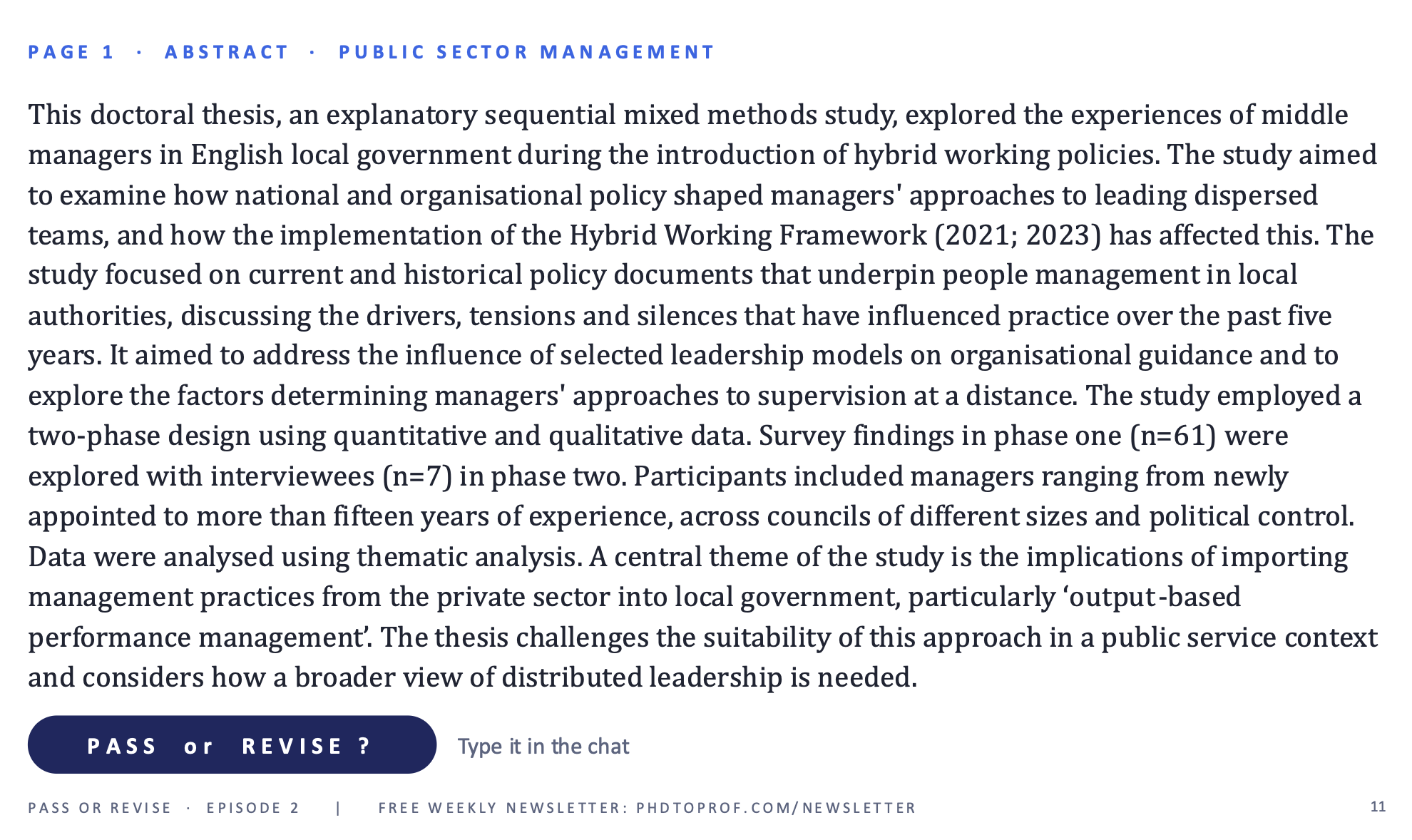
Here is the test I ran on it, and you can run it in two minutes. Read out only the main verbs, in order. Explored. Aimed to examine. Focused on. Discussing. Aimed to address. Employed. Were explored. Were analysed. Challenges. Considers.
Ten verbs. Every one tells me what the researcher did. Not one tells me what they found. Sixty-one people answered a survey and seven sat for interviews, and after reading the whole abstract I could not tell you what any of them said.
Fifteen people in the room voted revise, two voted pass, and the room was right.
What I would write on the report is this: the abstract describes the design and the way the study was conducted but does not report its findings. It should be revised to state, at least in the second half, what the survey and interviews showed and what the thesis therefore claims.
If you voted pass, you are in good company, as it sounds right and is a decent length and it uses the words an abstract is supposed to use. That is exactly why it fools people.
I see this kind of abstract more than any other. It also costs more than most pages. Your abstract is the first thing an examiner reads. It is frequently all the second examiner reads again before your defence. And once the thesis goes online it is the only part most people will ever open.
The solution takes an hour.
- Keep your first two sentences, then cut the method down to a single sentence.
- Use the space you save for your three main findings. Three, not every finding you have.
- Then close on one sentence saying why they matter.
Page Two: A Promise Nine Interviews Could Not Keep
The second page was the last page of an introduction, from a thesis on sustainable procurement in the NHS. I expected the room to split on this one.
The test here is to finish a sentence. By the end of this thesis I will have shown, and then what. The page gave two answers, and they were not the same. One was to engage the majority of procurement staff in sustainable purchasing. The other was to explore the change management approach, the challenges staff face, and the support they need. The first is about people changing what they do. The second is about understanding why they do or do not.
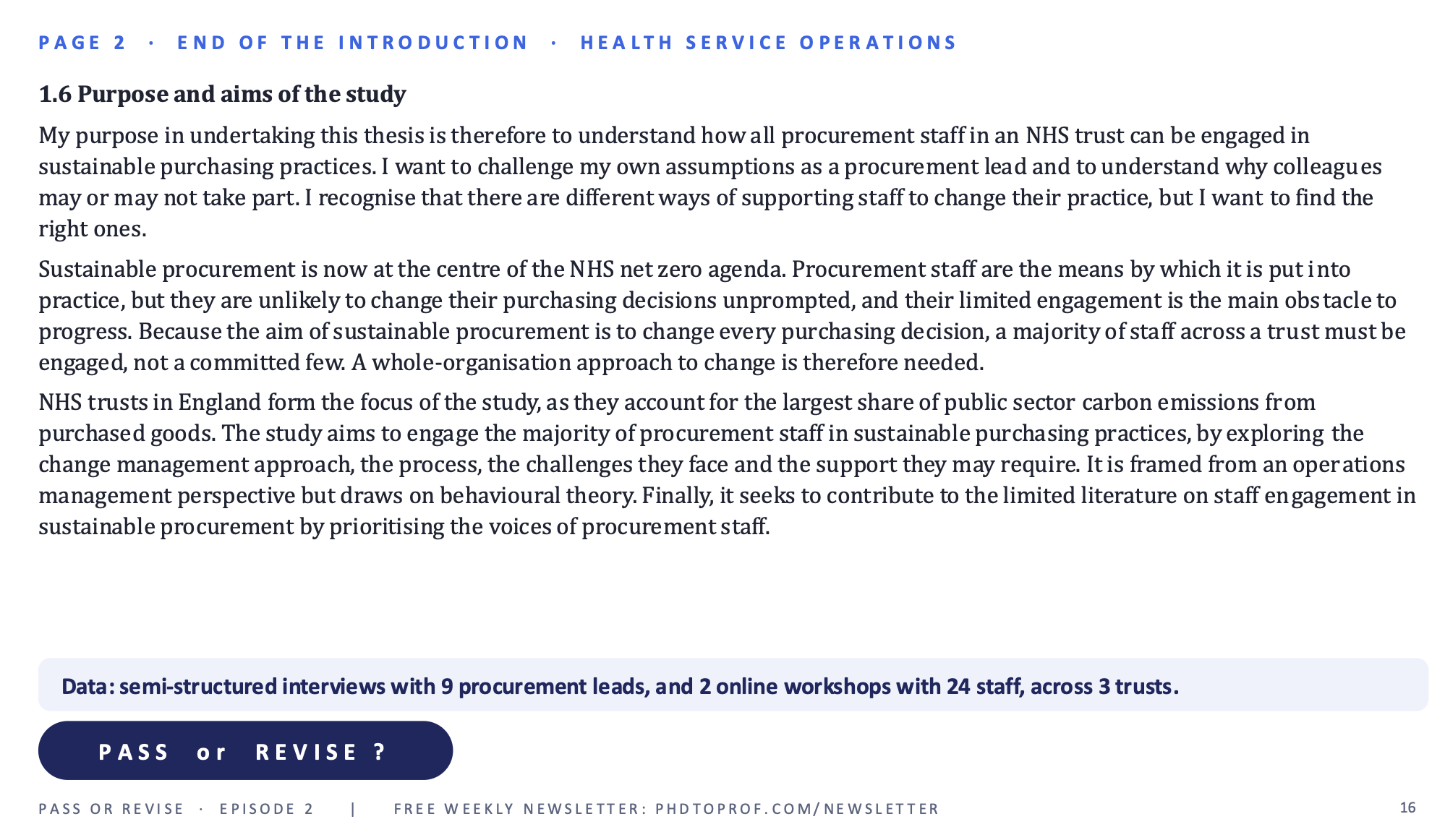
Then look at the study. Nine interviews and two workshops. Can nine interviews engage most of the staff across three hospital trusts and change how they buy things? No.
That change was never measured and was never going to be. What those nine interviews can do, and do well, is explain what helps and what gets in the way.
The room was harder on it than I expected. I thought we would be split, and the votes came in almost all revise. Here is what I would write:
The stated aim to engage the majority of procurement staff is not evidenced by the qualitative design used. The aim should be restated in terms of what the study can deliver: to explore the approaches, barriers and forms of support associated with staff engagement.
The solution here is a few words in one sentence. Change what you promise.
What Had Happened to That Promise by the Conclusion
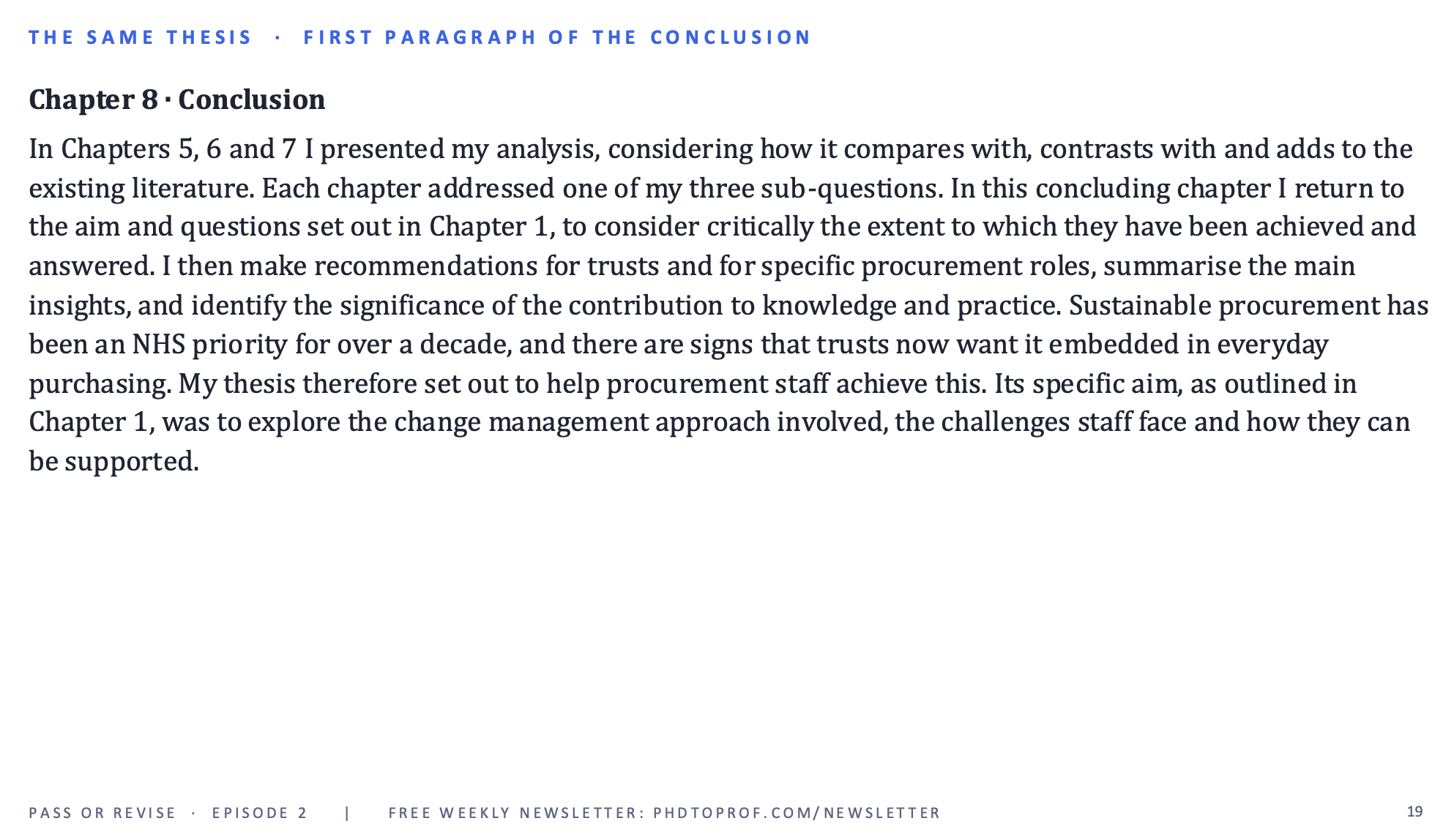
Then I showed them something you rarely get to see. The first paragraph of the conclusion, from that same thesis.
The introduction said engage the majority of staff. The conclusion says the thesis sets out to help procurement staff. Its specific aim, it says, was to explore the change management approach, the challenges staff face and how they can be supported.
Read those side by side and you can see what happened. The promise shrank somewhere between chapter one and the end, until it fit what the study could actually deliver. That is what a promise which was too big to begin with does. The conclusion cannot keep it, so the conclusion rewrites it on the sly and hopes nobody puts the two pages next to each other.
A lot of examiners will do exactly what I did.
That gap was the thing I most wanted people to take away on Tuesday. You will not find it on any single page, because it lives between them.
Your introduction promises one thesis and your conclusion delivers a slightly different one, and no one really notices, as those two pages are written months or years apart. The introduction gets drafted early and lightly edited. The conclusion gets written last, often in a rush. Most people never put those two pages next to each other.
Examiners do. Before I open your literature review I will have read your abstract, then the last page of your introduction, then the opening of your conclusion.
A zigzag, and it takes about ten minutes. So, by the time I reach chapter two I already have a view, and everything I read afterwards either supports that view or fights it. I wrote about this check a few weeks ago, in the issue on what examiners read first, but it is a very different thing to watch it happen on actual thesis pages.
Page Three, and the Four Things That Made It Work
The third page passed, and the room called it correctly.
It was the opening of a conclusion from a thesis on early literacy, where parents of kindergarten children were asked how they see their child's literacy, how they live it day to day, and how aware they are of their own role.
All three ideas come back in the conclusion with answers attached. Parents hold a narrow view of early literacy. That narrow view limits what they do at home. They care a great deal, and being better informed could change how they talk with their children.
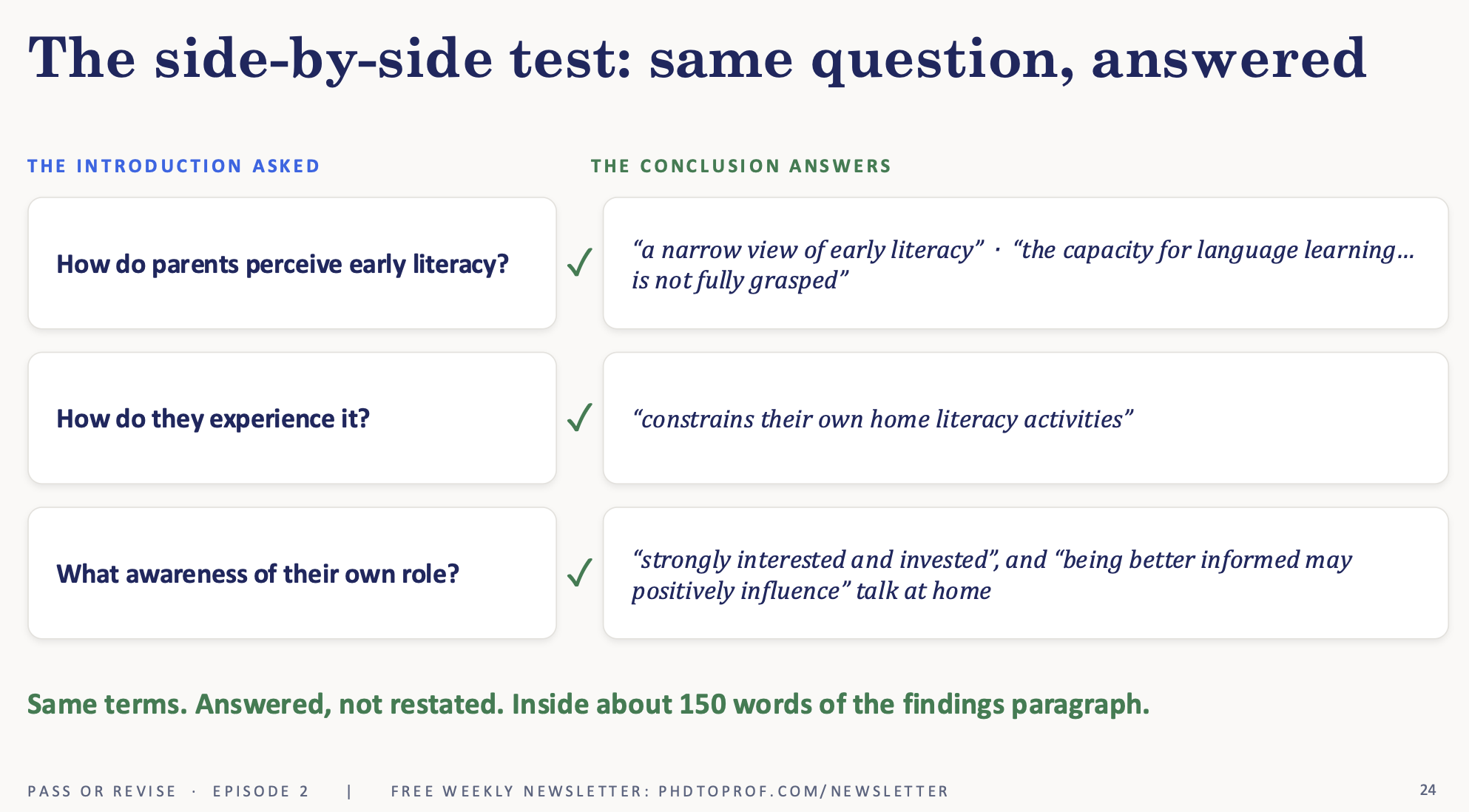
Four things make it work, and none of them is about good writing.
- It answers its own questions, so I do not have to work out for myself if it did.
- The findings come early, in the second paragraph, not hidden at the back.
- It says why they matter.
- And it does not oversell: the claims use suggests and may, which fits the size of the study.
If I were being picky I would move the finding sentence to the very top. That is a preference of mine, and I would not write it on a report.
The research behind all three pages could be equally good. The difference though is that the three pages tell the same story.
Fifteen Minutes on Your Own Three Pages
So here are the three tests, and together they take ten to fifteen minutes.
- Read the verbs in your abstract and ask if any of them says what you found.
- Finish the sentence at the end of your introduction: by the end of this thesis I will have shown what, and can your study actually deliver it.
- Then put your research question next to your conclusion and check that the answers are there.
This is also, more or less, what I do once a month inside my small group mentoring, with one difference that matters. There the pages belong to the Doctoral candidates part of the group, and they get the full read instead of a verdict.
What works and why, so they can repeat it elsewhere. Then what needs changing, why it needs changing, how to fix it, and an example so they know exactly what I mean.
Alongside that there is a masterclass every two weeks, a live clinic every two weeks where you bring whatever you are stuck on, and the ability to ask me a question any time and get a real answer. Everything is recorded, so missing a session costs you nothing.
It is a deliberately small group, and you can see what is involved here: https://www.phdtoprof.com/group-mentoring
Join and I will ask you for one page to start with, the same three I read on Tuesday being the obvious place to begin. You also get the term's schedule and every recording so far.
And if you are closer to submitting than that, there is a different route. The 8-Week Doctoral Submission Programme works backwards from your submission date. I read the whole thesis cold, the way your examiner will, and write you an examiner-risk report. We then work through it across four one-to-one sessions, I re-read the chapters you revise, and your emails get an answer within 48 hours for the full eight weeks. Once your date is set, two mock defences: https://www.phdtoprof.com/submission
If you would rather just keep reading, that is completely fine, and the next Pass or Revise is on 18th November. Three more real pages, read cold, and you get to vote before I do.
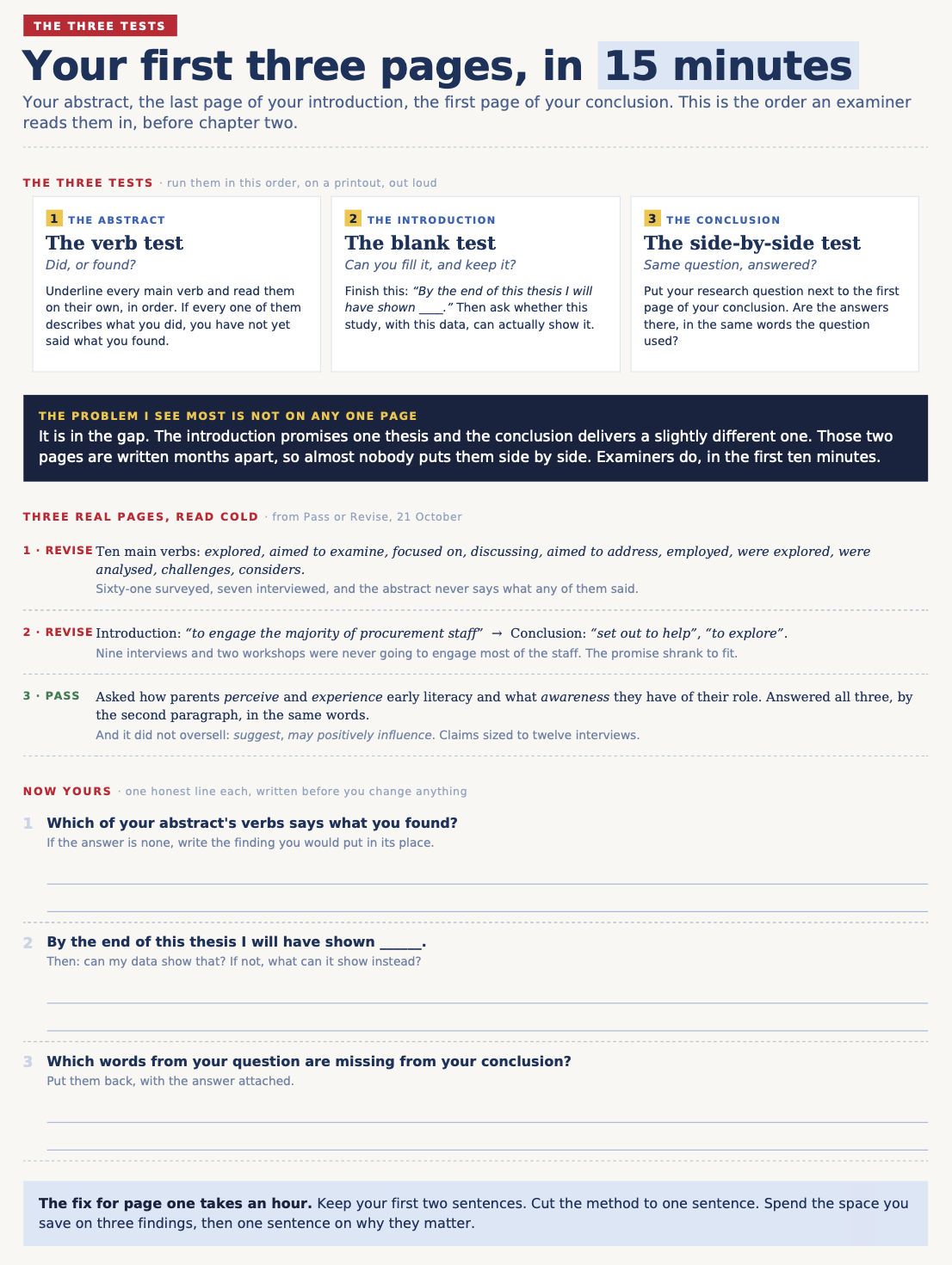
The Three Tests, one page: the verb test, the blank test and the side by side test, with the pages from Tuesday as worked examples and room to run all three on your own. Download here.
Until next week,
Prof. Emmanuel Tsekleves
New here? This is everything I offer, in one place.
Free guides and templates: www.phdtoprof.com/store
Next room: Pass or Revise, 18th November
Submitting in the next few months? The 8-Week Doctoral Submission Programme, timed back from your date, with a full examiner-style read and two mock defences: www.phdtoprof.com/submission
Small-group mentoring, with written feedback on your own writing and answers from me within 72 hours: www.phdtoprof.com/group-mentoring
1:1 mentoring, where I read your drafts the way an examiner will: www.phdtoprof.com/mentoring
Everything else, including thesis review: www.phdtoprof.com
Responses