
What examiners and reviewers want from your methods section, and why one short sentence sorts it.
21 October 2026
Read time: 2 minutes
There's a sentence I find in most methodology chapters I'm sent, and it does no work at all.
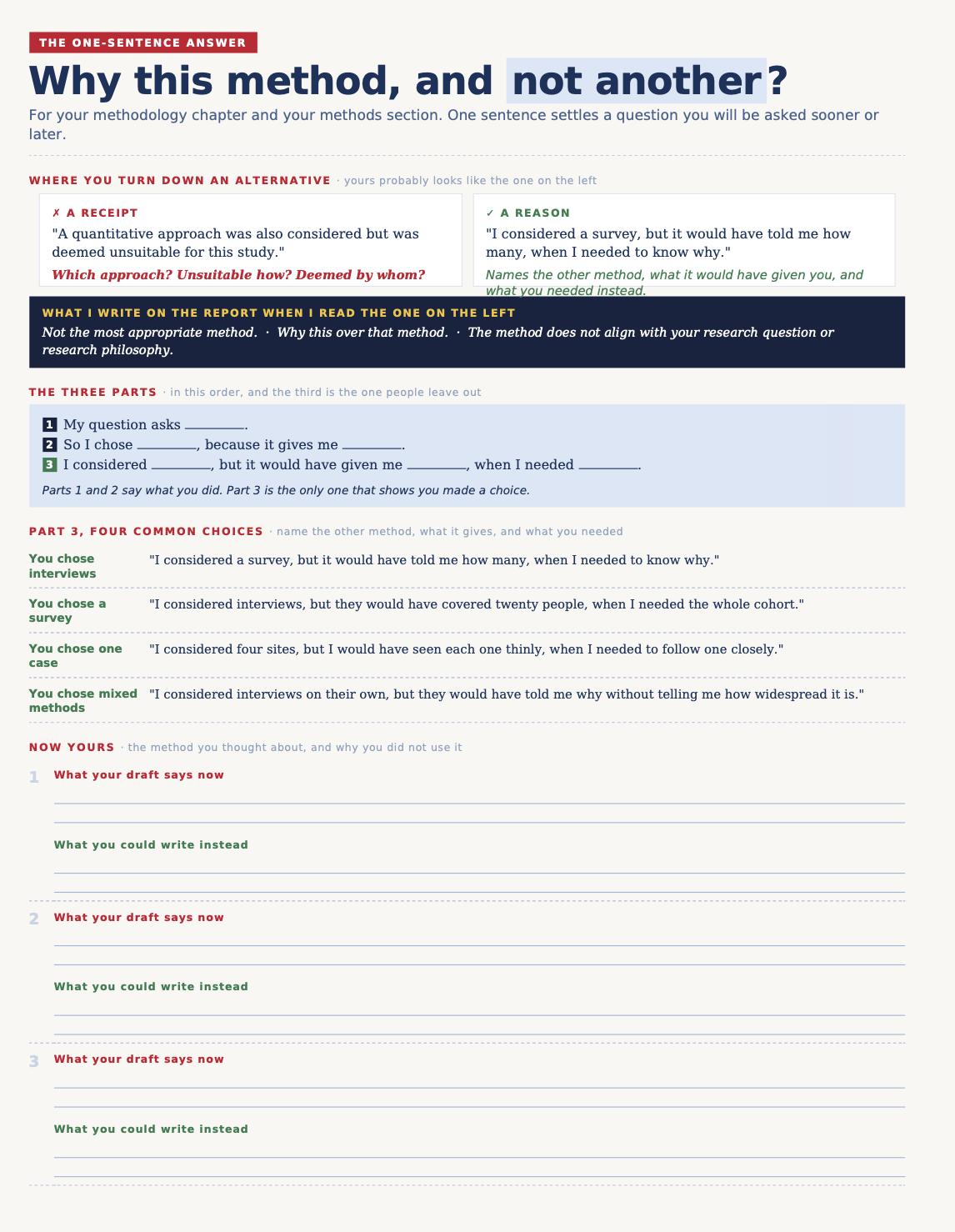
"A quantitative approach was also considered but was deemed unsuitable for this study."
I'd guess you've got something like this. Most candidates have a version of it. It is usually found near the end of the methods justification, one line, usually passive.
Here's what it makes me think as a reader and examiner. Which quantitative approach? Unsuitable how? Deemed by whom, on what grounds?
None of that is there, so I'm reading a sentence built like a justification that doesn't contain one.
Why Everyone Writes One
Because you know you're supposed to show you weighed the options. So you write a sentence saying you weighed them.
What you end up with is a receipt. It proves you went through the motion and tells me nothing about the thinking. That's a shame, because the thinking was usually real. Most candidates weighed the alternative properly. They just never wrote down what happened when they did.
When that sentence is all I have to go on, three comments tend to end up on the report. Not the most appropriate method. Why this over that method. The method does not align with your research question or research philosophy.
The third one is the heaviest, and it isn't really about the method. It says the chapter doesn't hold together.
What a Real One Looks Like
"I considered a survey, but it would have told me how many, when I needed to know why"
Here is an example of the one sentence. It names the other method, what that method would have given me, and what you needed instead. So, now I can see how you weighed it and then decided.
The full version has three parts, and the third is the one I see most candidates miss.
- What your question needs.
- What your method gives you.
- What the alternative couldn't give you.
If you leave out the third one, your methodology will read as a description of what you did. Now, when you keep it, the same chapter reads as an argument for what you did.
It Matters More in a Paper, Not Less
A thesis obviously gives you a whole chapter to justify your design. A paper, instead, gives you just a paragraph, sometimes a single sentence.
This is why "the authors should justify their choice of method" is one of the most common pieces of feedback a paper reviewer highlights when sending your paper back for revision.
In a paper, those ten words are the entire justification you have room for. so do make it count.
Why It Decides Your Viva
Some version of "why this over that method" is a guaranteed quuestion in a viva, and what it tests is whether you chose that method and the why behind it.
A candidate who inherited their design, from a supervisor or from the last paper they read, or from an AI tool output, can describe it well and still come apart on that question, as there's nothing underneath it to find.
If your rejection sentence is genuine, you've already answered it or got an answer for it.
Go and Find Yours
Now, open your methodology chapter, or the methods section of whatever paper you're drafting, and find the sentence where you reject an alternative.
- Does it name the alternative?
- Does it say what that alternative couldn't have given you?
If either is missing, write the ten-word version now. The reason is usually sitting in your head already.
The One-Sentence Answer, one page: the weak version against the strong one, the three parts in order, with examples for four common designs, and space to write your own.
Download it here
Until next week,
Prof. Emmanuel Tsekleves
P.S. If you tried writing your one sentence and it came out as three, that’s normal. You know why you chose your method, so the chapter feels finished to you. An examiner only sees what’s on the page.
That’s the job I do in the Thesis Review Service: I read your full draft the way an examiner would, then read it again after you’ve revised. If you’re getting close to submission, start here: www.phdtoprof.com
New here? This is everything I offer, in one place.
Free guides and templates: www.phdtoprof.com/store
Small-group mentoring, with written feedback on your own writing and answers from me within 72 hours: www.phdtoprof.com/group-mentoring
1:1 mentoring, where I read your drafts the way an examiner will: www.phdtoprof.com/mentoring
Everything else, including thesis review: www.phdtoprof.com
Responses