
An editor gives your submission about ninety seconds. Most cover letters spend fifteen of them saying nothing.
4 November 2026
Read time: 3 minutes
Next Pass or Revise Session: Wednesday 18 November, 4pm London. Does your thesis hold together?
When I examine a thesis I take five sentences out of it, the question, the aim, the method, the main finding and the contribution, and write them in one sentence.
If that line is straight, the thesis holds. If it bends, I know where my questions are coming from before your defence has started.
Three real pages again, read cold, and you vote before I do, free and capped at 50.
A quick word from this week's sponsor.
Your cover letter and your abstract are the few hundred words most certain to be read by an editor, and the ones your English gets judged on hardest if English is not your first language.
Paperpal is an academic editing tool for that job: it checks language, tone and structure against how academic writing actually reads, rather than how general writing tools think it should.
It cannot tell you what you found, and that sentence has to be yours, but it can stop the ones around it from being the reason an editor stops reading. Have a look here.
At my From Thesis to Publication session a few weeks ago, someone asked what you actually put in a cover letter.
Most attendees said they had opened the journal's template and changed the title. So did I, for my first four or five papers, and I had no idea it was costing me anything.
Here is the sentence I see most researchers tend to write:
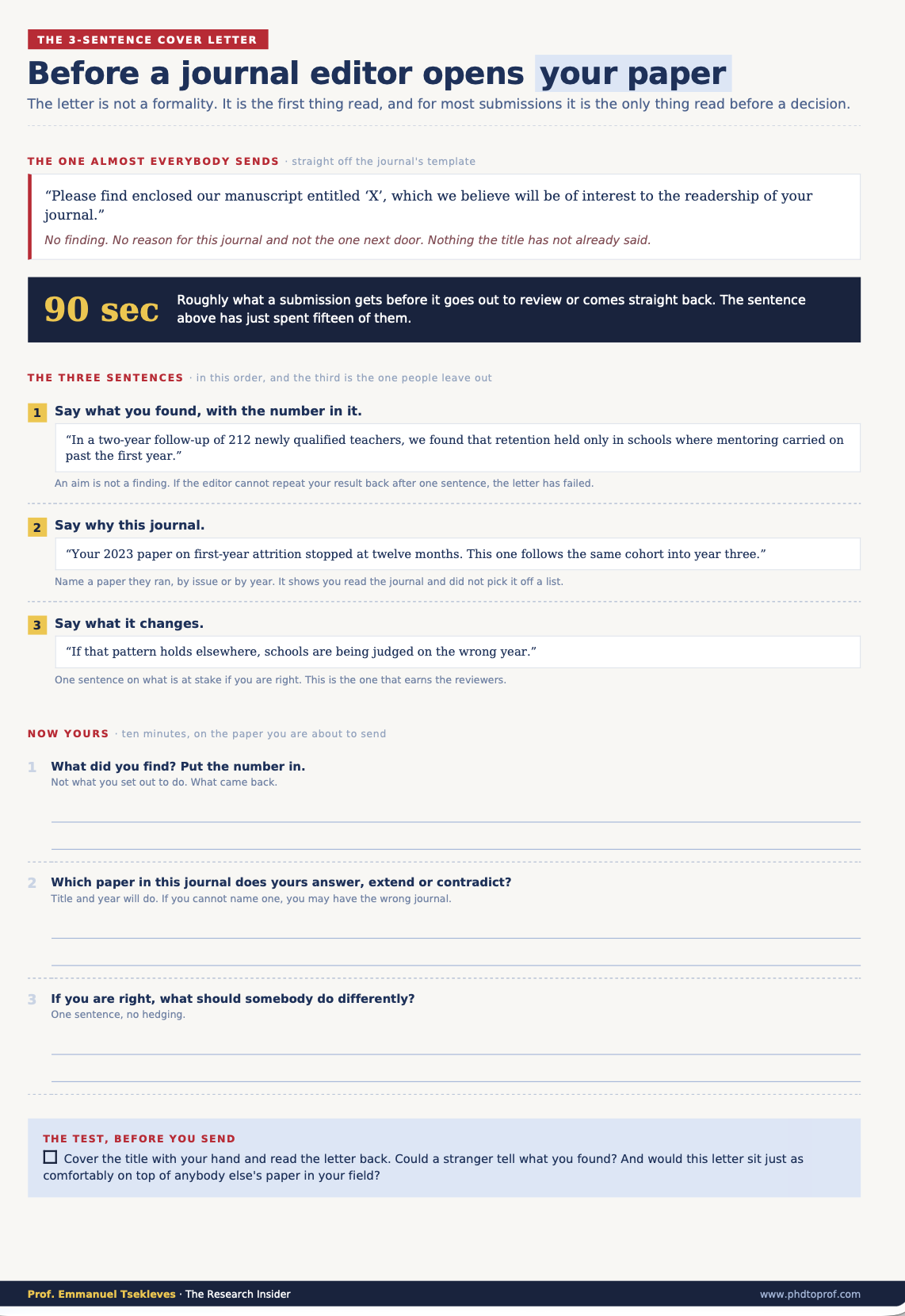
"Please find enclosed our manuscript entitled 'X', which we believe will be of interest to the readership of your journal."
Now read it as an editor with forty submissions waiting. It tells you nothing the title has not already said. There is no finding in it, no reason this journal was chosen and not the one next door, and nothing that would make you spend two reviewers on it instead of sending it back the same afternoon.
Editors give a submission somewhere between ninety seconds and two minutes, and that opening has just used fifteen of them.
Three sentences do the job properly, and these are the ones to focus on.
1) Say what you found, with the number in it.
"In a two-year follow-up of 212 newly qualified teachers, we found that retention held only in schools where mentoring carried on past the first year."
2) Say why this journal.
"Your 2023 paper on first-year attrition stopped at twelve months. This one follows the same cohort into year three."
3) Say what it changes.
"If that pattern holds elsewhere, schools are being judged on the wrong year."
That is a letter an editor can act on. It names a finding, shows you have read the journal, and says what is at stake if the paper is right. And the best part is that writing this in fact thing takes just ten minutes.
So, tonight, open your last cover letter and cover the title with your hand.
Now, can a stranger tell from the letter alone what you found? If the answer is yes, then the letter is doing no work for you. And if it would sit just as comfortably on top of any other paper in your field.
Here is my 3-Sentence Cover Letter, one page: the version that gets ignored, the version that works, and three lines to draft your own. Download here.
Episode 3 of Pass or Revise is a fortnight today, Wednesday 18 November, 4pm London. The subject is drift: chapters that each look fine on their own, while the contribution at the end answers a slightly different question from the one the thesis opened with. Three more pages, read cold, free and capped at 50: https://www.phdtoprof.com/pass-or-revise
Until next week,
Prof. Emmanuel Tsekleves
New here? This is everything I offer, in one place.
Free guides and templates: www.phdtoprof.com/store
Next room: Pass or Revise, 18th November
Submitting in the next few months? The 8-Week Doctoral Submission Programme, timed back from your date, with a full examiner-style read and two mock defences: www.phdtoprof.com/submission
Small-group mentoring, with written feedback on your own writing and answers from me within 72 hours: www.phdtoprof.com/group-mentoring
1:1 mentoring, where I read your drafts the way an examiner will: www.phdtoprof.com/mentoring
Everything else, including thesis review: www.phdtoprof.com
Responses