
The verb change that tells an examiner or reviewer what you think, and why it feels arrogant until you know what they're reading for.
14 October 2026
Read time: 2 minutes
Free live session: Pass or Revise, Wednesday 21 October
Pass or Revise is next Wednesday, 21 October, with a European and a US slot on the same day. I will read three real anonymised pages from a thesis and tell you what I'd be writing on the examiner's report.
First, you score each one before I do. Then I answer your questions, which is why each session is limited to 50 people, so everyone gets an answer.
The sessions on the same day. Just, pick the one that suits your timezone:
- Europe, Gulf & Africa: 4pm UK · 6pm Riyadh · 7pm Dubai
- Americas & Australia: 3pm Los Angeles · 6pm New York · Thursday 22 October, 9am Sydney
Register free here: https://www.phdtoprof.com/pass-or-revise
Can't make it? Register anyway and I'll send you the recording.
I have a confession to make.
I wrote my entire thesis in the wrong verbs.
So did nearly every paper I published in the five years after that. I had no idea until I started examining, and even then I only saw it because I was sitting on the other side of the table.
Here's the kind of sentence I mean:
"Patel says the results are mixed."
It's accurate, it's properly referenced, and I read a version of it on probably every page of most theses that I reviewed. It also tells me only what Patel said, and I already knew that. What I'm looking for is what YOU make of it.
The Same Sentence, One Verb Changed
Let's look at this one instead:
"Patel overlooked supervision, so the results look mixed."
What we have here is still the same study, evidence, and length. But now I know where you stand, and I know you've read Patel closely enough to spot what the review missed.
I can tell you that this isn't just a thesis problem. In fact, reviewers read papers the same way, and a paper that simply reports only the literature gets sent back for review, for exactly the same reason.
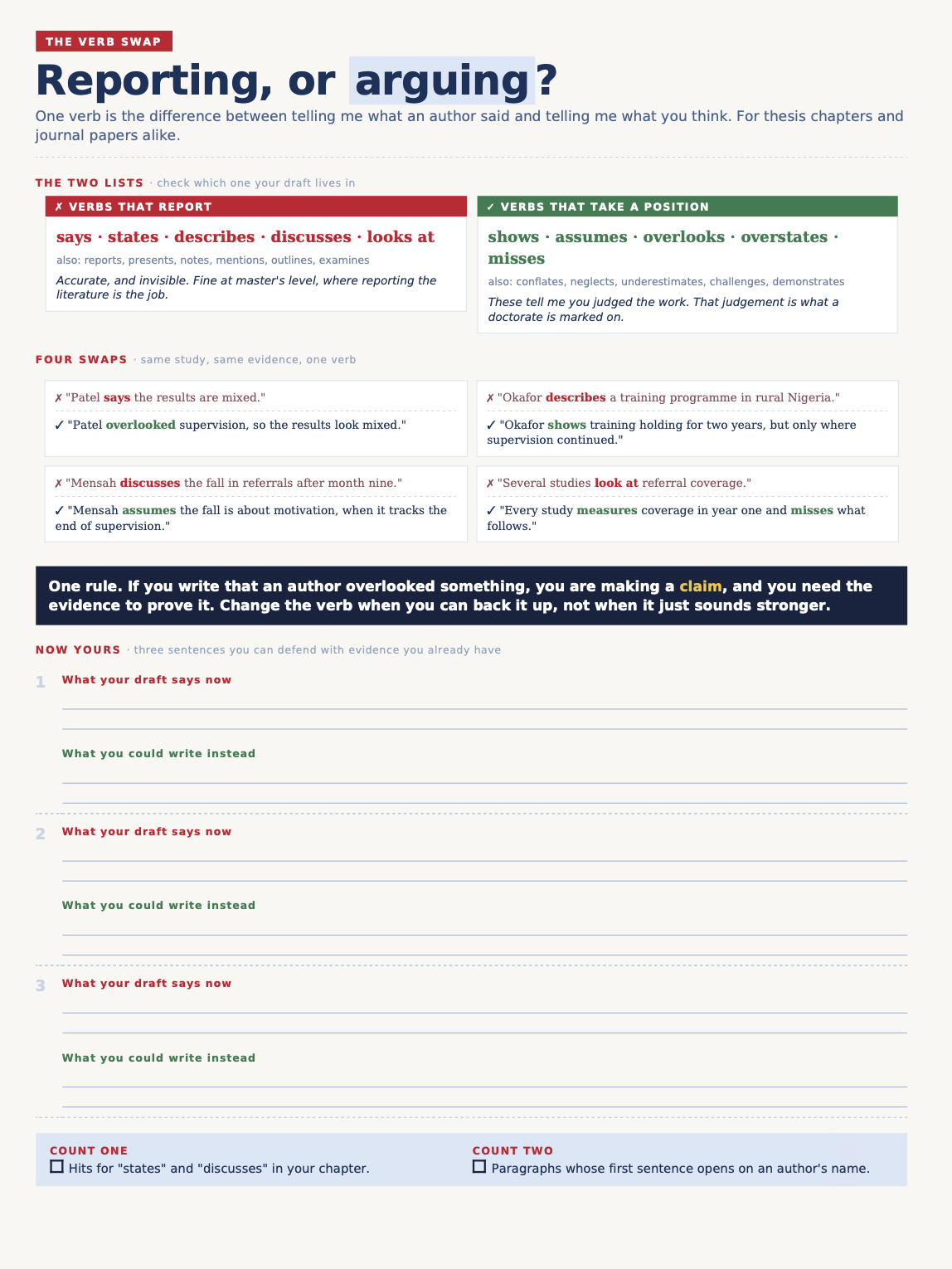
So, on one side you have the verbs that report: says, states, describes, discusses, looks at.
On the other, the verbs that take a position: shows, assumes, overlooks, overstates, misses.
That difference between the two lists is roughly the distinction between a master's and a doctorate. At master's level, reporting the literature accurately is the job. Whereas, at doctoral level, I already assume you can do that and I'm mainly looking for what YOU made of it.
Why hardly anyone does this?
In a session on Tuesday, on my small-group mentoring Masterclass on how to make your literature review argue, one of the members stopped me here and asked the question I was waiting for.
Isn't it arrogant? This is a famous scholar. Who am I to say they missed something?
Every single person I mentor asks me that, in those words or close to them. I thought exactly the same thing as a PhD student, and it's the reason I spent years writing "states" when I meant "overlooks".
Here is what matters. Your thesis examiner or research paper revewer is reading your work to find out whether you can judge the literature. A thesis or a paper that never judges anything reads as one whose author never formed a view.
One condition here, and it matters a lot. You don't swap the verb just for show. If you write that Patel overlooked supervision, your evidence has to actually show it. The job of the verb is to help you make the claim, but the claim needs backing by evidence like any other.
Tonight's Job
Open your draft and search for "states" and "discusses".
Count how many hits you get. Then take the three you feel most confident about and ask whether you could defend them by using a stronger verb with the evidence you already have in your chapter.
I can tell you that, based on my experience, most doctoral candidates and researchers find they could have, several times over.
So my 'gift' to you today is my Verb Swap exercise. It is one page with two lists side by side, including examples of each swap, and a place for you to rewrite three of your own. Have fun!
Download it here
Note: The issues will be shorter from now on, and they'll cover more ground: writing and method some weeks, AI in your research others, and getting published after that. Once a month I'll send a longer one on what I'm seeing across the free sessions and the Doctoral Circle, and in the writing people send me to read.
Until next week,
Prof. Emmanuel Tsekleves
Responses