
Today I'm showing you why AI gives you thirty summaries instead of a review, and the one-sentence test that tells you which one you've got.
7 October 2026
Read time: 2 minutes
Free live session: Pass or Revise, Wednesday 21 October
I read three actual but anonymised pages on the spot and tell you what I'd be writing on the examiner's report.
First, you score each one before I do. Then I answer your questions, which is why each session is limited to 50 people, so everyone gets an answer.
This month I'd be reading the pages an examiner reads first: the abstract, the promise at the end of the introduction, and whether the conclusion keeps it.
Two sessions on the same day.Just, pick the one that suits your timezone:
- Europe, Gulf & Africa: 4pm UK · 6pm Riyadh · 7pm Dubai
- Americas & Australia: 3pm Los Angeles · 6pm New York · Thursday 22 October, 9am Sydney
Register free here: https://www.phdtoprof.com/pass-or-revise
Can't make it? Register anyway and I'll send you the recording.
Today I gave three different AI tools the same thirty abstracts and asked each one to help me write the literature review.
All three gave me back more or less the same thing. Here's a sample of it:
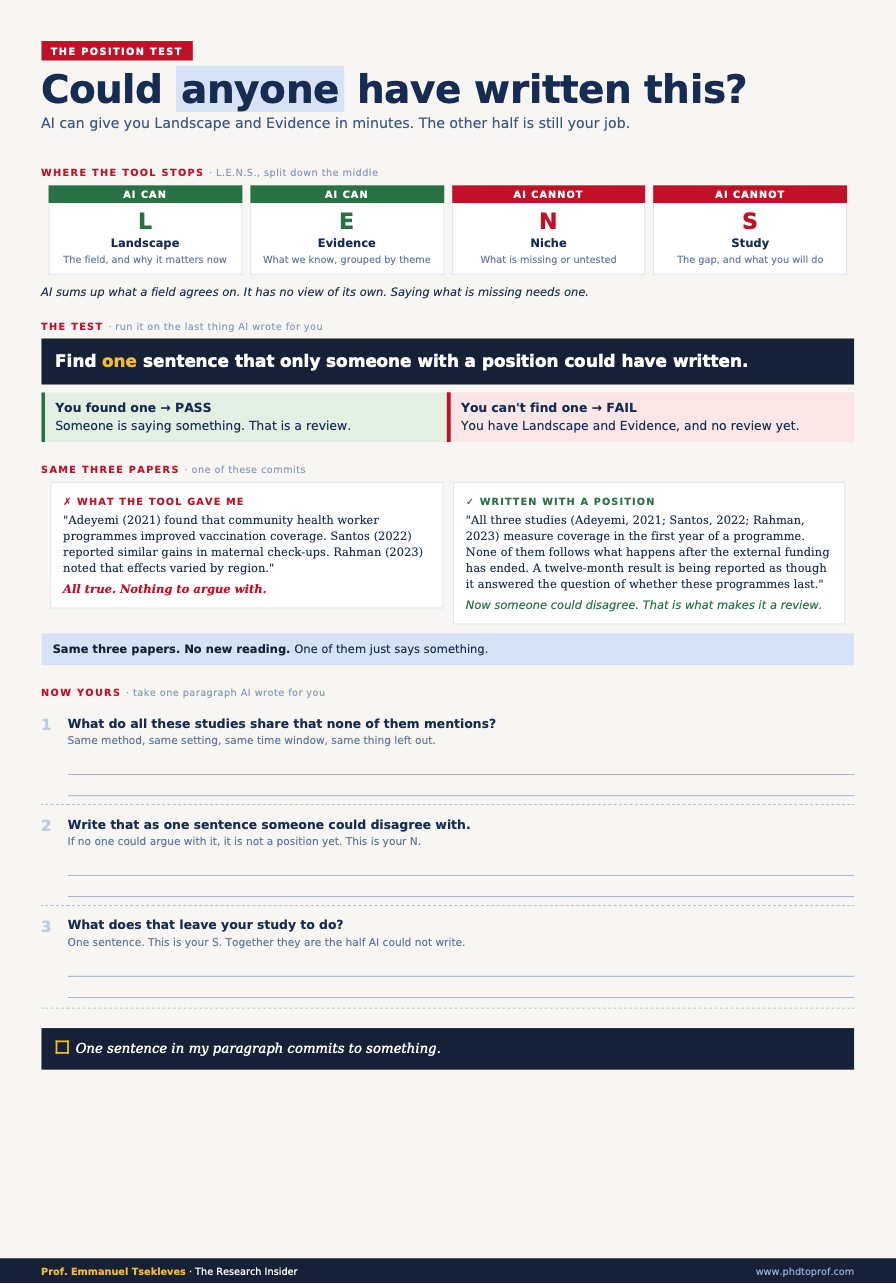
"Adeyemi (2021) found that community health worker programmes improved vaccination coverage. Santos (2022) reported similar gains in maternal check-ups. Rahman (2023) noted that effects varied by region."
Now, put that in a chapter and watch what happens when I reach it. Three actual studies, three true sentences, but not a single thing in there I could argue with. Now that's exactly the problem here.
So I write "reading list with sentences" in my examiner notes and carry on reading.
Ok, what happened here?
Well, the tool did exactly what I asked. Its default output is exactly the thing that gets chapters sent back for rewriting by supervisors and examiners.
AI Can Do Half of L.E.N.S. and Not the Other Half
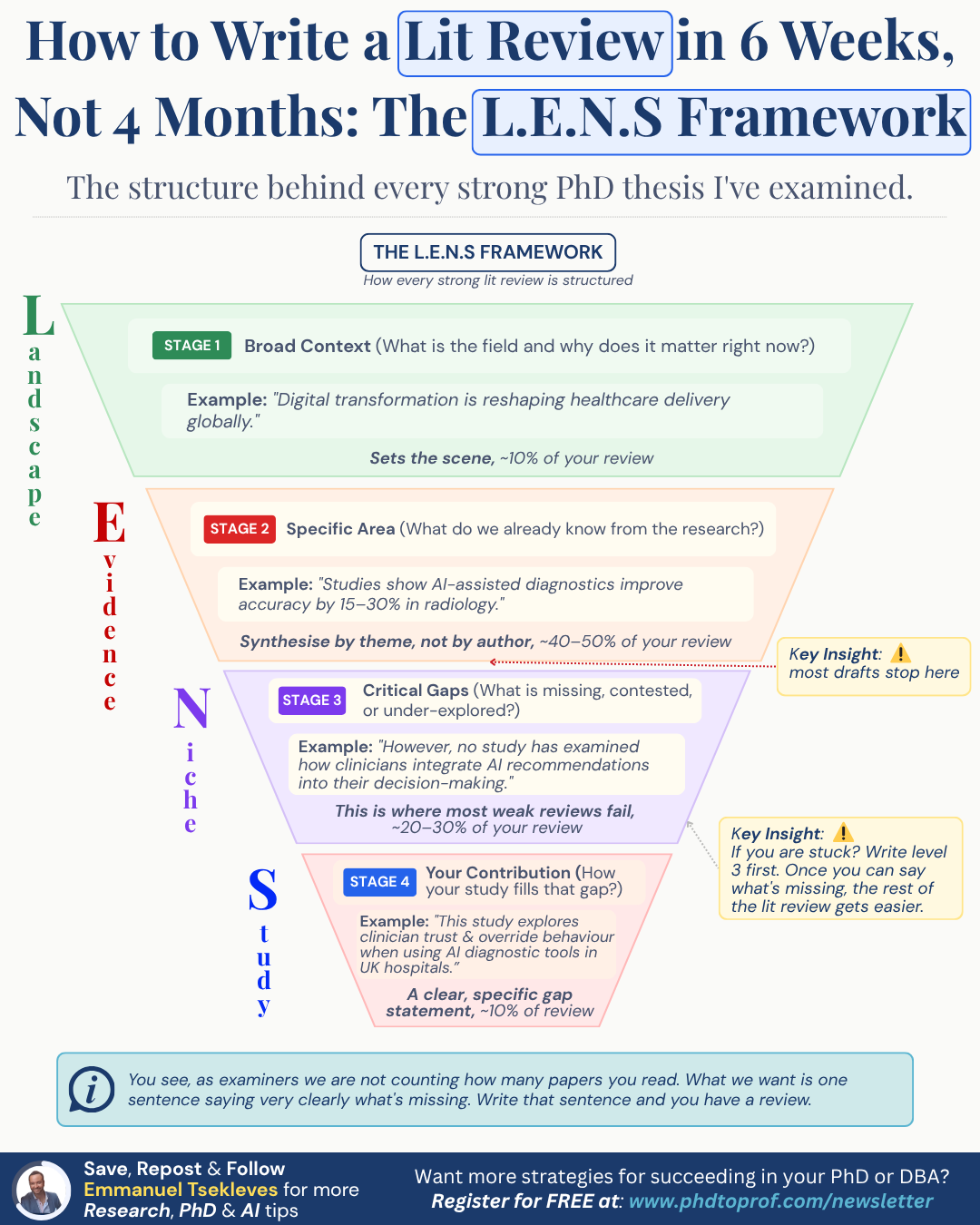
If you saw Monday's post (also see my visual above), you'll know I break a review into Landscape, Evidence, Niche and Study.
AI is genuinely good at the first two. In fact, it will set out a field and group what's known faster and more thoroughly than you can.
But, it cannot do the last two. Now you may ask why is that?
Well, naming what's missing requires a position, and an AI model built to summarise a consensus hasn't got one. It'll give you what the papers says. Where it stops is the judgement or criticism, and that judgement is precisely what is being valued and examined in a doctorate.
The Same Three Studies, With a Position
Here's that passage again, written by someone who has applied some judgement and has a specific position:
"All three studies (Adeyemi, 2021; Santos, 2022; Rahman, 2023) measure coverage in the first year of a programme. None of them follows what happens after the external funding has ended. A twelve-month result is being reported as though it answered the question of whether these programmes last."
So, here we have the same three papers and nothing new is read. What changed, though, is that someone is now saying something.
Tonight's Job
Open the last thing AI wrote for you about your reading.
Find one sentence in it that could only have been written by somebody with a position. That is one that commits to something.
If you can't find one, you have Landscape and Evidence and no review yet. That half was always going to be yours to write.
The Position Test, one page: what the tool gives you against what a position looks like, with space for you to rewrite one of your own paragraphs.
Download it here
Note: The issues will be shorter from now on, and they'll cover more ground: writing and method some weeks, AI in your research others, and getting published after that. Once a month I'll send a longer one on what I'm seeing across the free sessions and the Doctoral Circle, and in the writing people send me to read.
Until next week,
Prof. Emmanuel Tsekleves
Responses