Header Logo 2
My Newsletter Resources 1:1 PhD/DBA Mentoring
LOG IN
← Back to all posts

#168 - What Examiners Read First: The 10-Minute Alignment Check

by Emmanuel Tsekleves
Sep 30, 2026
Connect

Today I'm showing you the order examiners read a thesis in, and a quick check to help you stop the first thing they see from working against you.

30 September 2026

Read time: 2 minutes


Free live session: Pass or Revise, Wednesday 21 October

I read three real anonymised pages cold and say what I'd be writing on the examiner's report. You score each one before I do. Then I answer your questions, which is why each session is limited to 50 people, so everyone gets an answer.

This month I'm reading the pages an examiner reads first: the abstract, the promise at the end of the introduction, and whether the conclusion keeps it.

Two sessions on the same day, same three pages. Pick the one that suits your timezone:

  • Europe, Gulf & Africa: 4pm UK 路 6pm Riyadh 路 7pm Dubai
  • Americas & Australia: 3pm Los Angeles 路 6pm New York 路 Thursday 22 October, 9am Sydney

Register free here: https://www.phdtoprof.com/pass-or-revise
Can't make it? Register anyway and I'll send you the recording.


Last week someone asked me how examiners read a thesis. I think they expected me to say page one.

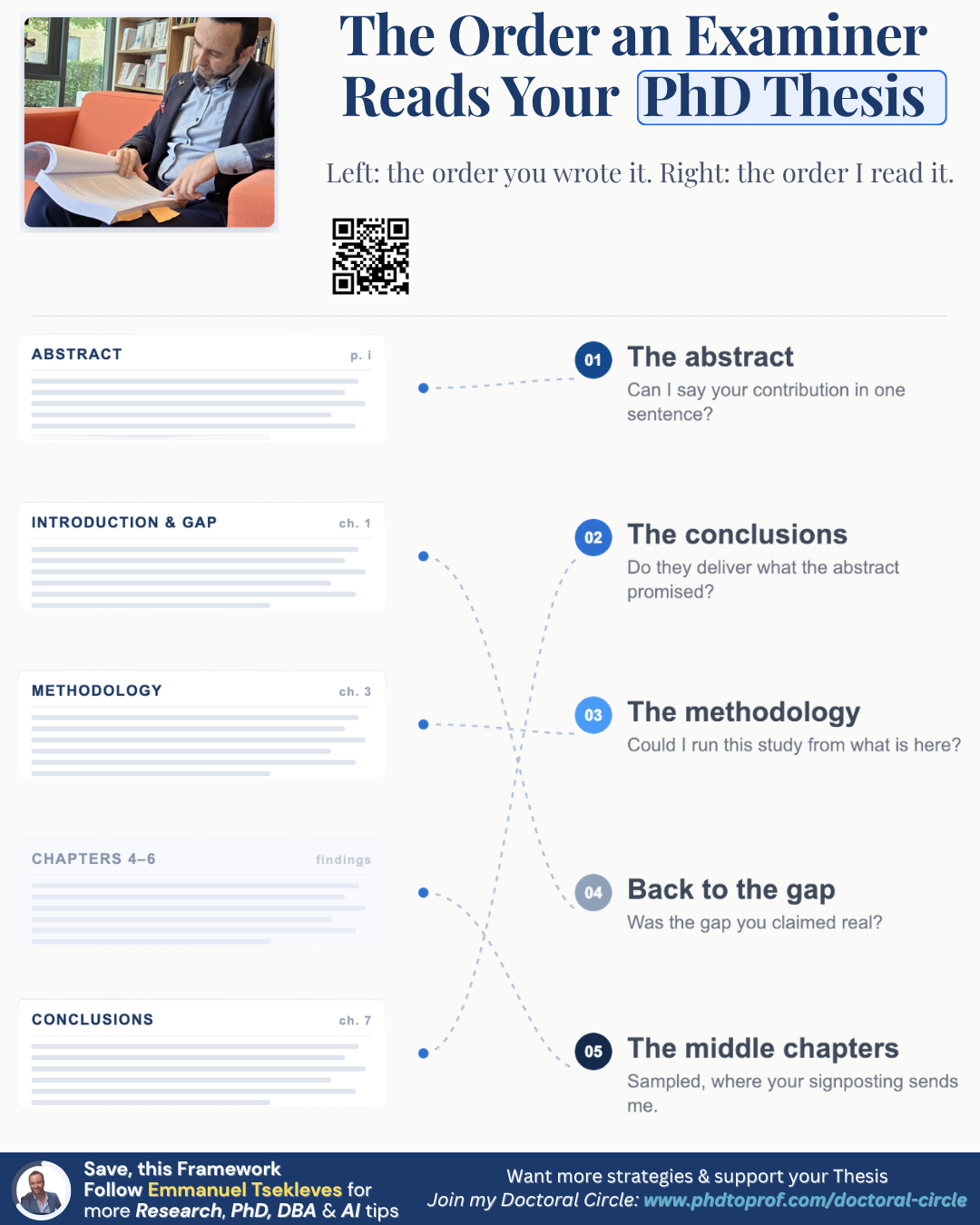
We don't read it front to back. Not the first time, anyway. My order is the abstract, then the contribution part of the conclusion, then back to the introduction, then the methodology. Only then do I get to the findings. Most examiners I know work in roughly the same order.

At each stop I'm checking something very specific:

  • The abstract shows me whether you know what you did,
  • The conclusion whether you delivered it.
  • Then the introduction: did you promise it in the first place?
  • The methodology is where I decide whether I believe any of it.

So by the time I reach your findings, I've already got a view. Your findings end up as evidence for or against it.
 

The Gap Examiners Spot Before Chapter One

Here's exactly where it goes wrong. This is from an abstract:

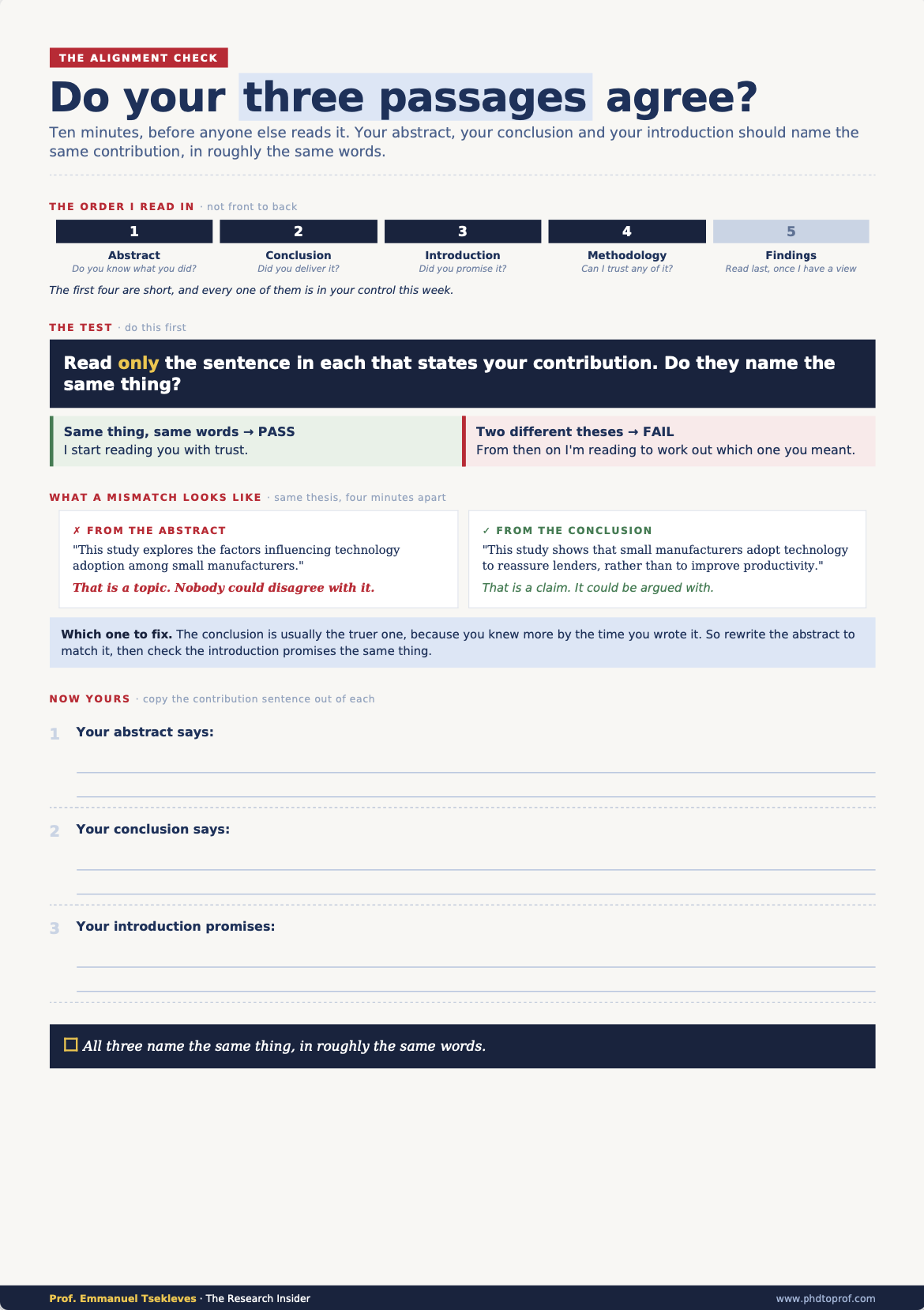
"This study explores the factors influencing technology adoption among small manufacturers."

In fact, this is from the conclusion of the same thesis, which I read about four minutes later:

"This study shows that small manufacturers adopt technology to reassure lenders, rather than to improve productivity."

The second example one is a claim, whereas the first one is a topic. They aren't describing the same thesis, and I'd noticed before I had read a single chapter properly.

I should say that I do not think that the candidate was careless here. The abstract was written early, or in a rush at the end, and the conclusion changed on as the work did. But it's the first thing I see, and from then on I'm reading to work out which one you meant.


When they disagree, trust your conclusion

If yours disagree, the conclusion is usually the truer one. Why? Simply, because you knew more by the time you wrote it. So rewrite the abstract to match. Then check your introduction promises the same thing.


Tonight's check

Here's tonight's job, and it takes about ten minutes.

  1. Open your abstract and your conclusion side by side.
  2. Read only the sentence in each that states your contribution.
  3. Ask whether they name the same thing, in roughly the same words.?

It's a small change, but it decides whether I start out trusting you.


The Alignment Check, is a one-page guide. It shows the order I read in and what a real mismatch looks like. There's also space to copy out your own three sentences and see if they agree: Download it here


Note: The issues will be shorter from now on, and they'll cover more ground: writing and method some weeks, AI in your research others, and getting published after that. Once a month I'll send a longer one on what I'm seeing across the free sessions and the Doctoral Circle, and in the writing people send me to read.


Until next week,

Prof. Emmanuel Tsekleves
 

Responses

Join the conversation
t("newsletters.loading")
Loading...
#167 - 2 Mistakes That Hide Your Contribution From Your Examiner, and the 1 Sentence That Fixes Them
Today I'm showing you the two mistakes that hide a contribution on the page, and the one plain sentence that fixes both. 23 September 2026 Read time: 4 minutes 聽 聽 Sponsored by Verasight What sinks candidates in a viva is rarely what they found. It's who answered, and you can't fix that once the data is in. Verasight, a survey company set up by academic researchers, which verifies ...
#166 - Show Me This Gap: How to Show a Research Gap Instead of Claiming One
Today I am showing you the three sentences that let an examiner see your gap for themselves, and the four-minute test that tells you whether yours is showing or only stated. 16 September 2026 Read time: 3 minutes 聽 Pass or Revise is tomorrow, and there are still places. Full details at the end of this issue. 聽 Sponsored by Verasight What sinks candidates in a viva is rarely what ...
#165 - How to Turn Professional Writing into Doctoral Writing: The 3-Layer Paragraph
Today I am showing you why strong professional writers struggle at doctoral level, and the three layers every doctoral paragraph needs. 09 September 2026 Read time: 4 minutes 聽 Before we start: my next free session is on the 17th September It is called Pass or Revise, and it is a taster of what we do inside the Doctoral Circle. Once a month in there I read a member's section cold a...

The Research Insider

What an examiner actually saw this week. A short letter from the other side of the viva table. I was a lost PhD student once, in my office at 2am, surrounded by papers nobody had taught me how to read. I got through it. Then I sat on the examiner's side of the table more than forty-five times, and learned the thing nobody had told me. Whether you pass comfortably rarely comes down to how good your research is. It comes down to whether your thesis shows the examiner what they're looking for, and most capable people were never shown that. That's all this letter does. Three weeks out of four it's short, about four hundred words. One real thing I read, details changed: a sentence that doesn't say what it thinks it says, a method that won't survive the first question, a passage where the writer's own voice has quietly disappeared. What I saw when I read it cold, the fix, and a test you can run on your own work tonight. That last one is newer, and it's where most of the worry is now. The question I get asked is whether a detection tool will flag them. The question that decides anything is whether an examiner will believe the thinking is theirs, and those aren't the same question. I train universities on this, and I've sat on the faculty side when a tool flagged an honest candidate, so I know how that conversation goes and what evidence actually helps. The fourth week is longer. Once a month I read every page people send me for Pass or Revise, my live session where three of them get read out loud. Then I write up what I found across the whole pile, including what it made me change in the way I teach. Free, and one ask a month at most. 45+ doctoral theses examined across 15+ universities. 25+ PhDs supervised to completion. 35+ working professionals mentored through a doctorate alongside a career. 240,000 researchers follow my work on LinkedIn. Free, and one ask a month at most.
© 2026 PHDTOPROF. ALL RIGHTS RESERVED.

Join The FREE Challenge

Enter your details below to join the challenge.