
Today I'm showing you the two mistakes that hide a contribution on the page, and the one plain sentence that fixes both.
23 September 2026
Read time: 4 minutes
Sponsored by Verasight
What sinks candidates in a viva is rarely what they found. It's who answered, and you can't fix that once the data is in. Verasight, a survey company set up by academic researchers, which verifies every panel member by text before they answer a single question, on US samples.
Today I finished reading the last of the pages you sent me, and I want to tell you what I found.
Last week I ran a free session called Pass or Revise, where I read three anonymised thesis pages live, the way an examiner would. Afterwards, many of you sent me a page of your own.
Here's what I noticed. Every page came back "Revise", and for the same reason: I couldn't find your contribution.
It wasn't missing. That's I want you to hear first, since I know how "revise" comes across when it's your work. The research was there, so was the thinking. In most cases the contribution was there too.
But it was hiding.
Sometimes it was hiding behind words like "seeks to", "may provide" and "potential". Sometimes it was two claims squeezed into one sentence, when the evidence could only carry one of them.
And every time, the solution was the same: one sentence at the top of the section.
I want to show you both, because once you've seen them, you'll spot them in your own draft tonight.
Mistake 1: Hiding Behind "Seeks To" and "May Provide"
Here's the first kind. I've changed the details so nobody can be recognised, but I read some version of this again and again:
"This study seeks to explore how informal wellbeing practices may provide potential benefits for employees in small firms."
Let me read it the way I read it the first time. Cold.
"Seeks to explore." Did it? Seeking is what you did in year one. By the time I'm reading your thesis, you've either explored it or you haven't, and I need to know which.
"May provide." Does it or doesn't it? If you found that it does, say so. If you found that it doesn't, that's a finding too, and often a more interesting one.
"Potential benefits." Which benefits? For whom? How do you know?
That's three vague phrases in one sentence. By the end of it, I know your topic, and I know you're nervous, but I don't know what you found.
Here's the same sentence with the vague words taken out:
"In the twelve firms I studied, informal wellbeing practices reduced short-term absence, but only where the owner-manager took part in them."
Look at what happened to the caution. It didn't disappear, it moved.
"In the twelve firms I studied" does the job that "may" was trying to do. It tells me exactly how far your claim reaches. That's a limit I can accept, because I can check it. "May" is a limit I can't check.
So that's the change I'd ask you to make. Swap the vague word for a clear specific one. Say clearly what you found, then say clearly where it's true.
Mistake 2: Squeezing Two Claims Into One Sentence
Now the second kind, which is harder to spot because it looks as confident academic writing.
"This study shows that informal wellbeing provision reduces absence in small firms and is more cost-effective than formal programmes."
Two claims. One sentence. And a single "and" holding them together.
The first claim is about absence. If you interviewed owner-managers and looked at their absence records, your evidence can carry it.
The second claim is about cost. To say one thing is more cost-effective than another, you have to have costed both. Most of the pages that did this hadn't. They'd studied one thing carefully, then added a second claim because it sounded like the obvious next step.
Here's why that matters. An examiner reads the sentence as a single promise. So when they read the chapter where you prove the first half, they're still waiting for the second. When it doesn't come, your strong half gets judged by your weak one.
The solution in this case is to split it. Keep the claim your evidence carries, at the top, on its own. Move the other one to where it belongs, which is usually your future research section, as a question you've earned the right to ask.
One claim you can defend is worth far more than two you can't.
Why You Can't See This in Your Own Work
So why is this so hard to see in your own work?
Because you know what you meant. When you read "may provide potential benefits", your brain quietly fills in the finding, because you were there when you found it. Your supervisor often does the same. They've followed the work from the start, so they read it warm.
Your examiner reads it cold, as all they have is what you've written. If your contribution isn't in plain words at the top of the section, they have to go looking for it, and an examiner who has to go looking is already starting to doubt.
The One Sentence That Fixes Them Both
That's why the solution is so simple, and why it works. One sentence, at the top of the section, saying what you're going to claim.
Here's something to try tonight.
Cover everything on the page except your contribution sentence. Could a stranger tell you what you're going to claim?
If you had to go looking for it, your examiner will too.
Reading your pages changed something on my side too.
This is what I built the Doctoral Circle for. Every month, I read members' pages cold, the way an examiner will, and tell them what I'd write on the report. In between, there are masterclasses, and Writing Rooms where we work on real drafts together. It's a small group of people doing a doctorate alongside a career, who want someone to find the problem before an examiner does. You can also ask me anything and get responses back.
The founding window closes this Saturday, 26 September.
Registering now doesn't start your term early. The Circle begins on 1 October whichever day you join, and your first term runs to the end of December. Registering keeps your place and locks your rate.
Join here: https://www.phdtoprof.com/doctoral-circle
One question before you decide.
Could a stranger find your contribution in the first line of your section? Yes or no.
If it's no, reply to this email with the word "hiding" and paste your sentence. I'll tell you what I see.
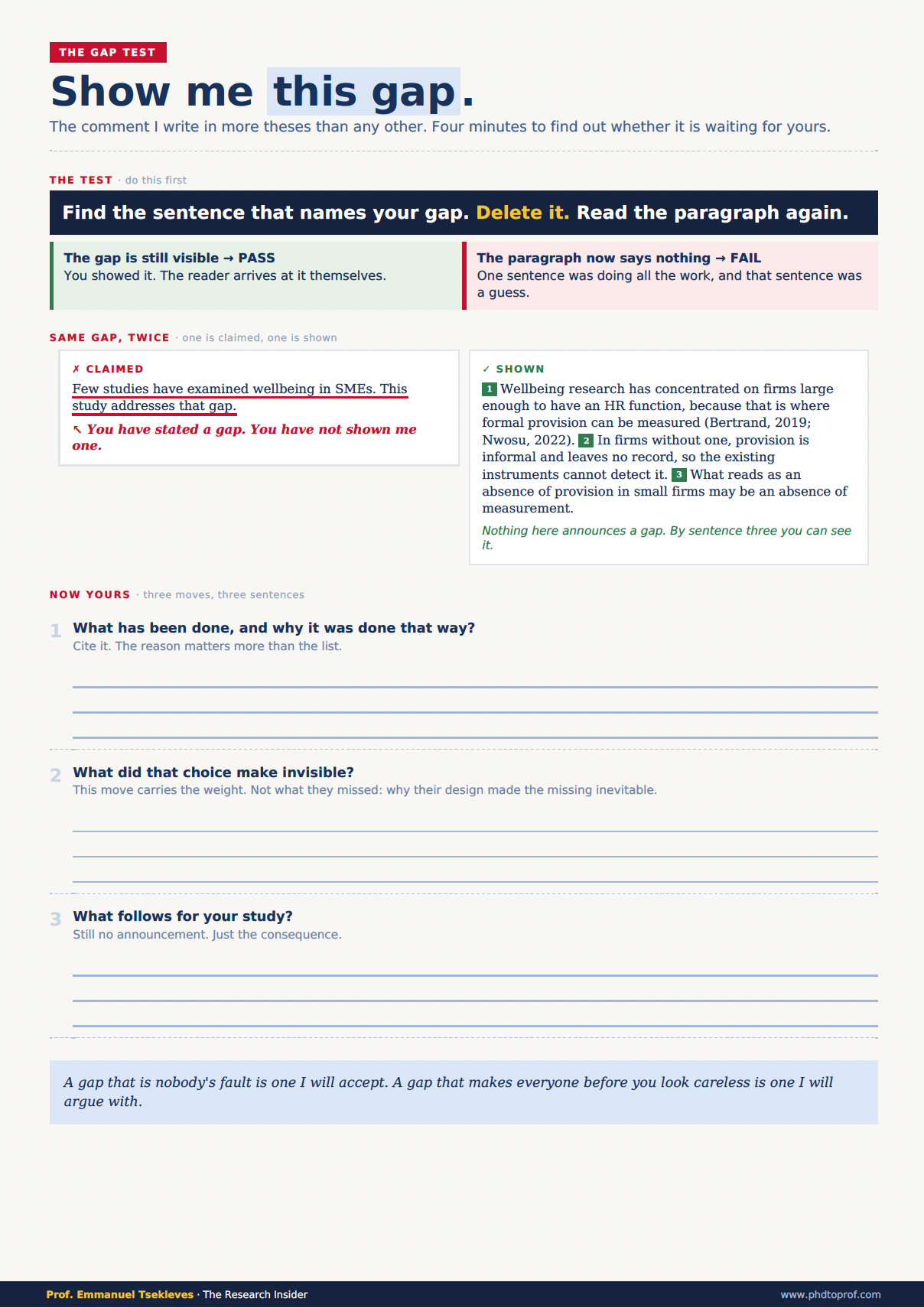
Also, I noticed that the platform I use to send the newsletter last week cut off the weblink to download the Gap Test. I have now fixed it and you can Download it here
Until next week,
Prof. Emmanuel Tsekleves
Responses