Header Logo 2
My Newsletter Resources 1:1 PhD/DBA Mentoring
LOG IN
← Back to all posts

#166 - Show Me This Gap: How to Show a Research Gap Instead of Claiming One

Sep 16, 2026
Connect

Today I am showing you the three sentences that let an examiner see your gap for themselves, and the four-minute test that tells you whether yours is showing or only stated.

16 September 2026

Read time: 3 minutes


Pass or Revise is tomorrow, and there are still places. Full details at the end of this issue.


Today I am going to repair the comment I write in more theses than any other, because I named it this week and did not show you the solution.

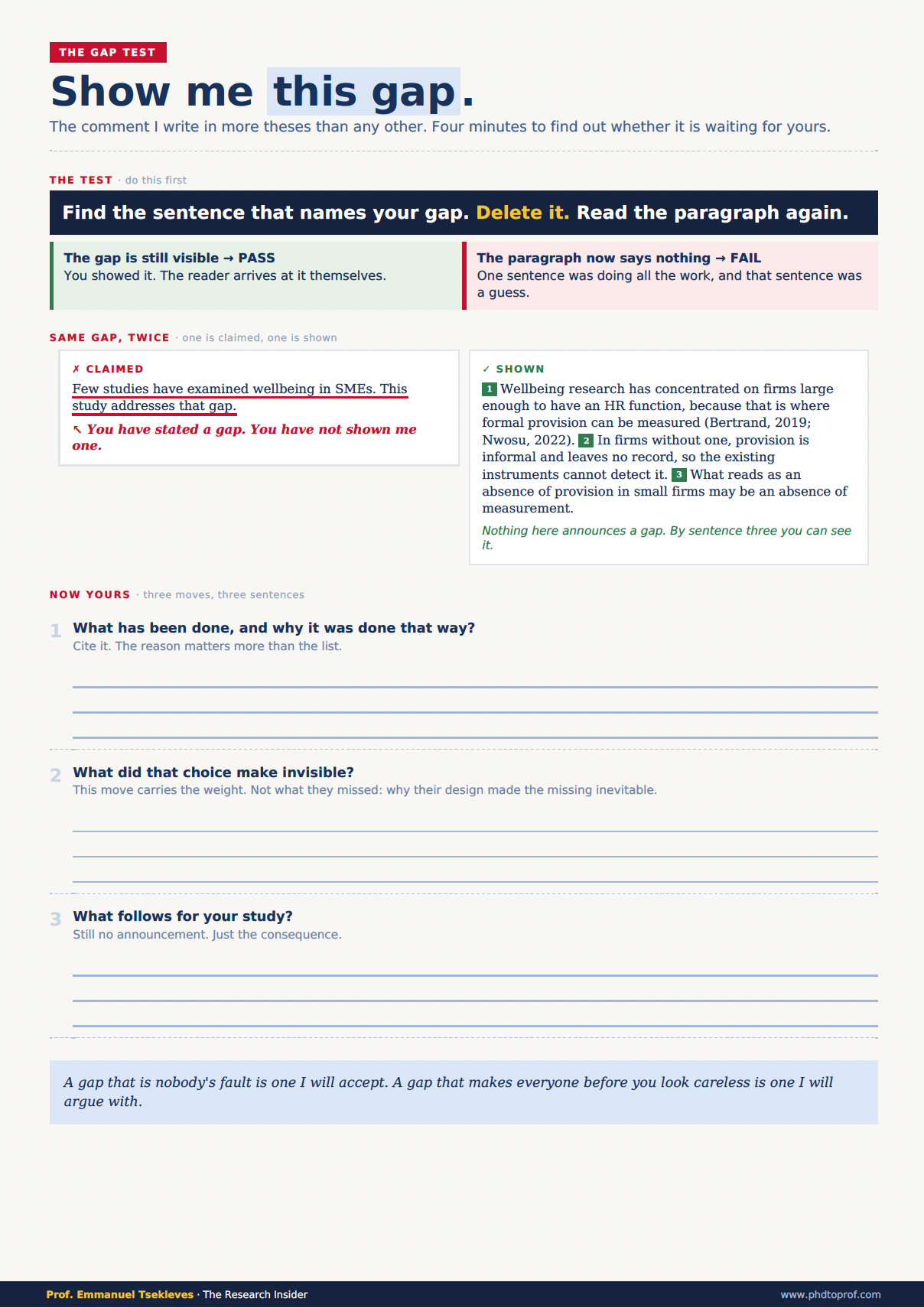
The sentence was this: "Few studies have examined wellbeing in SMEs. This study addresses that gap."

Read it the way I do.

Cold, with three hundred pages in front of me, and no reason to take anything on trust.

What have I been given? A claim that something is missing, and no way to check it. I do not know this literature as well as you do. That is the whole reason you are writing the chapter. So when you tell me there is a hole in it, I have only your word, and your word is the thing being examined.

A stated gap is a guess with a full stop after it.

Here is the same gap, shown.

"Wellbeing research has concentrated on firms large enough to have an HR function, because that is where formal provision can be measured (Bertrand, 2019; Nwosu, 2022). In firms without one, provision is informal and leaves no record, so the existing instruments cannot detect it. What reads as an absence of provision in small firms may be an absence of measurement."

Nothing in there really shows me a gap. By the third sentence I can see it, and I got there myself, which is a very different thing from being told.

Three moves, in fact, accomplished that.

  1. What has been done, and why it was done that way.
  2. What that choice made invisible.
  3. What follows for your study.


The second move is the key one here. It does not show me what the literature missed, but why its own design made the missing inevitable. A gap that is nobody's fault is one I will accept. Whereas a gap that makes everyone before you look careless is one I will argue with.

Here is tonight's job, and it takes four minutes.

Find the sentence in your chapter that names your gap. Delete it and read the paragraph again.

Can a reader still see the gap without it?

If they can, you have shown one. If the paragraph now says nothing, you had a single sentence doing all the work, and that sentence was a guess.

The Gap Test, one page: Download it here
Pass or Revise is tomorrow. I read three real anonymised pages cold and say what I would be writing on the examiner's report.

Thursday 17 September. 10am New York, 3pm London, 4pm Berlin and Johannesburg, 6pm Dubai. Sixty minutes, free.

Capped at 50, and I will stay until every question has been answered.

Take a place: https://www.phdtoprof.com/pass-or-revise


Until next week,

Prof. Emmanuel Tsekleves
 

Responses

Join the conversation
t("newsletters.loading")
Loading...
#165 - How to Turn Professional Writing into Doctoral Writing: The 3-Layer Paragraph
Today I am showing you why strong professional writers struggle at doctoral level, and the three layers every doctoral paragraph needs. 09 September 2026 Read time: 4 minutes   Before we start: my next free session is on the 17th September It is called Pass or Revise, and it is a taster of what we do inside the Doctoral Circle. Once a month in there I read a member's section cold a...
#164 - How to Write a Chapter That Passes Your Viva and Becomes a Journal Paper
Today I am showing you why so much strong doctoral research never reaches a journal, and the shift that fixes it while you are still writing rather than years after you finish. 02 September 2026 Read time: 4 minutes   Before we start: free live session next Wednesday 9th September Many PhD candidates finish a doctorate with three or four years of original research and nothing publi...
#163 - The 7 moves of an introduction that gets published
Today I am going to take you through the seven moves an introduction makes, and the one that gets people rejected. 26 August 2026 Read time: 3 minutes   Free LinkedIn Live: Methodology Made Simple - 27th August Before we start, one thing. Nobody teaches you methodology. Then they fail you for getting it wrong. So on Thursday 27 August I am running a free LinkedIn Live: Methodology ...

The Research Insider

What an examiner actually saw this week. A short letter from the other side of the viva table. I was a lost PhD student once, in my office at 2am, surrounded by papers nobody had taught me how to read. I got through it. Then I sat on the examiner's side of the table more than forty-five times, and learned the thing nobody had told me. Whether you pass comfortably rarely comes down to how good your research is. It comes down to whether your thesis shows the examiner what they're looking for, and most capable people were never shown that. That's all this letter does. Three weeks out of four it's short, about four hundred words. One real thing I read, details changed: a sentence that doesn't say what it thinks it says, a method that won't survive the first question, a passage where the writer's own voice has quietly disappeared. What I saw when I read it cold, the fix, and a test you can run on your own work tonight. That last one is newer, and it's where most of the worry is now. The question I get asked is whether a detection tool will flag them. The question that decides anything is whether an examiner will believe the thinking is theirs, and those aren't the same question. I train universities on this, and I've sat on the faculty side when a tool flagged an honest candidate, so I know how that conversation goes and what evidence actually helps. The fourth week is longer. Once a month I read every page people send me for Pass or Revise, my live session where three of them get read out loud. Then I write up what I found across the whole pile, including what it made me change in the way I teach. Free, and one ask a month at most. 45+ doctoral theses examined across 15+ universities. 25+ PhDs supervised to completion. 35+ working professionals mentored through a doctorate alongside a career. 240,000 researchers follow my work on LinkedIn. Free, and one ask a month at most.
© 2026 PHDTOPROF. ALL RIGHTS RESERVED.

Join The FREE Challenge

Enter your details below to join the challenge.