
Today I am showing you why strong professional writers struggle at doctoral level, and the three layers every doctoral paragraph needs.
09 September 2026
Read time: 4 minutes
Before we start: my next free session is on the 17th September
It is called Pass or Revise, and it is a taster of what we do inside the Doctoral Circle. Once a month in there I read a member's section cold and say what I would write on the examiner's report. This is that, run in the open.
I take three real anonymised pages and read each one the way I read a thesis I have been sent to examine. You score them first in the chat. Pass, revise, or major revisions. Then I give my verdict and tell you what would go on the report.
Thursday 17 September, 3pm UK time. Sixty minutes. Free.
Take a place here: https://www.phdtoprof.com/pass-or-revise
Nothing to prepare, and none of the pages belong to anyone in the room.
Here is something that surprised me for years.
The candidates who struggle most with doctoral writing are often the best writers.
Not candidates who cannot write a sentence, but who write for a living.
Directors who write board papers. Clinicians who write case reports that other clinicians act on. Consultants paid to take something complicated and land it on one page with someone who has four minutes.
They start a doctorate, they write a chapter and it comes back covered in comments.
One of my mentees said it to me like this. The problem was not that he could not write. It was that coming back from industry, it is a different lingo, and nobody hands you the dictionary.
He is right.
And most people get the diagnosis wrong. They think they have a skills gap.
They do not.
They learned to write for a different job, and they got very good at it.
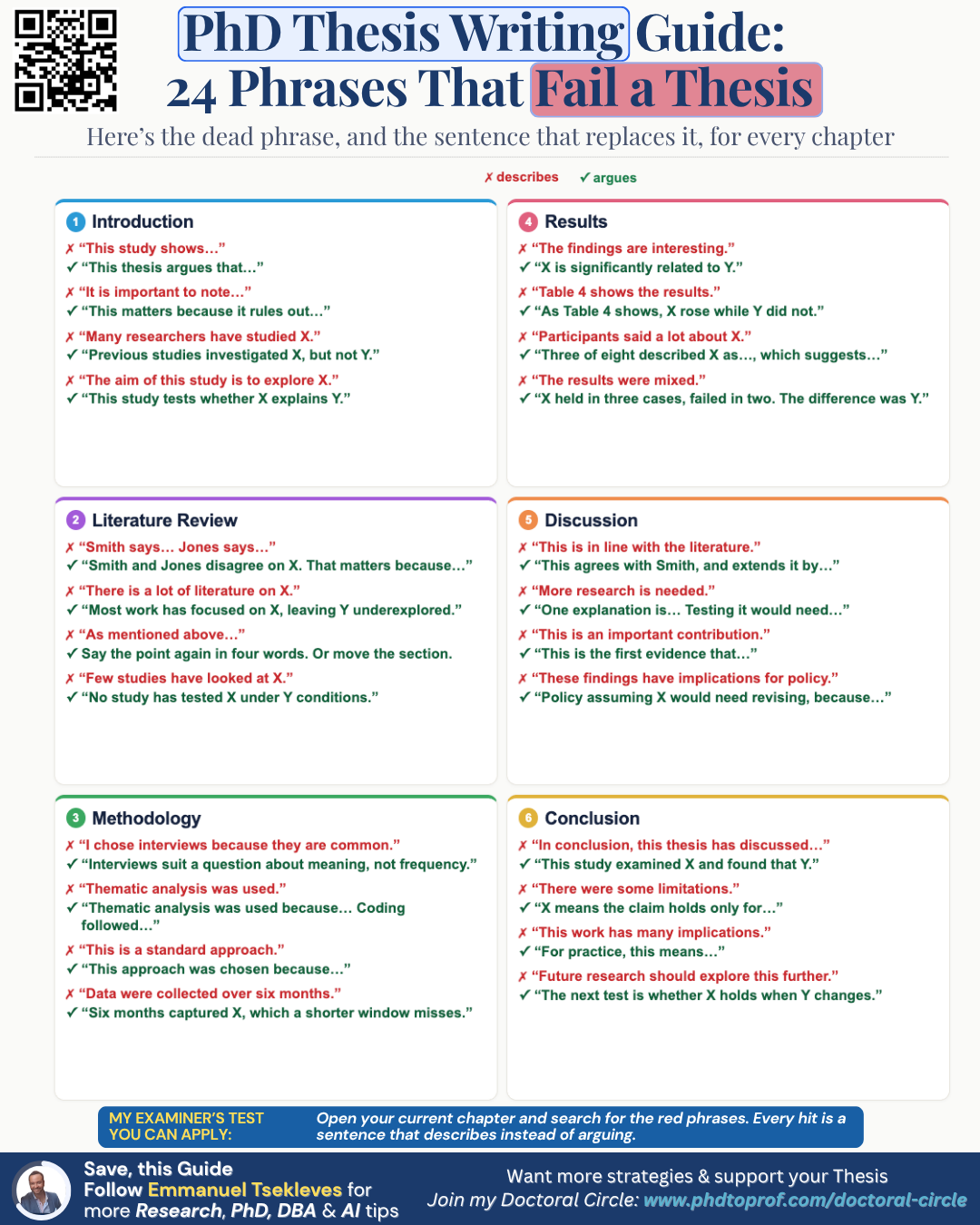
Two Kinds of Good Writing
The writing you do at work is built for a decision.
Someone senior has to act. They have no time. and your job is to clear everything out of the way of the point.
So you lead with the answer.
You cut the reasoning, because they pay you to do the reasoning so they do not have to.
You sound sure, because waffling looks like you do not know.
So you drop anything that will not change what they do on Monday.
That is a hard skill and to be honest most people are bad at it. If you are good at it, that is twenty years of work and it is probably why you have done well.
Doctoral writing is built for something else.
Your examiner will not act on your thesis. They will test whether your answer is earned.
So the reasoning is not the thing you cut to save their time.
The reasoning is the thing being marked.
The answer on its own is worth almost nothing to them. Anyone can state an answer, but they want to see how you got there.
Two forms that pull opposite ways.
Why It Is So Hard to Fix
You are not making mistakes; in fact, you are using rules that work, in a place where they have been turned upside down.
Short was good, but now it reads as unsupported. The sentence you would have cut is often the one your examiner needs, since it links the step from your evidence to your claim.
Sure was good. In a board paper, "this will improve retention" sounds strong and "this may improve retention under some conditions" sounds weak. In a thesis it is the other way round. The first invites an examiner to ask what your evidence for "will" is.
Answer first was good. It still is in your abstract, but inside a chapter it reads as a claim with decoration underneath it.
Every instinct that fires when you sit down is a good instinct. It is just aimed at the wrong reader.
What I See From the Examiner's Chair
Let me tell you what actually goes through my head when I hit a page like this.
I do not think this person cannot write. It is usually the opposite; the text is clean and easy to read.
What I think is: I do not know what they want me to conclude from this.
So I read on, waiting to be told. If it does not come, I go back in case I missed it. Then I write "so what follows from this?" in the margin and keep going.
By the fourth time I write that, I am not reading to be persuaded any more. I am reading to work out whether the argument is somewhere and just not on the page, or whether it was never made.
That is what produces a long viva.
None of it is a judgement about your research, as the research is often excellent. It is a judgement about the writing.
The 3-Layer Paragraph
Here is the fix, and it is the most useful thing I know on this.
A work paragraph has one layer.
A doctoral paragraph has three.
They go in this order.
Layer 1. The finding.
What you saw. Plainly. No interpretation yet.
"In all twelve firms, adoption stalled at the same point."
Layer 2. The link.
Why that follows, and what it rules out. This is the layer you were trained to delete, because at work it is the part nobody has time for.
"In each case, middle managers were held to delivery targets that the change temporarily lowered. Where senior leaders removed that clash, adoption carried on. Where they did not, it stopped. So the pattern is not explained by managers being resistant."
Layer 3. The claim.
What is now different because of layer 1 and layer 2.
"Transformation failure is better understood as a clash of accountabilities than as resistance."
Three layers. Findings, link, claim.
At work you write layer 3 and bin the rest, because layer 3 is what the decision needs. That is correct there.
Here, layer 3 on its own is an assertion. Layers 1 and 2 are what make it doctoral.
Now the test, and it takes about ten minutes.
Open your current chapter. Take any three paragraphs. Count the layers in each one.
One layer is a board paper.
Two layers is a report.
Three layers is a thesis.
Most professionals find they have written layer 1 and layer 3, and cut layer 2 without noticing, because at work layer 2 was always the part that got trimmed.
If that is what you find, you do not have a writing problem. You have a missing middle, and putting it back is a week of work, not a year.
Why You Cannot Spot This Alone
Here is the honest limit of everything above.
You can hold all of it and still miss it on your own page.
Because layer 2 is still there. It is in your head. You did the reasoning, so you read your own paragraph and your brain quietly fills the gap.
Your supervisor often cannot see it either. They watched the reasoning happen, so it fills in for them too.
It shows up the moment someone outside your topic reads the paragraph back and tells you what they can and cannot follow.
That is a large part of why I built the Doctoral Circle.
It is group mentoring for working professionals doing a part-time doctorate. Masterclasses. Writing Rooms where we work on real drafts. And the cold read you will see on the 17th, run every month on a member's own pages.
A room of people who came into a doctorate from a career, fitting it around a job.
Two things worth saying plainly.
Registering does not start your term early. The Circle begins on 1 October whichever day you join, and your first term runs to the end of December. Registering holds your place and locks your rate.
And the founder rate ends today. It is $450 for the three-month term, which is $150 a month. Tomorrow morning it goes to $500 and stays there. Whatever rate you join at, you keep.
Join here: https://www.phdtoprof.com/doctoral-circle
One question before you decide.
When your supervisor last sent you comments, were they about what you found, or about what you had not said about what you found?
If it was the second, that is layer 2. Reply to this email with the word "register" and tell me which chapter it was, and I will tell you what I would be looking for on that page.
Key Takeaways
Work writing is built for a decision and cuts the reasoning. Doctoral writing is built for a test, and the reasoning is what is being tested.
Short, sure, and answer-first are virtues in one job and problems in the other. You are not writing badly. You are writing well for the wrong reader.
Every doctoral paragraph needs three layers: the finding, the link, and the claim. Professionals write layer 1 and layer 3 and cut the middle.
→ Your Action Plan for This Week
Take three paragraphs from the chapter you are working on now.
Count the layers in each. One, two or three.
For every paragraph that comes out at one or two, write the missing layer 2. What had to be true for you to say this, and what does it rule out?
Then read the three back and ask whether someone outside your field could say what you were arguing.
Until next week,
Prof. Emmanuel Tsekleves
P.S. The Doctoral Circle founder rate closes tonight and the programme starts on 1 October: https://www.phdtoprof.com/doctoral-circle
Responses