
Today, I'm sharing the exact system that helped me increase my publication rate from 1 paper per year to 4 while reclaiming my evenings and weekends.
16 April 2025
Read time: 4 minutes
Supporting our sponsors directly helps us continue delivering valuable content for FREE to you each week — your clicks make a difference!
Anara AITransform your literature review process with Anara AI - a powerful tool that helps researchers uncover key insights and research gaps in minutes rather than months.Upload papers, ask targeted questions, and get immediate analytical summaries that highlight connections and opportunities in your field.Try it free at anara.com or use my code EMMANUEL20 for 20% off.
Jenni AI
If you're like most academics, you approach research in bursts of activity—intense writing retreats, late-night data analysis sessions, and frantic pre-deadline pushes.
You set aside "research days" that inevitably get consumed by meetings, student crises, and administrative fires.
Despite your best intentions, your publication pipeline remains frustratingly stalled.
What if I told you that the most productive researchers I've studied don't rely on marathon sessions or heroic effort...
...but instead use a deceptively simple 15-minute daily habit that compounds into remarkable output?
Today, I'm sharing the exact system that helped me increase my publication rate from 1 paper per year to 4 while reclaiming my evenings and weekends.
This isn't about working harder—it's about leveraging the surprising power of tiny, consistent actions that most academics overlook.

Five years into my academic career, I was drowning.
Despite blocking entire days for research, I was producing less than my peers who seemed to juggle heavier teaching loads.
My turning point came during a conference when I interviewed a distinguished prof who mentioned her "15-minute system."
Skeptical but desperate, I tracked down six other unusually productive researchers across disciplines who all described strikingly similar micro-habits.
When I implemented their approach, the results were transformative.
Within 18 months, I tripled my publication output while actually reducing my total working hours.
The secret wasn't working more—it was understanding how research productivity actually works in the brain and aligning my habits accordingly.
The Problem: How Traditional Research Approaches Fail Us
Most academics approach research using what I call the "marathon model"—setting aside large blocks of time for deep work.
This approach seems logical but fails for three critical reasons:
1. The Momentum Loss: Research shows that after pausing complex cognitive work for more than 24-48 hours, we lose up to 80% of our mental context.
Each time you return to a project after days away, you waste precious time rebuilding your understanding of where you left off.
2. The Threshold Barrier: Our brains perceive large tasks as threatening, triggering procrastination.
We consistently overestimate how much time we need to make "meaningful progress," creating an artificial barrier to starting.
3. The Consistency Paradox: Counterintuitively, shorter, consistent research engagement produces better results than irregular intensive sessions.
This happens because consistent engagement keeps relevant ideas in your subconscious, where much of your most creative problem-solving actually occurs.
The 15-Minute Research System: A Better Approach
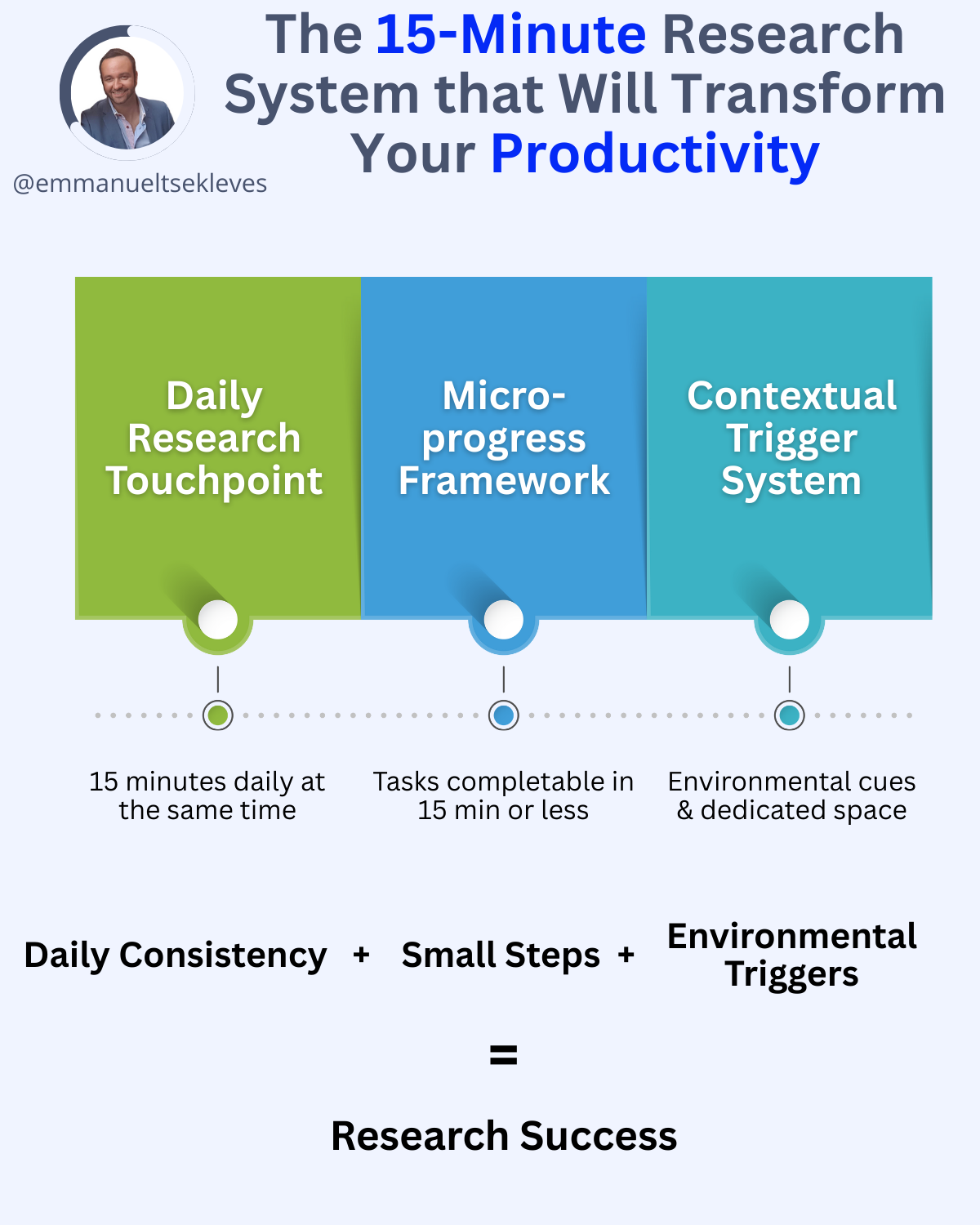
The system has three core components that work together to transform your research productivity.
Component #1: The Daily Research Touchpoint
The foundation of the system is a non-negotiable 15-minute daily research touchpoint.
This isn't enough time to complete significant work, but that's precisely the point.
How it works: Each day, set a timer for exactly 15 minutes.
During this time, engage with your research in any small way. This might involve:
- Reading and annotating one research paper
- Drafting or editing a single paragraph
- Outlining a section of a manuscript
- Analyzing a small data segment
- Refining a research question
- Creating one visualisation
The key is absolute consistency.
This daily touchpoint keeps your research constantly active in your subconscious mind, where your brain continues processing and making connections even when you're not actively working.
🚩 Action strategy: For the next 30 days, commit to a daily 15-minute research touchpoint at the same time each day.
- Use a physical timer (not your phone) to maintain focus.
- Keep a research journal noting what you accomplished in each session, however small.
Component #2: The Micro-Progress Framework
While most academics measure progress in completed papers or analyzed datasets, the micro-progress framework breaks research into tiny, completable units that provide consistent psychological rewards.
How it works: Research in behavioral psychology shows that the satisfaction of completion is a more powerful motivator than progress itself.
The micro-progress framework involves:
- Breaking research tasks into units completable in 15 minutes or less
- Creating physical or digital "done lists" rather than to-do lists
- Celebrating the completion of these micro-units
For example, instead of "write literature review," your micro-progress list might include "find 5 papers on X," "create citation spreadsheet," "outline paragraph on competing theories," etc.
🚩 Action strategy: Take your current research project and break it into at least 50 micro-tasks that could each be completed in 15 minutes or less.
Create a physical or digital system for tracking completions, not just tasks.
I recommend the free Trello app for this purpose.
Component #3: The Contextual Trigger System
While most academics rely on willpower to maintain research habits, the contextual trigger system uses environmental cues to prompt automatic research engagement.
How it works: Behavioral science shows that habits form more easily when linked to specific environmental triggers.
The contextual trigger system involves:
- Creating a dedicated physical or digital space used exclusively for your 15-minute sessions
- Establishing a consistent pre-research ritual that signals your brain to engage
- Using physical objects as commitment devices
🚩 Action strategy: Design your personal research trigger by selecting:
- A dedicated physical location (specific chair, desk corner, or café table)
- A unique object used only during research time (special notebook, mug, or pen)
- A consistent 3-step pre-research ritual (e.g., brewing tea, opening a specific notebook, and setting a timer)
The Compound Effect: How 15 Minutes Creates Transformation
The true power of this system comes from its compound effect over time:
- Neurological benefits: Daily engagement creates stronger neural pathways dedicated to your research questions
- Psychological benefits: Regular completion of micro-tasks builds momentum and confidence
- Practical benefits: Maintaining constant context eliminates ramp-up time when longer sessions are available
The Integration Strategy: Combining Short and Long Sessions
While the daily 15-minute habit forms the foundation, optimal research productivity comes from strategically combining these short sessions with occasional longer blocks.
How it works: Use your daily 15-minute sessions to:
- Process and integrate insights from previous deep work
- Maintain context and momentum between longer sessions
- Complete preparatory tasks that make longer sessions more productive
Key Takeaways:
-
-
Break tasks into units completable in 15 minutes or less
-
Create physical or digital systems for tracking completions
-
Establish environmental triggers that eliminate the need for willpower
-
Use daily sessions to maintain momentum between longer work blocks
-
Consistency matters more than duration—never miss your daily touchpoint
-
→ Your Action Plan for This Week
This week, I challenge you to implement the foundation of this system:
- Commit to a daily 15-minute research touchpoint at the same time each day for the next 30 days
- Break your current research project into at least 50 micro-tasks, each completable in 15 minutes or less
- Design your personal contextual trigger (location, object, and pre-research ritual)
Well, that’s it for today.
See you next week.
Whenever you're ready, there are 3 ways I can help you:
1. Get free actionable tips on how to secure a tenure-track job in academia by following me on X, LinkedIn and Instagram.
2. Take my Academic Job Seekers Assessment quiz to receive personalised recommendations & discover my 6P Academic Job Accelerator Program.
3. If you're ready to take your PhD application journey to the next level, join my PhD Application and Scholarship Masterclass waitlist. Click the link below to learn more and secure your spot.
Responses