
Today, I'm revealing five hidden evaluation metrics that search committees actually use to select candidates.
19 March 2025
Read time: 4 minutes
Supporting our sponsors directly helps us continue delivering valuable content for FREE to you each week — your clicks make a difference!
Jenni AI
Transform your academic papers from blank page to polished manuscript with Jenni AI - your AI-powered research assistant that cuts writing time in half while enhancing quality.Access a vast citation database, generate detailed outlines, and streamline your workflow.Try it today with 20% off using code EM20
Yomu AI
Transform your research into a publication-ready paper with Yomu AI – your AI research assistant that streamlines the entire process from outline creation to citation management.Perfect for first-time academic writers, Yomu helps you craft structured outlines, find relevant citations, and generate polished abstracts in just 5 simple steps.
Imagine spending years perfecting your CV, crafting an elegant research statement, and carefully curating your publication list...
...only to be rejected from position after position while candidates with seemingly weaker credentials land the jobs you want.
What's really happening behind those closed search committee doors?
Today, I'm revealing five hidden evaluation metrics that search committees actually use to select candidates.
Insights gained from my experience serving on over ten hiring committees and interviewing several 50+ candidates across disciplines.
These are the unwritten rules that separate successful candidates from the perpetually overlooked, regardless of publication count or h-index.

As a postdoc with strong publications but striking out on the job market, I couldn't understand why I kept receiving those devastating "we regret to inform you" emails.
It wasn't until I landed my first faculty position and began serving on search committees that I discovered the truth:
While publications and grants get your application into the "maybe" pile, the final selection often hinges on entirely different factors that most candidates never address.
After systematically comparing notes with colleagues across institutions and disciplines,
I uncovered these hidden evaluation metrics that can make or break your academic job prospects.
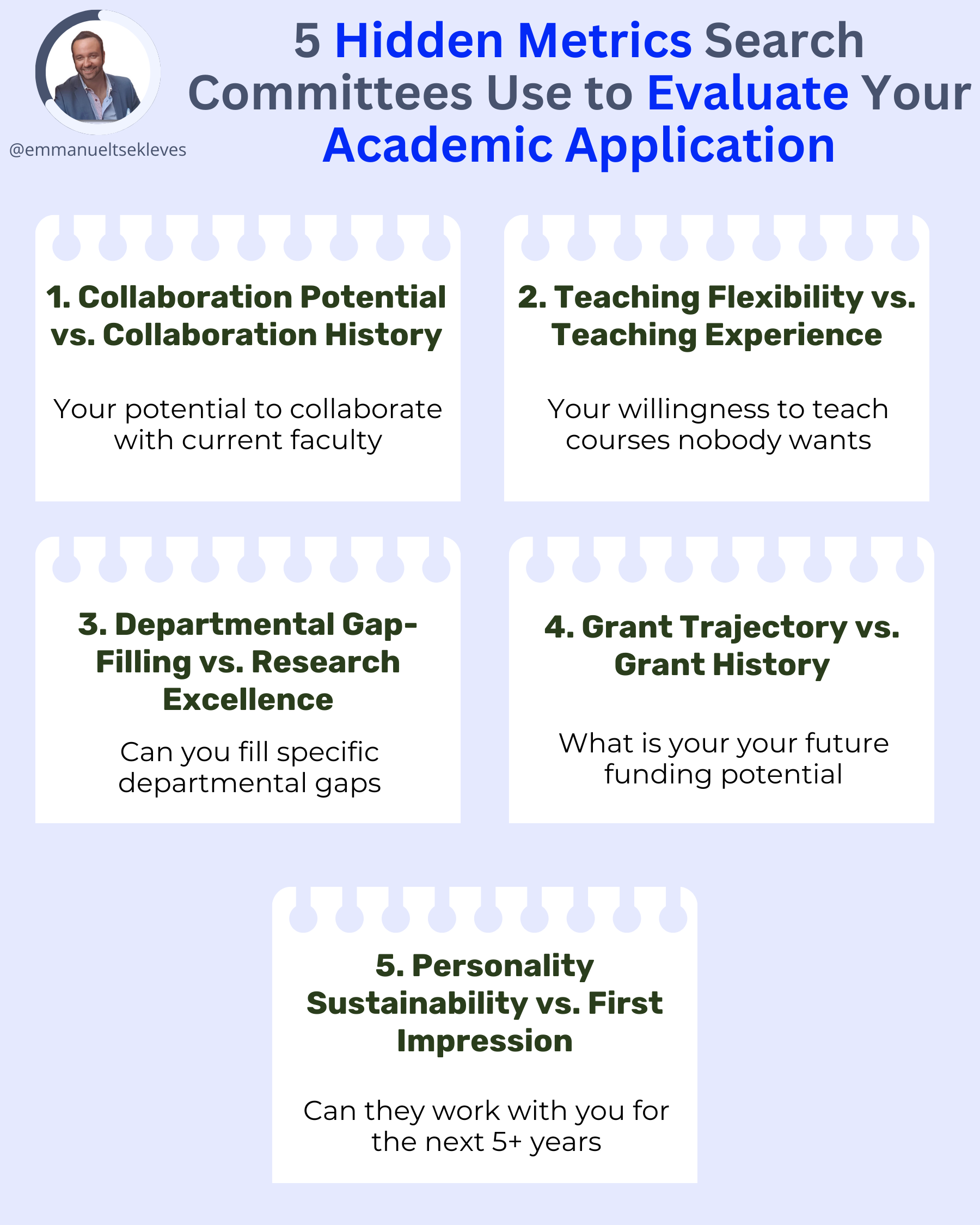
Hidden Metric #1: Collaboration Potential vs. Collaboration History
While most candidates showcase past collaborations, search committees are actually evaluating your potential to collaborate with current faculty.
❌ What most candidates do: List their previous co-authors and collaborative projects, assuming more is better.
✅ What search committees actually evaluate: How specifically your research program could intersect with existing faculty interests to create new funding opportunities.
🚩 Action strategy: Research the department thoroughly and identify 3-5 current faculty members whose work connects to yours in non-obvious ways.
In your cover letter, explicitly outline potential collaborative projects with these specific faculty members.
For example: "My work on quantum computing algorithms could complement Professor Garcia's research on network security by developing new encryption methods, potentially opening avenues for NSF Secure and Trustworthy Cyberspace funding."
Hidden Metric #2: Teaching Flexibility vs. Teaching Experience
While candidates emphasize courses they've taught, committees are secretly assessing your willingness to teach courses nobody wants.
❌ What most candidates do: Highlight their specialized teaching experience and propose new courses in their specific research area.
✅ What search committees actually evaluate: Your willingness and ability to teach core courses, especially the large, introductory classes that senior faculty often avoid.
🚩 Action strategy: Study the department's course catalog and identify the large enrollment or required courses that likely need staffing.
In your teaching statement, specifically mention your interest and preparation for teaching these courses.
For example: "While I have specialized expertise in Victorian literature, I'm particularly excited about teaching the department's core 'Introduction to Literary Analysis' course, where I would implement evidence-based approaches such as team-based learning to engage large groups of first-year students."
Hidden Metric #3: Departmental Gap-Filling vs. Research Excellence
While you're selling your research strengths, committees are often looking for someone who fills specific departmental gaps.
❌ What most candidates do: Emphasize the excellence and impact of their research program without considering the department's specific needs.
✅ What search committees actually evaluate: How you might solve existing problems in the department, which could include everything from methodological expertise to demographic representation to committee service capacity.
🚩 Action strategy: In informational interviews with current or former department members, ask questions like:
"What challenges is the department currently facing?" and
"Are there any gaps in expertise the department is looking to fill?"
Then address these specific needs in your application.
For example: "I notice the department currently lacks expertise in mixed-methods research design. My background bridging quantitative and qualitative approaches could help strengthen methodological training for graduate students across specializations."
Hidden Metric #4: Grant Trajectory vs. Grant History
While candidates highlight past funding, committees are secretly calculating your future funding potential.
❌ What most candidates do: List their previous grants and fellowships without clearly articulating their future funding strategy.
✅ What search committees actually evaluate: The specificity and feasibility of your funding pipeline for the next 3-5 years.
🚩 Action strategy: Create a detailed 3-year funding roadmap identifying specific grants you'll target, with deadlines and estimated budget amounts.
Include this in your research statement and reference it in your cover letter.
For example: "My research program has a clear funding trajectory, beginning with an NSF CAREER proposal in Fall 2026 (estimated $500K), followed by NIH R21 submission in Spring 2027 (estimated $275K), building toward a larger NIH R01 by 2028 (estimated $1.2M)."
Hidden Metric #5: Personality Sustainability vs. First Impression
While candidates focus on making a strong first impression, committees are evaluating whether they can tolerate working with you for the next 10+ years.
❌ What most candidates do: Present a highly polished, formal persona during interviews and campus visits.
✅ What search committees actually evaluate: Whether you would be a pleasant, reliable colleague during decades of department meetings, committee work, and hallway interactions.
🚩 Action strategy: During your campus visit, be consistently collegial with everyone from the department chair to administrative staff to graduate students.
Show genuine interest in others' work without dominating conversations.
Demonstrate your reliability by respecting time limits, responding promptly to emails, and following through on any commitments made during the interview process.
Most importantly, be authentic—committees can spot a personality that's being temporarily masked for the interview.
Key Takeaways:
-
Focus on collaboration potential with current faculty, not just your collaboration history
-
Demonstrate enthusiasm for teaching core courses, not just specialized seminars
-
Identify and address specific departmental gaps or challenges
-
Provide a detailed funding roadmap, not just a list of past grants
Show authentic collegiality to everyone you meet during the interview process
→ Your Action Plan for This Week
This week, I challenge you to revamp one application document to address these hidden metrics:
- Review your cover letter and add a specific paragraph identifying potential collaborations with 3-5 current faculty members at your target institution
- Modify your teaching statement to explicitly mention your willingness and ability to teach high-need core courses
- Create a visual 3-year funding roadmap with specific grants, deadlines, and dollar amounts
- Add a section to your research statement addressing how your expertise fills a specific gap in the department
Download my Academic Job Interview Guide and discover the 5 most common academic interview questions that you should prepare for and 3 insider tips to help you answer them
Well, that’s it for today.
See you next week.
Whenever you're ready, there are 3 ways I can help you:
1. Get free actionable tips on how to secure a tenure-track job in academia by following me on X, LinkedIn and Instagram.
2. Take my Academic Job Seekers Assessment quiz to receive personalised recommendations & discover my 6P Academic Job Accelerator Program.
3. If you're ready to take your PhD application journey to the next level, join my PhD Application and Scholarship Masterclass waitlist. Click the link below to learn more and secure your spot.
Responses