Header Logo 2
My Newsletter Resources 1:1 PhD/DBA Mentoring
LOG IN
← Back to all posts

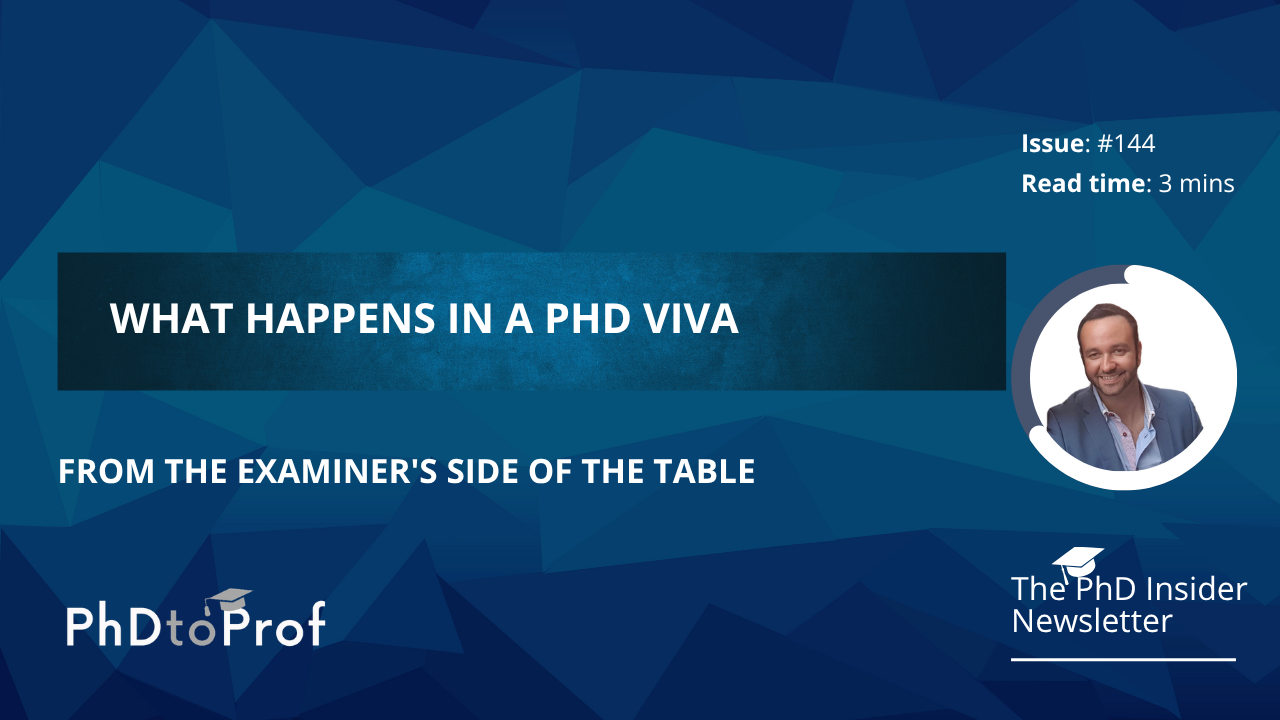
#144 - What Happens in a PhD Viva: From the Examiner's Side of the Table

Apr 15, 2026
Connect

Today I am giving you the full timeline, from the conversation we have before you walk in to the moment we tell you the outcome, along with exactly what to prepare for each stage so nothing catches you off guard.

15 April 2026

Read time: 3 minutes


Offers and opportunities:

Supporting our sponsors directly helps me continue delivering valuable content for FREE to you each week. Your clicks make a difference! Thank you. Emmanuel


A few spaces available for 1:1 mentoring 


I am taking on a small number of new 1:1 mentoring candidates this quarter. If you are a working professional doing a PhD, DBA, EDBA, EdD, or DrPH alongside your career and you want structured support at any stage, I would like to hear from you.
 

Takes a few minutes. No commitment. 


👉 It starts with a short form: phdtoprof.com/discovery .


Sponsor this newsletter

Nobody tells you what really happens in a viva.

Your supervisor might give you a few tips. You might read some blog posts.

But nobody walks you through it from the examiner's perspective, minute by minute, with the things we are actually thinking at each stage.

Today I am giving you the full timeline, from the conversation we have before you walk in to the moment we tell you the outcome, along with exactly what to prepare for each stage so nothing catches you off guard.

After 45 examinations, I can tell you that the candidates who know what is coming almost always handle it better than the ones who do not.


What Most Candidates Get Wrong About the Viva

Most students walk into their viva thinking it is a test they either pass or fail, like a final exam. It is not.

A viva is a professional conversation about your research between you and two people who have read your work carefully and want to understand how you think.

The other thing most candidates do not realise is that examiners go into a viva wanting you to pass.

We are not sitting there looking for reasons to fail you.

We are looking for evidence that you understand your own work and can talk about it like a researcher, not like a student reading from a script.

Once you understand that, the whole experience changes.


The Full Viva Timeline

Stage 1: The Examiner Meeting (about 10 minutes before you enter)

This is the part nobody tells you about.

Before you walk in, the two examiners are already in the room without you, and we have both read your thesis independently and written our own notes.

Those ten minutes are spent comparing our impressions, agreeing on the areas we want to explore, and dividing up who will lead which questions.

By the time you come through the door, we already have a rough sense of where things are heading. Not a final decision, but a direction.

That direction can absolutely change during the viva itself, and I have seen it go both ways, but it means the first few minutes after you sit down matter more than most candidates think.

What to prepare: You cannot control this stage, but you can influence it.

  • A well-structured thesis with clear research questions,
  • a solid methodology chain,
  • and a strong discussion chapter

means the examiners walk into that pre-meeting with a positive first impression.

Everything I have covered in the Thesis Blueprint guide feeds directly into this moment.


Stage 2: The Opening (about 5 minutes)

You come in, we introduce ourselves, and we explain how the viva will run.

Then we ask you to summarise your research. This is not a trick question and it is not a test of memory.

It is your chance to settle into the room, hear your own voice, and remind yourself that you know this work better than anyone else at the table.

The biggest mistake candidates make here is trying to recite their abstract from memory.

What the examiners actually want is for you to talk about your work the way you would explain it to a smart colleague over coffee: confident, relaxed, and clear.

What to prepare: Practice a two-minute summary of your thesis that covers:

  • your research question,
  • your approach,
  • your main findings,
  • and your contribution.

Say it out loud at least five times before the day.

Do not memorise it word for word, because it needs to sound natural, not rehearsed.


Stage 3: The Presentation (10 to 20 minutes, if required)

Some programmes ask you to give a short presentation before the questioning begins. If yours does, treat it seriously because it sets the tone for everything that follows.

Keep it focused on three things: what you did, why you did it, and what you found.

Speak directly to the examiners rather than reading from your slides, and keep it within the time limit.

Going over time in your own presentation is not a good signal to send at the start of a viva.

What to prepare:

  • Build no more than 10 to 12 slides.
  • Open with your research question,
  • walk through your methodology briefly,
  • present your key findings,
  • and close with your contribution.

Practise it until you can deliver it comfortably without notes.


Stage 4: The Core Questioning (60 to 90 minutes)

This is the main body of the viva, and it usually moves through four phases, though most candidates do not realise there is a structure to it.

Phase 1: The big picture. We start broad. Tell us about your research.

  • What is the contribution?
  • Why does it matter?

We are listening to how you think about your work as a whole, not testing whether you can remember specific page numbers.

Phase 2: Chapter by chapter. We move through the thesis section by section, asking about specific choices you made. This is where our notes come out.

  • Why did you choose this philosophy?
  • How did you arrive at these themes?
  • What happened with the data that surprised you?

The key here is to answer honestly rather than defensively.

Phase 3: The challenges. We push back on your choices, and this is the stage that frightens most candidates.

But it is not an attack. It is a test of whether you can engage with criticism like a researcher.

The best response I have ever heard in a viva was "That is a fair point, and here is why I made that call."

That single sentence showed me the candidate could hold their ground while staying open to other perspectives.

Phase 4: Wrapping up. We ask if there is anything you want to add or anything you would do differently.

This is not a throwaway question. It is your chance to show intellectual maturity by reflecting honestly on your own work.

Saying "If I were starting again, I would widen my sample to include X" is far stronger than "No, I am happy with everything."

What to prepare: Re-read your thesis with fresh eyes and mark every section where you made a choice.

For each one, write down why you made that choice and what the alternative was.

Prepare for the challenges by asking a colleague to play devil's advocate with your methodology and findings.

And have a genuine answer ready for what you would do differently.

Stage 5: The Deliberation (15 to 30 minutes)

You leave the room while the examiners discuss the outcome.

This is the hardest part for most candidates, not because of what is happening in the room but because of the silence and uncertainty while you wait outside.

Inside the room, we are agreeing on the result, naming the specific outcome, and talking through any conditions or corrections.

The most common result by far is a pass with minor corrections, which is completely normal and almost every thesis has something that needs tightening up. A pass with minor corrections is a good outcome.

What to prepare: Have someone waiting for you during this stage, whether that is a friend, a family member, or a colleague.

Bring water, bring your phone, and do not try to analyse every question you were asked.

The deliberation is usually quicker than candidates expect.

Stage 6: The Decision (5 to 10 minutes)

You come back in and we tell you the outcome. We give you feedback, explain any corrections, and answer any questions you have.

If you receive minor corrections, ask the examiners to be specific about what they want changed so you know exactly what to do.

What to prepare: Bring a notebook and a pen. Write down every correction they mention, because you will not remember the details later.

If anything is unclear, ask for clarification on the spot. This is the one moment where most candidates are so relieved or emotional that they forget to listen carefully, and that makes the corrections harder than they need to be.


Key Takeaways

  1. Examiners meet before you enter the room and already have a direction in mind, which is why the quality of your written thesis matters just as much as your performance on the day.
  2. The viva has a clear structure with four questioning phases, and knowing what each phase is testing helps you prepare the right kind of answers for each one.
  3. The most common outcome is a pass with minor corrections, and examiners go in wanting you to pass, so your job is to show them you understand your own work.
  1.  

→ Your Action Plan for This Week

  • Write a two-minute summary of your thesis and practise saying it out loud five times.
  • Go through your thesis and list every major choice you made, then write one sentence explaining why for each one.
  • Ask a colleague to challenge your methodology and your findings as if they were an examiner, and practise responding with "That is a fair point, and here is why I made that call."
  • Pack your viva bag the night before: printed thesis, notebook, pen, water, and your list of key choices.


Walk in knowing what is coming. That is the single biggest advantage you can give yourself.

If you are at proposal stage, I built a free 10-criterion self-assessment based on my experience examining 45+ theses. Takes 12 minutes. You get personalised feedback: phdtoprof.com/scorecard

Need personalised support? Ask about our Premium 1:1 PhD Mentorship Programme and PhD Thesis Review Service.


⭐ BONUS RESOURCE ⭐


I have turned this full timeline into a two-page Viva Preparation Checklist organised by stage: what to prepare before, what to expect during each phase, and what to do after the deliberation. It includes tick boxes for every item and examiner tip callouts for the moments that matter most.

đŸ“„ Download the Viva Preparation Checklist here: Viva Checklist

This is the kind of resource that will be part of my upcoming premium newsletter for subscribers who want deeper tools and practical guides.

For now, they are yours at no cost.


Well, that’s it for today.

Until next week,

Prof. Emmanuel Tsekleves


Whenever you're ready, there are 3 ways I can help you:


1. Get free actionable tips on how to complete your PhD on time and use AI responsibly in research by following me on X, LinkedIn, Instagram


2. Join my Premium 1:1 PhD/DBA Mentorship Program. I provide exclusive, results-driven support for professionals who need fast-track guidance on proposals and thesis completion. Visit my website to learn more about this premium consultancy and book a discovery call.


3. Submit your thesis with confidence through my PhD/DBA Thesis Review Service. As an external examiner for 40+ PhDs, I review your work the way examiners do and give you two rounds of detailed feedback. Fill out the discovery form on my website to get started.


Responses

Join the conversation
t("newsletters.loading")
Loading...
#143 - Where to Draw the AI Line in Your Research and Doctoral Research
Today I am sharing exactly where that line sits, based on real cases I have examined and the three uses that will always result in a fail. 8 April 2026 Read time: 4 minutes Offers and opportunities: Supporting our sponsors directly helps me continue delivering valuable content for FREE to you each week. Your clicks make a difference! Thank you. Emmanuel   I built something for doct...
#142 - How I Mark a Doctoral Thesis: The Chapter-by-Chapter Blueprint
Today I am taking you inside my process. I am going to walk you through exactly what I look for, what I write in my notes, and the moments where I decide if a thesis is heading for minor corrections or major ones. 1 April 2026 Read time: 4 minutes Offers and opportunities: Supporting our sponsors directly helps me continue delivering valuable content for FREE to you each week. Your ...
#141 - How to Build a Methodology Chapter Examiners Cannot Break
Today I am sharing the exact process I walk my students through to build that chain, with two full worked examples you can follow. 25 March 2026 Read time: 4 minutes Offers and opportunities: Supporting our sponsors directly helps me continue delivering valuable content for FREE to you each week. Your clicks make a difference! Thank you. Emmanuel   How to Find the Papers Your Liter...

The Research Insider

One insider strategy per week to complete your PhD or DBA on time, use AI responsibly, and navigate the academic system with confidence. 230,000+ researchers follow my work on LinkedIn. 10,000+ subscribe to this newsletter. Here's why. Whether you're a full-time researcher or a working professional doing a doctorate alongside your career, the system wasn't built for you. Universities teach methodology. They don't teach you how to actually finish. Every Wednesday, I share one technique from the examiner's side of the table. The things I've learned from examining 45+ PhD theses, supervising 30+ researchers to completion, and mentoring working professionals through doctorates they were told they couldn't do while working. All in under 3 minutes. AI is changing research fast. I've tested 12+ tools with doctoral students and I train universities on responsible AI use. I'll show you what works, what makes things up, and how to use these tools without putting your integrity at risk. My followers call me their virtual mentor. This newsletter is where that mentoring goes deeper. No fluff. No jargon. Just the strategies I use with my own mentees, in your inbox every Wednesday.
© 2026 PHDTOPROF. ALL RIGHTS RESERVED.

Join The FREE Challenge

Enter your details below to join the challenge.