Header Logo 2
My Newsletter Resources 1:1 PhD/DBA Mentoring
LOG IN
← Back to all posts

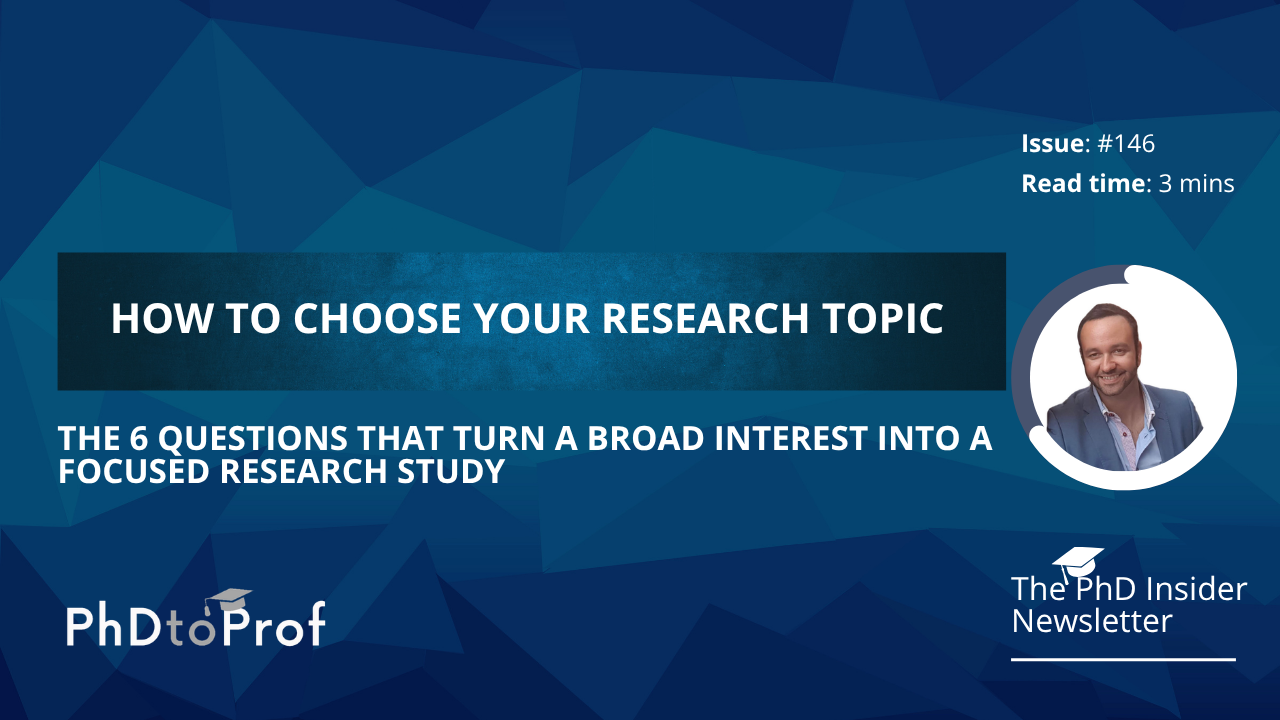
#146 - How to Choose Your Research Topic: The 6 Questions to Turn an Interest Into a Research Study

Apr 29, 2026
Connect

Today I am giving you the six questions that fix this. You can work through them before you read a single paper, and by the end you will have a research topic with real direction.

29 April 2026

Read time: 3 minutes


Offers and opportunities:

Supporting our sponsors directly helps me continue delivering valuable content for FREE to you each week. Your clicks make a difference! Thank you. Emmanuel


1:1 Mentoring.

I am expanding the 1:1 mentoring side of PhD to Prof and looking for a small number of new candidates to work with this quarter.

If you are currently doing a DBA, EDBA, PhD, EdD, or DrPH alongside your career, I would like to hear from you. 

Whether you are working on your proposal and want to make sure it is examiner ready before you submit...

Whether you are in the middle of data collection and struggling to keep momentum alongside your career...

Whether you are deep in the writing phase and the chapters are not coming together the way you expected...

Whether you are approaching your viva and want to walk in feeling prepared rather than anxious...

Or whether you have hit a wall entirely and need help getting back on track...

If that sounds like you, the starting point is a short discovery form. It takes a few minutes and helps me understand where you are and whether I can help.


👉 Fill in the Discovery Form.


Sponsor this newsletter

P.S. I'm live in the comments under every LinkedIn post on Mon, Tue, Thu and Sat from 2:34pm GMT. Drop by if you want to dig into the topic, ask a question, or just say hello.
 

I spent the first six months of my own PhD reading everything I could find before someone finally asked me:

What was my research actually about?

I could not answer in one sentence.

That was over twenty years ago, and in the twelve years since I started supervising and mentoring doctoral researchers, I have watched the same thing happen again and again.

A smart, capable person walks in with a broad interest, spends months reading, and still cannot tell me in one clear sentence what their research is actually about.

Today I am giving you the six questions that fix this.

You can work through them before you read a single paper, and by the end you will have a research topic with real direction.

If you are fitting a doctorate around a full-time career, a poorly defined topic does not just slow your research down.

It makes every supervision meeting harder, every chapter more difficult to write, and every viva question harder to answer.


The Problem That Costs You Months

Within my doctoral research supervision and mentoring practice, I see many doctoral researchers start with a broad interest.

Most assume the reading will eventually narrow it down.

I can tell you that it almost never does.

Reading without a defined question is like driving without a destination.

You cover a lot of ground but you end up exactly where you started, just more overwhelmed and further behind schedule.

The working professionals I mentor, directors, senior managers, consultants, are usually the busiest people in the room when this happens.

Most of them have already put in months before we start working together, and the first session almost always begins the same way: we go back to the research topic and rebuild it from scratch.


The 5Ws and 1H Framework

I put this framework together after watching the same pattern repeat across dozens of mentees.

Six questions, answered in order.

By the time you reach the end, you have a focused research topic you can defend.

The important thing is answering them in sequence. Do not skip ahead.


1. Who: whose problem are you investigating?

Not a whole sector and not a profession in general.

One specific group of people in one specific situation.

The tighter you define your who, the easier everything after it becomes.

"Leaders" is not a who.

"Newly promoted middle managers in their first six months" is a who that an examiner can work with.


2. What: what exactly are you studying about them?

Not a broad theme like leadership or digital transformation, but one specific aspect of it that can be measured, explored, or examined.

If your what could be the title of an entire textbook, it is too wide.

Keep narrowing until it sounds like a chapter heading instead.


3. Where: what context or setting?

An industry, a country, a type of organisation, a specific region.

Narrower is better at this stage because you can always widen later.

Widening a study that started narrow is far easier than trying to narrow one that started too broad. 

Your where also shapes your access, your sampling, and your methodology, so getting it right early saves you months of rethinking later on.


4. When: what time period?

Current practice, a historical shift, a post-pandemic transition, a specific policy window.

Time boundaries make a topic easy to research.

Without them, scope creeps and your examiner will ask why you did not include data from a decade you never intended to cover.


5. Why: why does this matter?

This is the question most candidates answer last and should answer first.

If you cannot say clearly why your research matters to your field and to real-world practice, you do not yet have a topic.

You have an interest.

The why is what turns your research from something you are curious about into something that needs to exist.

It feeds directly into your gap statement and your contribution.


6. How: how will you investigate it?

Qualitative, quantitative, or mixed?

Case study, survey, interviews, secondary data?

Your how must match your what.

If you are exploring lived experience, a large-scale survey will not get you there.

If you are testing a hypothesis across a population, three interviews will not be enough.

The how shapes your methodology chapter, but it does not go into your research question itself.


Putting Your Research Question Together

Once you have answered all six, combine your answers for questions one through five into a single sentence using this shape:

How do [WHO] [WHAT] in [WHERE] since [WHEN], and what [WHY-linked outcome]?

The how from question six shapes your methodology, not the question itself.

That distinction matters because your research question should tell the reader what you are investigating, not how you plan to do it.

Let me show you what that looks like in practice.

A mentee came to me saying she wanted to research digital exclusion.

After working through the six questions together, her research question became:

"How do adults aged 65 and over in rural English communities access digital public services post-2020?"

One sentence. Every word doing a job.

Her examiner approved it in the first supervision meeting.

Another mentee, a senior HR director doing a DBA part-time, started with "I want to research talent management."

After the same six questions, his research question became: "How do HR directors in UK professional services firms retain senior talent during digital transformation?"

Exactly the same process, but completely different field, same result.

Clear, focused, and defensible.

That's exactly what you should aim for.


Why This Matters Even More If You Work Full-Time

If you are doing your doctorate part-time while holding down a senior role, you cannot afford to spend six months finding your topic.

Every month without a clear question is a month of reading that might not end up in your thesis, a supervision session spent going in circles, and a growing sense that you are falling behind.

This framework is designed to give you that clarity in a single sitting so that your reading, your writing, and your supervision all have direction from day one.


Key Takeaways

  1. Answer the six questions in order: Who, What, Where, When, Why, How. Do not skip ahead and do not start your reading until you have at least a working answer for each one.
  2. Your Why should come before your How, not after it. If you cannot explain why your research matters, no methodology will save it.
  3. Combine answers one through five into a single research question. The How shapes your methodology chapter, not the question itself.
  1.  

→ Your Action Plan for This Week

  • Write one sentence for each of the six questions. If any answer could fill an entire textbook, it is too broad. Keep narrowing until it sounds like a chapter heading.
  • Combine your first five answers into one research question using the formula: How do [WHO] [WHAT] in [WHERE] since [WHEN], and what [WHY-linked outcome]?
  • Read it out loud and ask yourself: could someone outside my field understand exactly what this study does from that one sentence? If not, tighten it.
  • Take your research question to your next supervision meeting and see if your supervisor can repeat it back to you without looking at the page.


A good research question is not the result of months of reading. It is what makes those months of reading worthwhile.

If you are at proposal stage, I built a free 10-criterion self-assessment based on my experience examining 45+ theses. Takes 12 minutes. You get personalised feedback: phdtoprof.com/scorecard

Need personalised support? Ask about our Premium 1:1 PhD Mentorship Programme and PhD Thesis Review Service.


⭐ BONUS RESOURCE ⭐


I have turned the 5Ws and 1H framework into a one-page printable worksheet with fill-in space for each question, the research question formula, and a self-check at the bottom. Pin it next to your desk and work through it before your next supervision meeting.

đŸ“„ Download the 5Ws and 1H Research Topic Worksheet here 

These are the kind of resources that will be part of our upcoming premium newsletter for subscribers who want deeper tools and writing guides.

For now, they are yours at no cost.


Well, that’s it for today.

Until next week,

Prof. Emmanuel Tsekleves


Whenever you're ready, there are 3 ways I can help you:


1. Get free actionable tips on how to complete your PhD on time and use AI responsibly in research by following me on X, LinkedIn, Instagram


2. Join my Premium 1:1 PhD/DBA Mentorship Program. I provide exclusive, results-driven support for professionals who need fast-track guidance on proposals and thesis completion. Visit my website to learn more about this premium consultancy and book a discovery call.


3. Submit your thesis with confidence through my PhD/DBA Thesis Review Service. As an external examiner for 40+ PhDs, I review your work the way examiners do and give you two rounds of detailed feedback. Fill out the discovery form on my website to get started.


Responses

Join the conversation
t("newsletters.loading")
Loading...
#145 - How to Find and Write a Research Gap That Holds Up
Today I am giving you the complete process, from finding a genuine gap in the literature through to writing a statement that no panel or reviewer can push back on, with annotated examples showing exactly what passes and what fails. 22 April 2026 Read time: 4 minutes Offers and opportunities: Supporting our sponsors directly helps me continue delivering valuable content for FREE to y...
#144 - What Happens in a PhD Viva: From the Examiner's Side of the Table
Today I am giving you the full timeline, from the conversation we have before you walk in to the moment we tell you the outcome, along with exactly what to prepare for each stage so nothing catches you off guard. 15 April 2026 Read time: 3 minutes Offers and opportunities: Supporting our sponsors directly helps me continue delivering valuable content for FREE to you each week. Your ...
#143 - Where to Draw the AI Line in Your Research and Doctoral Research
Today I am sharing exactly where that line sits, based on real cases I have examined and the three uses that will always result in a fail. 8 April 2026 Read time: 4 minutes Offers and opportunities: Supporting our sponsors directly helps me continue delivering valuable content for FREE to you each week. Your clicks make a difference! Thank you. Emmanuel   I built something for doct...

The Research Insider

One insider strategy per week to complete your PhD or DBA on time, use AI responsibly, and navigate the academic system with confidence. 230,000+ researchers follow my work on LinkedIn. 10,000+ subscribe to this newsletter. Here's why. Whether you're a full-time researcher or a working professional doing a doctorate alongside your career, the system wasn't built for you. Universities teach methodology. They don't teach you how to actually finish. Every Wednesday, I share one technique from the examiner's side of the table. The things I've learned from examining 45+ PhD theses, supervising 30+ researchers to completion, and mentoring working professionals through doctorates they were told they couldn't do while working. All in under 3 minutes. AI is changing research fast. I've tested 12+ tools with doctoral students and I train universities on responsible AI use. I'll show you what works, what makes things up, and how to use these tools without putting your integrity at risk. My followers call me their virtual mentor. This newsletter is where that mentoring goes deeper. No fluff. No jargon. Just the strategies I use with my own mentees, in your inbox every Wednesday.
© 2026 PHDTOPROF. ALL RIGHTS RESERVED.

Join The FREE Challenge

Enter your details below to join the challenge.