Header Logo 2
My Newsletter Resources 1:1 PhD/DBA Mentoring
LOG IN
← Back to all posts

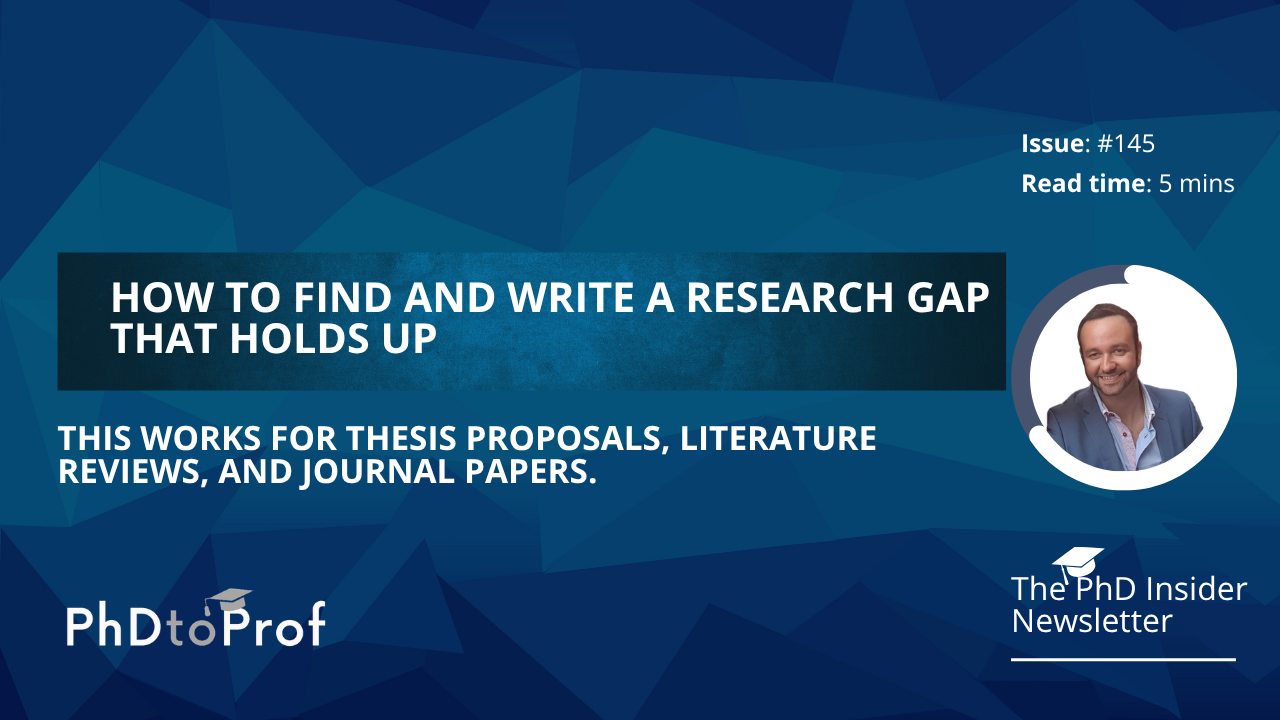
#145 - How to Find and Write a Research Gap That Holds Up

Apr 22, 2026
Connect

Today I am giving you the complete process, from finding a genuine gap in the literature through to writing a statement that no panel or reviewer can push back on, with annotated examples showing exactly what passes and what fails.

22 April 2026

Read time: 4 minutes


Offers and opportunities:

Supporting our sponsors directly helps me continue delivering valuable content for FREE to you each week. Your clicks make a difference! Thank you. Emmanuel


Free Webinar: AI Does the Searching. You Do the Thinking.

AI can find papers keyword searches miss. But how do you verify what it finds? How do you cite responsibly? How do you stay academically defensible?


I'm running a free 60-minute webinar with the team at Consensus to answer exactly this.


AI Does the Searching. You Do the Thinking. A practical framework for PhD students and early career researchers. Here's what you'll walk away with:


→ A step-by-step framework you can apply to your next literature review immediately

→ Live demos showing how semantic search finds papers keyword searches miss

→ A practical method for verifying AI outputs before you cite them

→ Techniques for mapping interdisciplinary connections in your field

→ A clear, academically defensible approach to using AI

📅 Thursday 23 April 2026 🕐 9:00am PST / 12:00pm EST / 5:00pm UK


👉 Free registartion: Register Here.

Sponsor this newsletter

Before we started working together, one of my mentees had already had her proposal rejected three times.

Same research. Same methods. Same supervisor.

Three attempts, three rejections.

When I read her proposal for the first time, I could see the problem within two minutes.

Her research was solid.

Her reading was extensive.

But her gap statement was doing one thing when it needed to do three.

Six weeks later, after we rebuilt that single paragraph together, her panel approved it the same day.

She was never doing bad research.

She had just never been shown what a gap statement actually needs to do, or how to find the gap that belongs inside it.

Today I am walking you through the whole process from start to finish, finding a genuine gap and then writing it in a way that no panel or reviewer can push back on, with real examples of what passes and what gets sent back.

This works for thesis proposals, literature reviews, and journal papers. The method is exactly the same.

Why Most Gap Statements Get Sent Back

Here is the thing nobody tells you early enough:

most students describe the literature and then jump straight to their research question, as if naming a topic nobody has covered is the same as identifying a gap.

It is not.

A topic nobody has covered is just a hole in the literature.

On its own, that means nothing.

A gap is a hole where the absence of research has a real consequence, where something important remains unknown or unexplained because nobody has looked at it yet.

And if you cannot explain why that absence matters, you do not have a gap.

You have a topic change dressed up as a contribution, and your panel will see right through it.


The 5-Step Method for Finding a Real Gap

Let me walk you through the exact process I use with every mentee.

Step 1: Map the field.

Start by pulling out the five to eight core concepts from your research question and searching each one across your key databases.

  • What you are looking for is the shape of the field.
  • Where does the literature cluster?
  • Where are there dozens of studies all saying similar things?

Those dense areas are your consensus zones, and the thin edges where very few studies exist are where genuine gaps tend to live.

You are not trying to read everything at this stage. You are trying to see the landscape.


Step 2: Find the solid ground first.

This is the step most students skip, and it is the one that makes everything else harder.

Before you go hunting for what is missing, you need to be really clear about what is already established.

Look at the last ten years of research in your area and ask yourself:

  • What does the field consistently agree on?
  • What assumptions does everyone take for granted?

You cannot argue that something is missing until you can clearly describe what is already there, because that solid ground is the foundation your gap statement is going to stand on.


Step 3: Look for the cracks.

Now it gets interesting.

  • Where do studies disagree with each other?
  • Where do findings from one context contradict findings from another?

These contradictions are one of the most overlooked sources of genuine gaps, and they are often the strongest ones because the disagreement itself proves the question matters.

A gap that comes from a contradiction in the literature is almost always more defensible than one that simply comes from nobody having looked at something, because you can point to the evidence that shows the field has not settled this yet.


Step 4: Ask the four missing questions.

Once you know the solid ground and the cracks, run through these four questions and see what falls out.

  • Which populations have not been studied?
  • Which time periods are missing from the evidence?
  • Which methods have not been applied to this problem?
  • Which contexts have been assumed but never actually tested?

Each of these can point you to a gap that is both genuine and defensible, and the strongest gaps I have seen combine two or more of them.

A missing population plus an untested context is much harder for a panel to dismiss than either one on its own.


Step 5: Test it before you claim it.

This is the step that saves you from embarrassment.

Before you write your gap statement, put it through a simple test. Ask yourself honestly:

  • Would a senior researcher in my field say this matters?
  • Would they fund a study to look at it?
  • Would they read the findings?

If the answer to any of those is no, you do not have a gap yet.

You have a topic.

Go back to step three and keep looking.

A gap that fails this test in your head will fail it in your viva too.


How to Write the Gap Statement

Finding the gap is only half the job.

The other half is writing it in a way that holds up when someone pushes back on it, and this is where most candidates come unstuck.

A gap statement needs to do three things in one paragraph.

  1. It names what the existing research has established.
  2. It identifies what that research has not addressed.
  3. And it explains why that absence matters.

All three. In that order. In one paragraph.

Most candidates only do the first one, and that is exactly why their panels keep sending them back.


The Template I Teach Every Mentee

Here is the formula I use:

Despite [what we know], [specific gap] remains unexamined. This matters because [consequence]. This study addresses this gap by [your approach].

Thirty to fifty words. One paragraph.

Every panel question answered before it is even asked.


What Strong Looks Like vs What Weak Looks Like

Let me show you the difference, because once you see it, you cannot unsee it.

A weak gap statement says something like:

"Studies have examined leadership in large organisations. This research will look at leadership in SMEs."

That is not a gap. That is a topic change.

The moment your examiner reads it, they will ask why it matters that nobody has studied this and what we actually lose by not knowing.

A strong gap statement says:

"While leadership in large organisations is well documented, studies have consistently excluded SMEs despite evidence that leadership dynamics differ significantly in resource-constrained environments. This gap matters because the frameworks guiding leadership development in SMEs are built on evidence from contexts that do not reflect how most small firms actually operate. This study addresses that gap by examining how SME leaders navigate strategic decisions without the structural support available in larger firms."

Can you see the difference?

The strong version names the established knowledge, identifies the specific thing that is missing, and then makes the case for why that missing piece has real consequences.

That is what passes.


The Mistake That Catches the Most Candidates

The most common thing I see is students who find a genuine gap but then write about it as if the reader already agrees it matters.

They say "no study has examined X" and move straight on, assuming the examiner or reviewer will fill in the importance themselves.

They will not. If you do not tell them why the gap matters, they will assume it does not.

Every gap statement must answer the question:

  • What is the consequence of this gap existing?
  • What are we getting wrong, missing, or assuming because this research has not been done?

That consequence is what turns a gap from "nobody has looked at this" into "somebody needs to."


Key Takeaways

  1. A gap is not a topic nobody has covered. It is an absence with a consequence, and if you cannot explain why it matters, you need to go back and look again.
  2. The strongest gaps come from contradictions in the literature, not just from missing studies. Disagreement between researchers proves the question is worth asking.
  3. Your gap statement must do three things in one paragraph: name what is known, identify what is missing, and argue for why that matters.
  1.  

→ Your Action Plan for This Week

  • Map your field using keyword clustering and identify where the literature is thick and where it thins out.
  • Write down the three things your field consistently agrees on, then look for where studies disagree or contradict each other.
  • Draft your gap statement using the template: Despite [what we know], [specific gap] remains unexamined. This matters because [consequence]. This study addresses this gap by [your approach].
  • Read it out loud and ask yourself: would a senior researcher in my field say this matters? If you hesitate, keep revising until you do not.


Your gap is not what you chose to study. It is the reason your study needs to exist.

If you are at proposal stage, I built a free 10-criterion self-assessment based on my experience examining 45+ theses. Takes 12 minutes. You get personalised feedback: phdtoprof.com/scorecard

Need personalised support? Ask about our Premium 1:1 PhD Mentorship Programme and PhD Thesis Review Service.


⭐ BONUS RESOURCE ⭐


Bonus 1: Research Gap Finder Worksheet

I have turned the 5-step method into a two-page fill-in worksheet you can work through for your own research. For each step, there is space to write your field, your consensus findings, the contradictions you found, your recency checks, and the "so what" test result. It works for thesis chapters and journal paper introductions.

Bonus 2: Gap Statement Examples: Thesis vs Paper

I have also put together six annotated gap statements, three from thesis proposals and three from published papers, with examiner and reviewer margin notes explaining what works and what does not. Each one includes a before-and-after version so you can see exactly what a strong revision looks like.

📥 Download both the Research Gap Finder Worksheet and Gap Statement Examples here

These are the kind of resources that will be part of our upcoming premium newsletter for subscribers who want deeper tools and writing guides.

For now, they are yours at no cost.


Well, that’s it for today.

Until next week,

Prof. Emmanuel Tsekleves


Whenever you're ready, there are 3 ways I can help you:


1. Get free actionable tips on how to complete your PhD on time and use AI responsibly in research by following me on X, LinkedIn, Instagram


2. Join my Premium 1:1 PhD/DBA Mentorship Program. I provide exclusive, results-driven support for professionals who need fast-track guidance on proposals and thesis completion. Visit my website to learn more about this premium consultancy and book a discovery call.


3. Submit your thesis with confidence through my PhD/DBA Thesis Review Service. As an external examiner for 40+ PhDs, I review your work the way examiners do and give you two rounds of detailed feedback. Fill out the discovery form on my website to get started.


Responses

Join the conversation
t("newsletters.loading")
Loading...
#144 - What Happens in a PhD Viva: From the Examiner's Side of the Table
Today I am giving you the full timeline, from the conversation we have before you walk in to the moment we tell you the outcome, along with exactly what to prepare for each stage so nothing catches you off guard. 15 April 2026 Read time: 3 minutes Offers and opportunities: Supporting our sponsors directly helps me continue delivering valuable content for FREE to you each week. Your ...
#143 - Where to Draw the AI Line in Your Research and Doctoral Research
Today I am sharing exactly where that line sits, based on real cases I have examined and the three uses that will always result in a fail. 8 April 2026 Read time: 4 minutes Offers and opportunities: Supporting our sponsors directly helps me continue delivering valuable content for FREE to you each week. Your clicks make a difference! Thank you. Emmanuel   I built something for doct...
#142 - How I Mark a Doctoral Thesis: The Chapter-by-Chapter Blueprint
Today I am taking you inside my process. I am going to walk you through exactly what I look for, what I write in my notes, and the moments where I decide if a thesis is heading for minor corrections or major ones. 1 April 2026 Read time: 4 minutes Offers and opportunities: Supporting our sponsors directly helps me continue delivering valuable content for FREE to you each week. Your ...

The Research Insider

One insider strategy per week to complete your PhD or DBA on time, use AI responsibly, and navigate the academic system with confidence. 230,000+ researchers follow my work on LinkedIn. 10,000+ subscribe to this newsletter. Here's why. Whether you're a full-time researcher or a working professional doing a doctorate alongside your career, the system wasn't built for you. Universities teach methodology. They don't teach you how to actually finish. Every Wednesday, I share one technique from the examiner's side of the table. The things I've learned from examining 45+ PhD theses, supervising 30+ researchers to completion, and mentoring working professionals through doctorates they were told they couldn't do while working. All in under 3 minutes. AI is changing research fast. I've tested 12+ tools with doctoral students and I train universities on responsible AI use. I'll show you what works, what makes things up, and how to use these tools without putting your integrity at risk. My followers call me their virtual mentor. This newsletter is where that mentoring goes deeper. No fluff. No jargon. Just the strategies I use with my own mentees, in your inbox every Wednesday.
© 2026 PHDTOPROF. ALL RIGHTS RESERVED.

Join The FREE Challenge

Enter your details below to join the challenge.