
Today I am showing you why so much strong doctoral research never reaches a journal, and the shift that fixes it while you are still writing rather than years after you finish.
02 September 2026
Read time: 4 minutes
Before we start: free live session next Wednesday 9th September
Many PhD candidates finish a doctorate with three or four years of original research and nothing published from it.
Next Wednesday I am running a free session on why that happens and what to do differently, called From Thesis to Publications.
It's Wednesday 9 September. Register here: https://www.linkedin.com/events/7499799914156064768
I was on a call a few weeks ago with a candidate who is close to submission.
She had done everything properly. Three years of data, a supervisor who was pleased with it and a viva date in the diary.
She wanted to talk about what happens afterwards, because she has plans. Two articles, a monograph eventually.
Then she said something I have heard so often that I could have finished the sentence for her.
"I know how to write, but not to what a journal is expecting."
She thought she was describing a gap in her training, something she had missed, something she could go away and learn from a book or a workshop.
I did not have the heart to say it on the call, so I am going to say it here.
What she is describing is not a writing problem.
I have examined many doctoral theses and have published over one hundred and thirty papers and spent twenty years reviewing for journals. Which means I have spent most of my career sitting in two chairs that do not really talk to each other, and I can tell you that the people in them are looking for opposite things.
I know that no one explains this to you, so you write your thesis for one of them, submit it, pass, and then discover that the other one cannot use any of it.
That is what she was really telling me.
The Two Types of People Who Read Your Work
Think about what your examiner is actually doing when they open your thesis.
They are deciding whether you are competent. Whether you can design a study, defend the choices you made, understand where your work sits in a field, and know what it does not prove.
So they want completeness. They want to see the alternatives you rejected and why. They want the limitations named before they have to name them for you. If something important is missing, that absence is what they will ask you about for two hours.
Now think about a reviewer opening your paper.
They are not assessing you. They do not care whether you are competent, and they will never meet you. They are deciding one thing: whether a single claim is worth the attention of their readers.
So they want the opposite of completeness. One argument, that is backed-up and everything that does not serve it taken out. When they see the careful, thorough, everything-covered writing that passes a viva, they do not read it as good research for a paper. They read it as a paper that has not decided what it is about.
So, two different types of readers who want you to do the reverse of each other.
To be honest, this took me an embarrassingly long time to see, and I only saw it because I ended up doing both jobs. If you are only ever on one side of it, there is no reason you would know.
What This Actually Does To Your Chapters
Here is where it bites.
You write a results chapter that presents all your findings, since your examiner needs to see all of them. You write a discussion that draws threads from every chapter, because that is what shows you understand your own work as a whole. You write a literature review broad enough to cover the field, since a narrow one looks like you have not read enough.
Every one of those decisions is correct for the thesis.
Every one of them is wrong for a paper.
So when you finish, and someone says now you should publish, you open the chapter and find that there is no single argument in it to build on. There are three, tangled together, all of them supported and none of them foregrounded. The literature you engaged with is the field's literature, not the journal's. The methodology only makes sense if the reader has read the two chapters before it.
You are not extracting a paper, you are taking the chapter apart and building something else out of the pieces.
And that work arrives at your desk at the precise moment you have the least appetite for it. Corrections done, you are back at work properly.
So the the thesis goes on the shelf. That is where most doctoral research ends up: read by your two examiners, your supervisor and you.
I have watched this happen to work that genuinely deserved better, sitting on the examining side of the table, and there is nothing I can do about it from that chair.
The Question I Ask Every Mentee
So what do you actually do instead?
Definitely, not writing everything twice, as you do not have time for that and I would not ask you to.
You answer one question before you write the chapter, and then you keep answering it while you write.
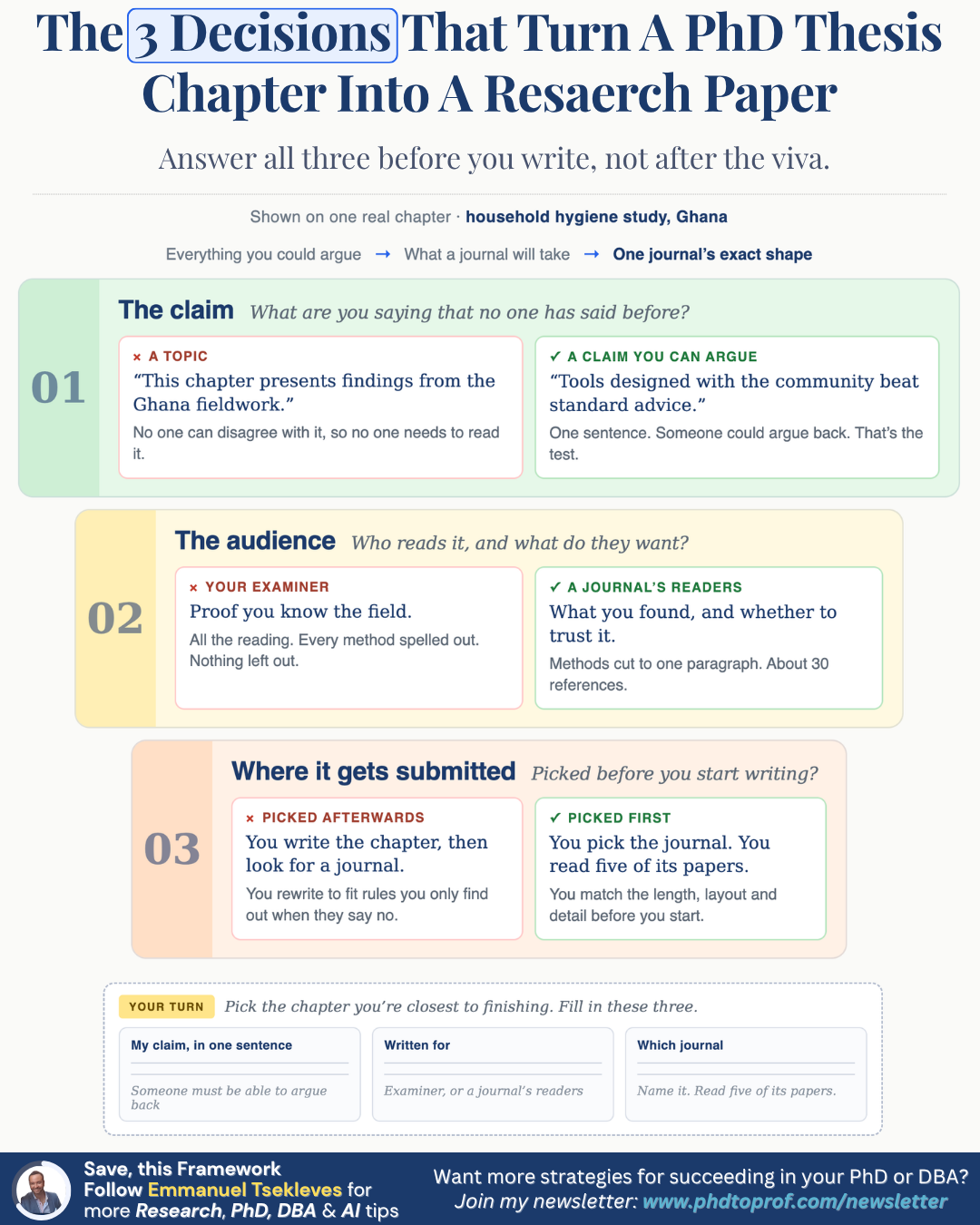
The question is: what does this chapter argue that somebody could disagree with?
Not what it is about, but what it argues.
Most candidates, when I ask this, tell me the topic. Something like: this chapter examines the factors influencing digital transformation in mid-sized manufacturing firms.
That is a description of an area and nobody can disagree with it, because it does not say anything yet. It tells me where you were looking, not what you saw.
Whereas: middle managers, not senior leaders, decide whether digital transformation succeeds in mid-sized manufacturing firms.
Now we are somewhere. Someone could push back on that and could design a study to test it. That is what makes it a paper rather than a section.
Write that sentence down before you draft. If it takes more than twenty-five words, you have two arguments in it, and two arguments is two papers. It is much better to find that out now than in year four, when the chapter is finished and the seam is invisible.
Then, and only then, decide who you are writing it for.
You see, the same finding can go to more than one place and it looks different each time. That middle managers result, sent to an operations journal, is a story about where a process breaks. Sent to a human resource management journal, it is a story about what a role is being asked to absorb. Same data, same finding, two entirely different introductions and two different sets of literature.
If you have not chosen, you write for both, and the paper reads as though it is arguing with itself.
Once you have chosen, spend an hour reading three recent papers from that journal. Do not read for their findings but read to get their structure and style. How long before they state their contribution, whether they open on the problem or the gap, where the limitations sit and how much space they get, etc.
Doing This Without Writing Anything Twice
None of this means abandoning the thesis chapter. Your examiner still needs the completeness, and you still have to give it to them.
What changes is that there is now an argument running underneath the chapter, and you know what it is.
The practical way to do this is to have one page kept open beside you while you draft. Your sentence, the journal, and reader named. Also three notes about the structure and style you are aiming at.
When you reach the end of the chapter, you have something that overlaps with a paper by perhaps seventy percent. The remaining thirty is cutting, and cutting is a weekend. What you have avoided is the rebuild, which is a year, and which is the reason it usually never happens.
That is the difference between finishing with a thesis and finishing with a thesis and four papers behind it.
Why You Cannot See Your Own Argument
I will tell you where this falls down.
You cannot see your own argument. You have been inside the material for years and every part of it feels necessary, because to you it is. Ask any candidate to say what their chapter argues in one sentence and watch what happens: it takes four sentences, then six, then they start explaining the methodology.
That is not a failure of intelligence, but what I call proximity. It is the single most common thing I see, and it is the thing an outside reader spots in ten minutes that you will not spot in ten months.
Your supervisor is not well placed to fix it either, and not because they are not good. They are in there with you and have followed the thinking from the beginning, so the argument is obvious to them too.
What actually works is saying it out loud to people who are not inside your topic and watching their faces.
That is a large part of why I am opening the Doctoral Circle.
It is group mentoring for working professionals doing a part-time doctorate. You bring the chapter, you say the sentence, and a room of people who are doing the same thing you are doing tell you honestly whether it held. Live masterclasses, live working sessions on your real writing, and people who understand what it is to fit this around a job and a family.
The founding group opens once, and it is open now.
One thing worth clarifying: registering now does not start your term early. The Circle begins on 1 October whichever day you join. What registering does is hold your place and lock your rate.
Your first term runs from 1 October to the end of December, and everything is open to you for all of it: the masterclasses, the Writing Rooms, the live Q&As, and the ability to put a question to me directly through the platform.
It is $450 for the three-month term, which works out at $150 a month. That is the founder rate, and it holds until Wednesday 9 September. On the 10th it goes to $500 and it does not come back down. Whatever rate you join at is the rate you keep for as long as you are a member.
Anyone inside by the 9th also gets the Examiner's Scorecard, which is the sheet I genuinely work from when I open a thesis to examine it along with several more bonuses and extra access to me.
The founder window shuts on Saturday 26 September.
Join here: https://www.phdtoprof.com/doctoral-circle
One question to sit with before you decide.
How many papers have come out of your thesis so far?
If the answer is none yet, reply to this email with the word "none" and tell me which chapter you think is closest. I will read it as a reviewer would and send you back what I see.
Key Takeaways
Your examiner and a journal reviewer want opposite things. One needs to see everything you considered. The other needs one claim, defended, with everything else removed.
This is why publishing after submission so rarely happens. It is not extraction, it is a rebuild, and it arrives when you have nothing left in the tank.
One sentence written before you draft, saying what the chapter argues that somebody could disagree with, is most of the fix.
→ Your Action Plan for This Week
Open the chapter you are working on now, or the one you are about to start.
Write down, in one sentence, what it argues that somebody could disagree with. Time yourself. If it takes more than five minutes or more than twenty-five words, that is the finding, and it is worth knowing.
Then name one journal you would want it in, and read three recent papers from it for their shape rather than their findings.
Keep those notes on one page beside you while you write.
Until next week,
Prof. Emmanuel Tsekleves
Responses