Header Logo 2
My Newsletter Resources 1:1 PhD/DBA Mentoring
LOG IN
← Back to all posts

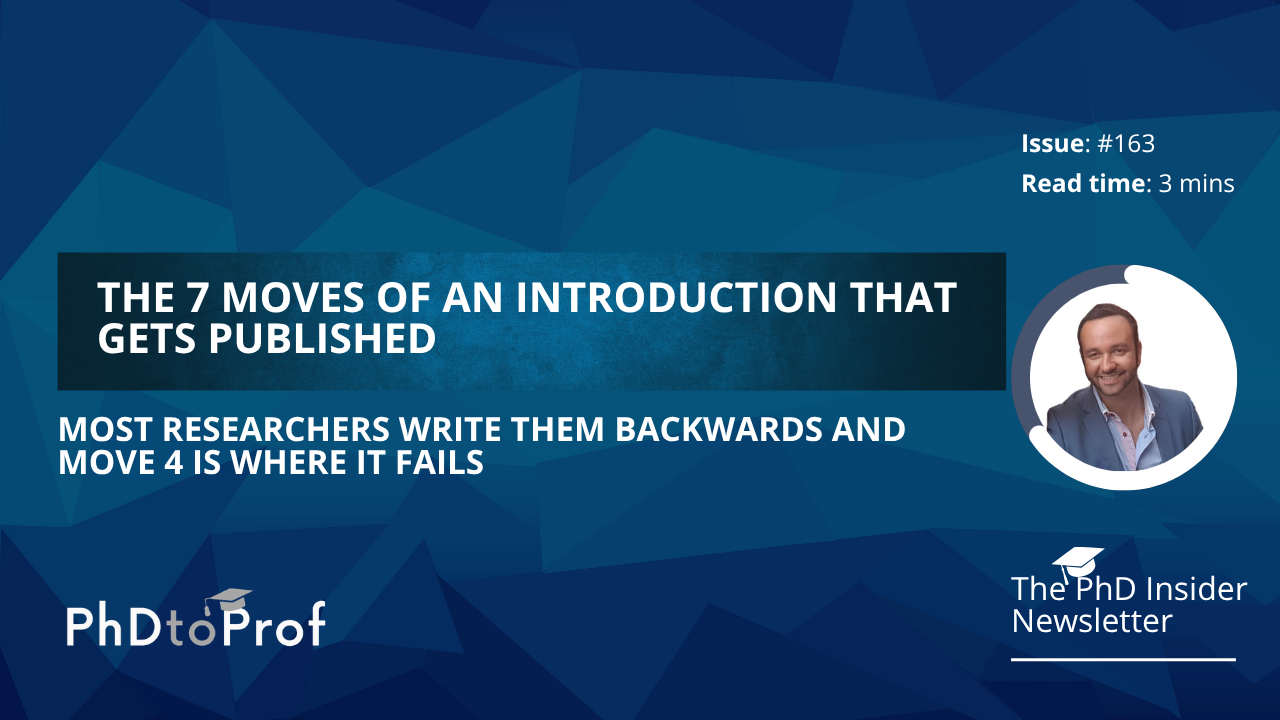
#163 - The 7 moves of an introduction that gets published

Aug 26, 2026
Connect

Today I am going to take you through the seven moves an introduction makes, and the one that gets people rejected.

26 August 2026

Read time: 3 minutes


Free LinkedIn Live: Methodology Made Simple - 27th August

Before we start, one thing.

Nobody teaches you methodology. Then they fail you for getting it wrong.

So on Thursday 27 August I am running a free LinkedIn Live: Methodology Made Simple. Thirty five minutes on choosing a method, justifying it, and the alignment we look for as examiners. Then your questions, live.

27 August, 17:00 BST. Set a reminder here: https://www.linkedin.com/events/7494712916366180352

Bring the question you are stuck on.


A quick word from this week's sponsor.

Writing an introduction means saying exactly what has not been done, in language precise enough that a reviewer cannot argue with it. That is hard in your first language and harder in your second.

Paperpal is an academic editing tool for that job. It checks language, tone and structure against how academic writing actually reads, rather than how general writing tools think it should.

It will not find your research gap for you. Nothing will. But it will stop the sentence carrying that gap from being the reason a reviewer stops trusting you.

Have a look here.


For years I wrote introductions for myself.

I opened with what I had done, and then I spent the rest of the page explaining why it mattered. It felt logical at the time, and it was completely backwards.

Now I sit on the other side of it, reading introductions as a reviewer and as an examiner.

I can usually tell by the end of the first paragraph whether the work is going to get through.

It is rarely the research that fails, but I find it is the first page failing to make anyone care.
Subscribe to keep reading this post

Subscribe

Already have an account? Log in

Loading...
#162 - 15 Rules of the PhD Viva
Today, I am going to tell you what I wish every candidate knew before they sat down across from me, because most of what you have been told about viva preparation is either vague or wrong. 19 August 2026 Read time: 3 minutes   The viva is not a test of whether you got everything right. It is a test of whether you can defend what you chose. That is a completely different thing, and u...
#161 - 9 Habits of PhD Candidates Who Finish on Time
Today, I am going to tell you what actually separates the candidates who finish from the ones who do not, because after twenty years of supervising and examining, I am certain it is not what you think. 12 August 2026 Read time: 3 minutes   I have supervised more than twenty-five doctoral researchers to the finish line and examined over forty-five theses on top of that. I have been w...
#160 - How to Write a Doctoral Proposal That Gets Accepted
Today, I am going to walk you through what I actually want to see in a doctoral proposal, because most of the ones that land on my desk get the balance completely wrong. 5 August 2026 Read time: 3 minutes   I have turned down 40-page proposals and accepted 10-page ones. The difference is never the length. It is usually whether I can see a clear mind behind the document. A proposal i...

The Research Insider

One insider strategy per week to complete your PhD or DBA on time, use AI responsibly, and navigate the academic system with confidence. 230,000+ researchers follow my work on LinkedIn. 10,000+ subscribe to this newsletter. Here's why. Whether you're a full-time researcher or a working professional doing a doctorate alongside your career, the system wasn't built for you. Universities teach methodology. They don't teach you how to actually finish. Every Wednesday, I share one technique from the examiner's side of the table. The things I've learned from examining 45+ PhD theses, supervising 30+ researchers to completion, and mentoring working professionals through doctorates they were told they couldn't do while working. All in under 3 minutes. AI is changing research fast. I've tested 12+ tools with doctoral students and I train universities on responsible AI use. I'll show you what works, what makes things up, and how to use these tools without putting your integrity at risk. My followers call me their virtual mentor. This newsletter is where that mentoring goes deeper. No fluff. No jargon. Just the strategies I use with my own mentees, in your inbox every Wednesday.
© 2026 PHDTOPROF. ALL RIGHTS RESERVED.

Join The FREE Challenge

Enter your details below to join the challenge.