#159 - What Your PhD Examiner Is Actually Checking

Today, I am going to tell you what I am actually looking for when I open your thesis, because it is not what most candidates think.
29 July 2026
Read time: 3 minutes
I have examined over forty-five doctoral theses.
And I can tell you that the ones that pass smoothly are never the most impressive.
They are those that are easy to defend.
That is a distinction worth reflecting on, as most candidates spend their final months trying to make their thesis smarter, more sophisticated, more polished.
That is not what gets you through.
What gets you through is making it easy for me to say yes.
Your supervisor helps you build the thesis.
I decide whether it passes.
We are doing different jobs, and I am looking for different things.
#165 - How to Turn Professional Writing into Doctoral Writing: The 3-Layer Paragraph
#164 - How to Write a Chapter That Passes Your Viva and Becomes a Journal Paper
#163 - The 7 moves of an introduction that gets published
The Research Insider
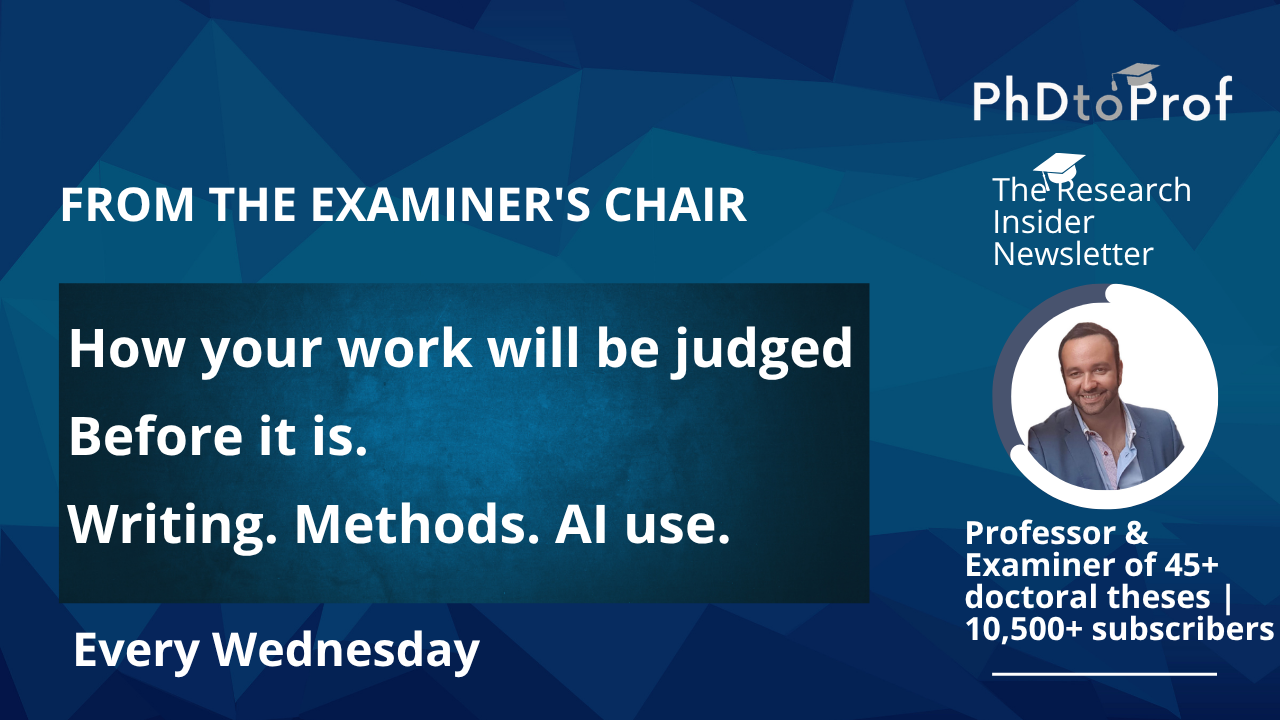
What an examiner actually saw this week. A short letter from the other side of the viva table. I was a lost PhD student once, in my office at 2am, surrounded by papers nobody had taught me how to read. I got through it. Then I sat on the examiner's side of the table more than forty-five times, and learned the thing nobody had told me. Whether you pass comfortably rarely comes down to how good your research is. It comes down to whether your thesis shows the examiner what they're looking for, and most capable people were never shown that. That's all this letter does. Three weeks out of four it's short, about four hundred words. One real thing I read, details changed: a sentence that doesn't say what it thinks it says, a method that won't survive the first question, a passage where the writer's own voice has quietly disappeared. What I saw when I read it cold, the fix, and a test you can run on your own work tonight. That last one is newer, and it's where most of the worry is now. The question I get asked is whether a detection tool will flag them. The question that decides anything is whether an examiner will believe the thinking is theirs, and those aren't the same question. I train universities on this, and I've sat on the faculty side when a tool flagged an honest candidate, so I know how that conversation goes and what evidence actually helps. The fourth week is longer. Once a month I read every page people send me for Pass or Revise, my live session where three of them get read out loud. Then I write up what I found across the whole pile, including what it made me change in the way I teach. Free, and one ask a month at most. 45+ doctoral theses examined across 15+ universities. 25+ PhDs supervised to completion. 35+ working professionals mentored through a doctorate alongside a career. 240,000 researchers follow my work on LinkedIn. Free, and one ask a month at most.
Join The FREE Challenge
Enter your details below to join the challenge.