
Today I am sharing exactly where that line sits, based on real cases I have examined and the three uses that will always result in a fail.
8 April 2026
Read time: 4 minutes
Supporting our sponsors directly helps me continue delivering valuable content for FREE to you each week. Your clicks make a difference! Thank you. Emmanuel
I built something for doctoral candidates at proposal stage
If you are currently writing or revising your doctoral proposal, I built a free self assessment tool you might find useful. The Doctoral Proposal Readiness Scorecard scores your proposal against the 10 criteria I use when examining a thesis.Takes 12 minutes. You get a personalised readiness guide based on your score.
It works for DBA, EDBA, PhD, EdD, and DrPH candidates.
👉 Take the scorecard here.
Almost every researcher and PhD student I work with now uses AI in some form. Most of them have no idea where the line is.
Their universities have not told them clearly.
Their supervisors are unsure themselves.
And by the time it reaches me as the examiner, it is too late to fix.
Today I am sharing exactly where that line sits, based on real cases I have examined and the three uses that will always result in a fail.
I am also giving you a simple framework to check every AI use in your thesis before you submit.
If you are using AI in your research and you cannot answer "why" and "how" for every single use, you are at risk.
Why This Matters Now
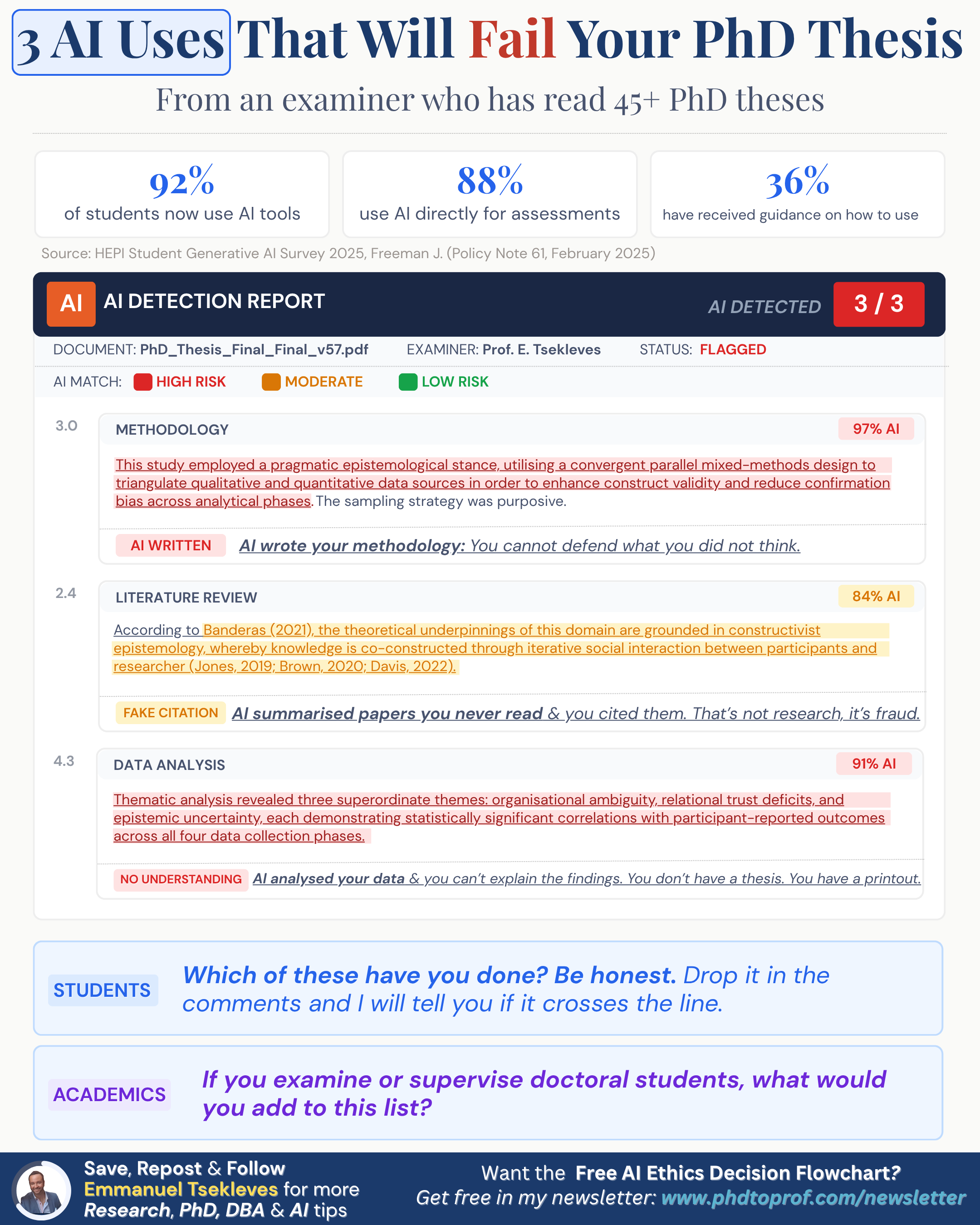
Recent data shows that 92% of doctoral students now use generative AI in some part of their work.
But only around a third feel confident they are using it within acceptable boundaries.
That gap between usage and understanding is where careers get damaged.
I have seen this play out in real examinations.
A candidate submits strong research with clear findings, but somewhere in the thesis the writing shifts.
- The tone changes.
- The vocabulary jumps.
- The level of detail suddenly becomes inconsistent.
When that happens, I start asking questions, and those questions can reshape an entire viva.
The Three AI Uses I Will Always Fail
1. AI wrote your methodology and you cannot defend it.
I examined a thesis last year where the methodology chapter read beautifully.
Every choice was justified. Every alternative was ruled out.
But in the viva, the candidate could not explain why they chose interpretivism over pragmatism.
They could not tell me what grounded theory actually means for their study.
The chapter was polished, but the understanding behind it was empty.
If you cannot walk me through your methodology without notes, in your own words, something is wrong.
2. AI summarised papers you never actually read.
This is becoming more common and it is the one that worries me most.
A candidate cites forty sources in their literature review.
In the viva I pick three at random and ask what the authors actually argued. If you cannot tell me, I know you never read them.
Using AI to generate summaries of papers and then citing those papers as if you engaged with them is not a shortcut.
It is academic dishonesty, and examiners are getting better at spotting it every month.
3. AI analysed your data and you cannot explain the findings.
Your findings chapter says the analysis revealed four themes.
I ask how you moved from raw data to those four themes.
If you cannot walk me through your coding process, explain why you grouped certain codes together, or tell me about the ones you discarded, then the analysis is not yours.
Having a tool generate your findings means you do not have a thesis. You have a printout.
Where AI Is Perfectly Fine
Not all AI use is a problem. In fact, some uses are genuinely helpful and no examiner would question them.
- Using AI to search for relevant literature and identify papers you might have missed is a smart research strategy, as long as you then read those papers yourself.
- Using AI to check your grammar, refine your academic writing style, or catch inconsistencies in your formatting saves time without touching your intellectual contribution.
- Using AI to help you brainstorm ideas, test the logic of your arguments, or prepare for your viva by generating practice questions is exactly the kind of tool use that shows good research judgment.
The line is simple: if AI helped you think better, that is a tool. If AI did the thinking for you, that is a problem.
The Test I Give Every Student
Before you submit, go through every chapter and ask yourself three questions about any AI-assisted section.
- Can I explain this in my own words without looking at the text?
- Did I make every intellectual decision myself, with AI only helping me express or organise those decisions?
- Could I defend this section in a viva without hesitation?
If the answer to any of those is no, that section needs to be rewritten by you, in your own voice, with your own thinking.
A Note on Tense, Tone, and Consistency
One thing AI-assisted writing almost always gets wrong is tense consistency, and this is often what first alerts an examiner that something is off.
- Your methodology should be in simple past because you already did it.
- Your findings should be in simple past because the data collection is finished.
- Your discussion moves between present and past because you are interpreting what you found.
- Your conclusion should be in present because you are making a claim about knowledge that now exists.
When AI writes sections for you, it tends to mix these up in ways that a researcher who actually did the work would never do.
Those inconsistencies are not just grammar problems.
They tell the examiner that the writer did not fully understand the difference between what is established, what was done, and what was found.
.
Key Takeaways
- AI as a thinking tool is fine. AI as a replacement for your thinking will get you failed.
- The three uses that always cross the line are AI-written methodology you cannot defend, AI-summarised papers you never read, and AI-generated analysis you cannot explain.
- Before you submit, test every AI-assisted section with three questions: can I explain it, did I make the decisions, and can I defend it in a viva?
→ Your Action Plan for This Week
- Open your thesis and highlight every section where you used AI in any form.
- For each one, answer the three test questions honestly.
- Rewrite any section where you cannot confidently say the thinking is yours.
- Check your tense consistency across all chapters. If it shifts without reason, that is the section an examiner will question first.
Your research is yours. Make sure your thesis proves it.
If you are at proposal stage, I built a free 10-criterion self-assessment based on my experience examining 45+ theses. Takes 12 minutes. You get personalised feedback: phdtoprof.com/scorecard
Need personalised support? Ask about our Premium 1:1 PhD Mentorship Programme and PhD Thesis Review Service.
⭐ BONUS RESOURCE ⭐
Bonus 1: AI Ethics Decision Flowchart
I have created a one-page decision tree that covers every common AI use case in doctoral research: literature searching, grammar checking, paraphrasing, data analysis, and writing drafts. It walks you through simple yes/no questions and sorts each use into Green, Amber, or Red zones so you know exactly where you stand before you submit.
📥 Download the AI Ethics Decision Flowchart here: Flowchart
Bonus 2: Academic Tense Guide (High-Resolution Printable)
I have also expanded my section-by-section tense guide into a high-resolution printable PDF with before-and-after examples for every thesis chapter. Pin it next to your desk and check it every time you write.
📥 Download the Tense Guide here: Guide
These are the kind of resources that will be part of our upcoming premium newsletter for subscribers who want deeper tools and practical guides.
For now, they are yours at no cost.
Well, that’s it for today.
Until next week,
Prof. Emmanuel Tsekleves
Whenever you're ready, there are 3 ways I can help you:
1. Get free actionable tips on how to complete your PhD on time and use AI responsibly in research by following me on X, LinkedIn, Instagram
2. Join my Premium 1:1 PhD/DBA Mentorship Program. I provide exclusive, results-driven support for professionals who need fast-track guidance on proposals and thesis completion. Visit my website to learn more about this premium consultancy and book a discovery call.
3. Submit your thesis with confidence through my PhD/DBA Thesis Review Service. As an external examiner for 40+ PhDs, I review your work the way examiners do and give you two rounds of detailed feedback. Fill out the discovery form on my website to get started.
Responses