
Today I am taking you inside my process. I am going to walk you through exactly what I look for, what I write in my notes, and the moments where I decide if a thesis is heading for minor corrections or major ones.
1 April 2026
Read time: 4 minutes
Supporting our sponsors directly helps me continue delivering valuable content for FREE to you each week. Your clicks make a difference! Thank you. Emmanuel
How to Use AI Without Risking Your Research Integrity
4,300 researchers asked the same question: am I using AI in a way that could get me in trouble?
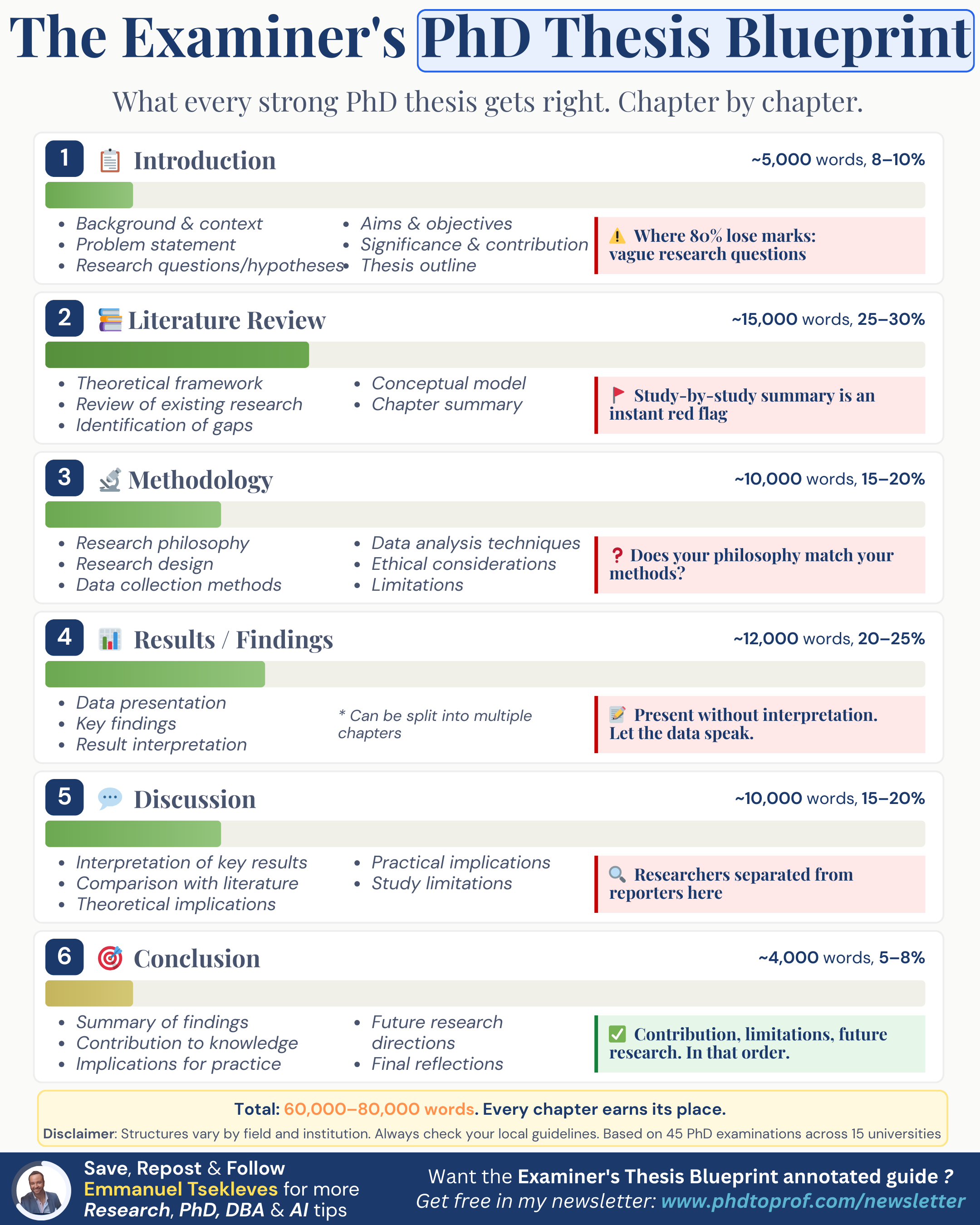
Last week I shared the structural blueprint I use when examining a thesis. Many of you saved it. But the most common question I received was this.
"What are you actually thinking when you read each chapter?"
Fair question. The blueprint shows you the structure. But it does not show you what is going on inside the examiner's head.
Today I am taking you inside my process.
I am going to walk you through exactly what I look for, what I write in my notes, and the moments where I decide if a thesis is heading for minor corrections or major ones.
This is 45 examinations of pattern recognition in one newsletter.
I Do Not Read Your Thesis Front to Back
Most students assume I start at page one and read to the end. I do not.
- I read your abstract first.
- Then I skip to your research questions.
- Then I jump to your methodology.
- Then I check whether your findings actually answer those questions.
- Only then do I go back and read everything in order.
By the time I start chapter one properly, I already have a view. Your job is to make sure that first view is a good one.
What I Write in My Notes for Each Chapter
Chapter 1: Introduction
The first thing I look for is your research question.
I need to find it fast. If I am three pages in and still reading background, I write "lacks focus" in my notes. That is hard to recover from.
I once examined a thesis where the introduction was 12,000 words. It read like a second literature review.
The student had buried three sharp research questions on page 19. I nearly missed them.
Do not make your examiner search for the most important sentence in your thesis.
Your introduction should take me from the broad context to your exact question in under 5,000 words.
Background, problem, questions, aims, significance, thesis outline. In that order. No detours.
Chapter 2: Literature Review
I can tell within two pages whether this is a synthesis or a summary.
If I see "Han (2019) found X. Fernandes (2020) found Y" repeating paragraph after paragraph, I already know the student has read widely but has not thought deeply.
What I want to see is themes, not authors.
I want to see you group the literature by ideas, show where researchers agree, where they disagree, and where nobody has looked yet.
That gap at the end should point directly at your research questions like an arrow.
The strongest literature reviews I have examined all had one thing in common. I could remove the author names and still follow the argument. That is synthesis.
Chapter 3: Methodology
This is where I spend the longest. I read this chapter with one question in my head: can this student defend every choice they made?
I look for the chain. Philosophy to approach to methodology to methods. If the chain holds, I move on. If it breaks, I start writing questions for the viva.
The weakest answer I hear in vivas is "my supervisor suggested it."
That tells me the student followed instructions. It does not tell me they understood why.
The strongest answer is "I chose this because my research question asks about lived experience, which requires an interpretivist lens, which led me to phenomenology." That is a chain I cannot break.
Chapter 4: Findings
I look for one thing here. Evidence. Every claim must have data behind it. A quote, a statistic, a table.
The moment I see a claim with no evidence, I highlight it. If it happens once, I note it. If it happens throughout the chapter, I write "assertions unsupported by data" and that becomes a major correction.
I also watch for interpretation creeping in.
Your findings chapter should present what you found. Save what it means for the discussion. When students mix the two, it muddies both chapters.
Chapter 5: Discussion
This is the chapter where I decide what kind of researcher you are.
A weak discussion repeats the findings. "The data showed that participants felt X." I already read that. Tell me what it means.
A strong discussion takes each key finding and holds it up against the literature.
- Where does it agree?
- Where does it challenge what we thought we knew?
- What does it add?
The best discussions I have read made me rethink something I believed. That is the level you should aim for.
I examined a thesis last year where the student found results that directly contradicted a well-known framework.
Instead of ignoring it, she gave it three pages of careful analysis explaining why the framework did not hold in her context. That section alone secured her minor corrections.
Chapter 6: Conclusion
Contribution first. Always.
What did this thesis add to knowledge that did not exist before?
If I cannot find that statement in your first paragraph, something is wrong.
Then limitations. Be honest but do not undermine your own work. Then future research. Then a final reflection.
I have seen students write two-page conclusions for 80,000-word theses. That tells me they ran out of energy.
Your conclusion is the last thing the examiner reads before writing their report. Make it count.
Three Things I Wish Every Student Knew Before Submitting
1. Print your thesis and read it on paper before you submit
Screens hide problems. Every time I examine a thesis, I print it. I read it with a pen.
You should do the same before I do. You will catch errors, repetition, and structural gaps that you missed on screen.
If a paragraph does not make sense when you read it out loud with a pen in your hand, it will not make sense to your examiner either.
2. Your thesis must tell one story from start to finish
I should be able to read your research questions in chapter one and trace a straight line through every chapter to your conclusion.
If your literature review covers topics that never appear again, cut them.
If your discussion introduces ideas that were not in your findings, remove them.
Every chapter earns its place or it does not belong.
3. Give your examiner signposts
At the end of every chapter, tell me what is coming next and why.
At the start of every chapter, remind me where we are in the argument.
These short linking paragraphs take five minutes to write.
But they are the difference between a thesis that reads like a connected argument and one that reads like six separate essays stapled together.
Key Takeaways
- Examiners do not read front to back. They jump to your research questions, methodology, and findings first. Make sure those sections stand on their own.
- Every chapter is judged on one thing. Introduction: clarity. Literature review: synthesis. Methodology: justification. Findings: evidence. Discussion: interpretation. Conclusion: contribution.
- The discussion chapter is where examiners form their strongest opinion of you as a researcher. Invest your best thinking there.
→ Your Action Plan for This Week
- Read your introduction and time how long it takes to find your research question. If it takes more than two minutes, rewrite the opening.
- Open your findings chapter and check every claim. If any claim has no evidence underneath it, fix it now.
- Read your discussion out loud. Every sentence that repeats a finding instead of interpreting it needs to be rewritten.
Write your thesis like the examiner is already reading it. Because the structure you choose tells them everything before the viva begins.
If you are at proposal stage, I built a free 10-criterion self-assessment based on my experience examining 45+ theses. Takes 12 minutes. You get personalised feedback: phdtoprof.com/scorecard
Need personalised support? Ask about our Premium 1:1 PhD Mentorship Programme and PhD Thesis Review Service.
⭐ BONUS RESOURCE ⭐
Bonus 1: The Examiner's Thesis Blueprint Annotated Guide
I have expanded the blueprint into a fully annotated guide with worked examples for every chapter. It shows exactly what examiners look for, what they flag, and what a strong version looks like next to a weak one.
📥 Download the annotated guide here: Download Link
Bonus 2: Academic Writing Phrase Bank
I have also put together a phrase bank of ready-to-use academic writing phrases organised by chapter and purpose for your PhD, DBA or next research paper. It covers introductions, literature reviews, methodology justifications, findings presentation, discussion interpretation, and conclusions.
📥 Download the phrase bank here: Download Link
These are the kind of resources that will be part of our upcoming premium newsletter for subscribers who want deeper tools and writing guides.
For now, they are yours at no cost.
Well, that’s it for today.
Until next week,
Prof. Emmanuel Tsekleves
Whenever you're ready, there are 3 ways I can help you:
1. Get free actionable tips on how to complete your PhD on time and use AI responsibly in research by following me on X, LinkedIn, Instagram
2. Join my Premium 1:1 PhD/DBA Mentorship Program. I provide exclusive, results-driven support for professionals who need fast-track guidance on proposals and thesis completion. Visit my website to learn more about this premium consultancy and book a discovery call.
3. Submit your thesis with confidence through my PhD/DBA Thesis Review Service. As an external examiner for 40+ PhDs, I review your work the way examiners do and give you two rounds of detailed feedback. Fill out the discovery form on my website to get started.
Responses