
Today I am sharing the exact process I walk my students through to build that chain, with two full worked examples you can follow.
25 March 2026
Read time: 4 minutes
Supporting our sponsors directly helps me continue delivering valuable content for FREE to you each week. Your clicks make a difference! Thank you. Emmanuel
How to Find the Papers Your Literature Review Is Missing
Your examiner searches your topic with terms you never thought of.
"Patient experience" vs "service user satisfaction." Same concept. Different words. Invisible to keyword search.
Patsnap Eureka matches meaning across 210M+ papers, not keywords.
Find what your examiner will find. Before they do.
👉 Try Patsnap Eureka free: here
Last week I shared my research methodology framework.
Four layers. Philosophy, approach, methodology, methods.
Hundreds of you saved it. But the most common reply I received was the same question.
"I understand the layers. But how do I actually connect them for my study?"
That is the part nobody teaches. Knowing the layers exist is step one.
Building a chain of reasoning that links them together is what gets you through your viva.
Today I am sharing the exact process I walk my students through to build that chain, with two full worked examples you can follow.
If your examiner cannot break the chain, they cannot fail your methodology.
The 4 Layers at a Glance
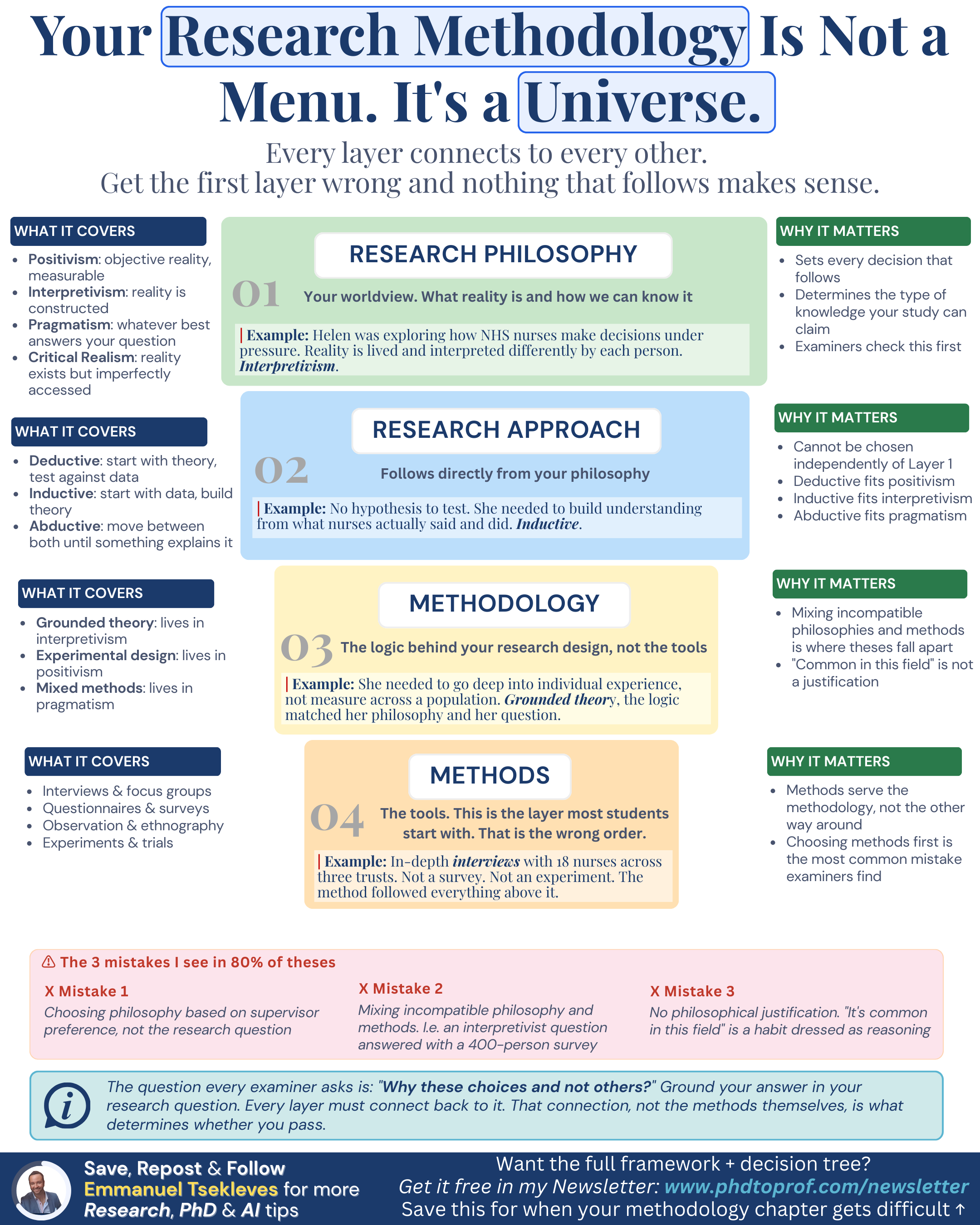
Here is a quick overview before we go deeper.
Layer 1: Research Philosophy. Your worldview. What you believe reality is and how we can know it.
- Positivism sees reality as objective and measurable.
- Interpretivism sees reality as constructed by people.
- Pragmatism says use whatever best answers your question.
- Critical realism says reality exists but we access it imperfectly.
This layer sets everything else in motion.
Layer 2: Research Approach. How you move between theory and data.
- Deductive means you start with theory and test it.
- Inductive means you start with data and build theory.
- Abductive means you move between both.
Your philosophy determines which approach fits.
Layer 3: Methodology. The logic behind your research design, not the tools.
Grounded theory, case study, phenomenology, experimental design.
Each one lives inside a particular philosophy.
Mix them carelessly and your thesis falls apart.
Layer 4: Methods. The tools you use to collect data. Interviews, surveys, observation, experiments.
This is where most students start.
That is the wrong order.
Methods must serve the methodology, not the other way around.
Those are the building blocks. Now let me show you how to connect them.
What Examiners Are Really Looking For
When I examine a thesis, I do not read the methodology chapter from top to bottom. I read it backwards.
I start with the methods. Then I ask:
Does the methodology justify these methods?
Then I check whether the approach supports that methodology.
Then I look at whether the philosophy holds everything together.
If any link in that chain is missing or forced, I write the same comment every time: "The candidate has not justified their methodological choices."
That one sentence has sunk more vivas than poor data ever has.
The Chain of Reasoning Test
Before you write your methodology chapter, you need to pass a simple test.
Take your research question and build one sentence that links all four layers.
If you cannot do it, your chain is broken.
Here is the formula.
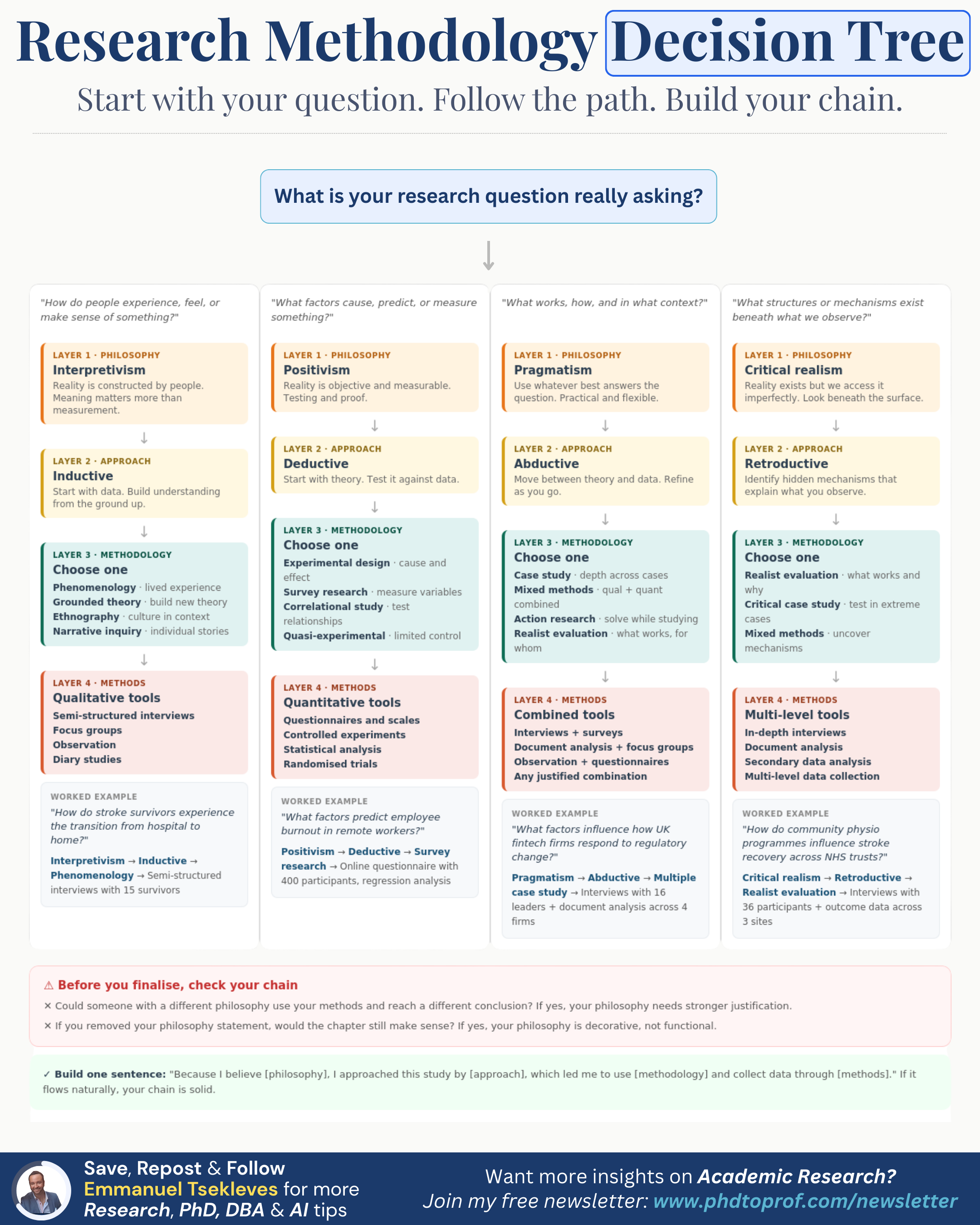
"Because I believe [philosophy], I approached this study by [approach], which led me to use [methodology] and collect data through [methods]."
If that sentence sounds forced or contradictory, something does not fit.
Let me show you what a strong chain looks like.
Worked Example 1: A PhD in Health Sciences
Research question: How do stroke survivors experience the transition from hospital to home-based rehabilitation?
The word "experience" tells you this study cares about individual meaning, not measurable outcomes. That points to interpretivism.
Interpretivism calls for an inductive approach. You are not testing a theory. You are building understanding from what people tell you.
The methodology that fits is phenomenology, because the goal is to understand lived experience from the inside.
The methods follow naturally. Semi-structured interviews with 15 stroke survivors, analysed using interpretive phenomenological analysis.
Every layer connects. Nothing is forced. An examiner reading backwards would find no gaps.
Worked Example 2: A DBA in Financial Services
Research question: What factors influence how UK fintech firms respond to new regulatory frameworks?
This question is looking for factors and patterns across multiple organisations. It is not asking how individuals feel. That points to pragmatism, because you need both breadth and depth to answer it properly.
Pragmatism supports an abductive approach. You move between existing theory and your data, refining your understanding as you go.
The methodology that fits is a multiple case study design. You study four firms, compare their responses, and look for patterns.
The methods combine semi-structured interviews with senior leaders and document analysis of regulatory filings. The mix is justified because pragmatism allows you to use whatever tools best answer the question.
Again, every layer connects. The examiner reads backwards and finds a solid chain.
The Two Questions That Expose a Broken Chain
After you build your chain, stress-test it with these two questions.
Question 1: Could someone with a different philosophy use the same methods and reach a different conclusion?
If yes, you need to explain why your philosophy is the right lens for your question. This is where most students go silent in the viva.
Question 2: If you removed your philosophy statement, would the rest of your chapter still make sense on its own?
If yes, your philosophy is decorative, not functional. It needs to actively shape every choice below it.
The Paragraph Your Methodology Chapter Must Have
Every strong methodology chapter contains one paragraph that most weak ones are missing. It sits right after you state your philosophy and before you describe your approach.
It says: given this philosophy, certain approaches are possible and others are not. Then it names which ones are ruled out and why.
This paragraph is the glue. It shows the examiner that you did not just pick a philosophy and move on. You used it to make decisions. T
hat is the difference between a methodology chapter that reads like a shopping list and one that reads like an argument.
Key Takeaways:
- Your methodology must work as a chain: philosophy to approach to methodology to methods. Every link must hold.
- Test your chain by building one sentence that connects all four layers to your research question.
- The paragraph that rules out alternatives is the most important paragraph in your methodology chapter. Most students leave it
→ Your Action Plan for This Week
- Write your research question at the top of a blank page.
- Build your chain using the formula above.
- Write the "ruling out" paragraph that explains which approaches your philosophy eliminates and why.
- Read your chain backwards. If any link feels forced, that is where your examiner will push.
Build the chain now. Do not wait for the viva to find out it is broken.
Need personalised support? Ask about our Premium 1:1 PhD Mentorship Programme and PhD Thesis Review Service.
⭐ BONUS RESOURCE ⭐
I have turned the full 4-layer framework into a downloadable PDF with a decision tree and worked examples for each philosophy.
Print it out and pin it above your desk. It will save you when your methodology chapter gets difficult.
📥 Download the full framework and decision tree here: Framework & Decision Tree
This is the kind of resource that will be part of our upcoming premium newsletter for subscribers who want deeper tools and visual guides.
For now, it is yours at no cost.
Well, that’s it for today.
Until next week,
Prof. Emmanuel Tsekleves
Whenever you're ready, there are 3 ways I can help you:
1. Get free actionable tips on how to complete your PhD on time and use AI responsibly in research by following me on X, LinkedIn, Instagram
2. Join my Premium 1:1 PhD/DBA Mentorship Program. I provide exclusive, results-driven support for professionals who need fast-track guidance on proposals and thesis completion. Visit my website to learn more about this premium consultancy and book a discovery call.
3. Submit your thesis with confidence through my PhD/DBA Thesis Review Service. As an external examiner for 40+ PhDs, I review your work the way examiners do and give you two rounds of detailed feedback. Fill out the discovery form on my website to get started.


Responses