Today I am sharing the honest comparison I wish someone had given me, covering PhD, DBA, EdD, and Health Doctorates, plus the three questions I ask every working professional before they commit.
18 March 2026
Read time: 3 minutes
Supporting our sponsors directly helps me continue delivering valuable content for FREE to you each week. Your clicks make a difference! Thank you. Emmanuel
Stop Rebuilding Slides From Scratch
For years I lost hours turning research notes into presentations. Copy. Paste. Rebuild. Realise thinking evolved. Start again.
Then a PhD student showed me Gamma.
Plan in Claude. Generate in Gamma. Refine together.
👉 Try Gamma free: here
Free Webinar: AI in Academic Writing - Where's the Line?
I'm co-hosting a webinar with Paperpal to cover AI disclosure, plagiarism risks, and how to use AI without losing your voice.
The real question isn't whether to use AI. It's how to use it without risking plagiarism, rejection, or misconduct.
📅 March 19 | 6:00 PM GMT
👉 Register (limited places): here
After mentoring working professionals through doctorates for over a decade, I can tell you something uncomfortable.
Most people choose the wrong one.
Universities will not explain the difference clearly. Why would they? Every programme charges the same fees.
Whether you finish or not.
Today I am sharing the honest comparison I wish someone had given me, covering PhD, DBA, EdD, and Health Doctorates, plus the three questions I ask every working professional before they commit.
This decision will cost you 3 to 7 years of your life. You deserve to make it with your eyes open.
The Four Doctorates Most Working Professionals Choose
1. PhD (Doctor of Philosophy)
Aim: To create new knowledge through original research that advances theory in your field.
Duration: 3 to 4 years full-time, or 5 to 7 years part-time.
Focus: You go deep into one question. You are not solving a workplace problem. You are pushing the boundaries of what is known in your discipline.
Best for: Professionals who want a career in academia, full-time research, or who want to become recognised experts in a specialist area.
Career outcomes: University lecturer or professor, postdoctoral researcher, research institute roles, or senior specialist positions where deep expertise is valued.
Good to know: The PhD is the most recognised doctoral qualification worldwide. This matters if you plan to work across countries or institutions. It is also the standard requirement for most permanent academic positions.
Example: A computer scientist studying how AI interfaces can improve digital access for older adults. The goal is a new theory, not a product.
2. DBA (Doctor of Business Administration) and EDBA (Executive DBA)
Aim: To solve a real business problem using rigorous research methods. Your work bridges the gap between theory and practice.
Duration: 3 to 5 years part-time alongside your career.
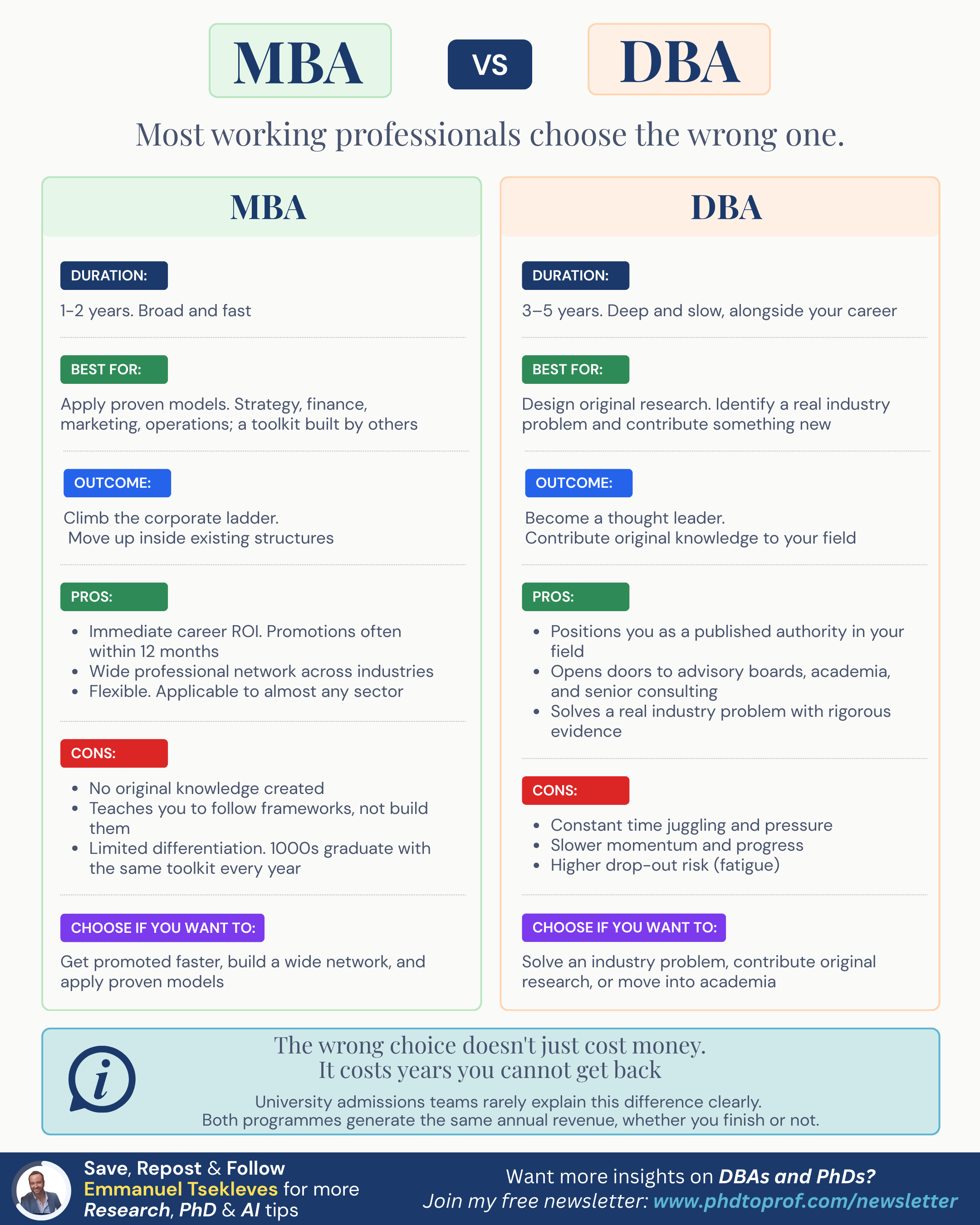
Focus: Unlike an MBA, which teaches you to apply other people's frameworks, a DBA teaches you to build your own. You identify a real challenge in your industry and design original research to address it.
Best for: Senior professionals, directors, and executives who want to become thought leaders, move into high-level consulting, or bring evidence-based thinking to their organisations.
DBA vs EDBA: The EDBA is designed specifically for C-suite and senior executives. It follows the same research rigour as a DBA but is structured around shorter, intensive residentials rather than weekly sessions. Cohorts are typically smaller and made up of peers at board level or equivalent. If you are already in a senior leadership role and cannot commit to regular weekly study, the EDBA format may suit your schedule better.
Career outcomes: Advisory board positions, keynote speaking, senior consulting, C-suite leadership with research credibility, or part-time academic roles such as visiting professor.
Good to know: Many DBA and EDBA graduates go on to publish in practitioner journals and shape industry standards. The output is a practical framework or model, not just a thesis that sits on a library shelf.
Example: An operations manager researching how fintech firms navigate changing regulations. The goal is a practical framework other businesses can use.
3. EdD (Doctor of Education)
Aim: To improve educational practice through applied research that solves real problems in learning environments.
Duration: 3 to 5 years part-time.
Focus: You tackle a real challenge in your school, university, or training organisation. Your research is rooted in practice, not pure theory. You stay in your role while you study.
Best for: Teachers, headteachers, curriculum leaders, university administrators, and training professionals who want to lead change based on evidence rather than opinion.
Career outcomes: Senior leadership in schools or universities, education policy roles, curriculum development, educational consultancy, or academic positions in education departments.
Good to know: The EdD carries the same academic weight as a PhD. The difference is not the level of rigour. It is the purpose. A PhD in education builds theory about learning. An EdD uses research to improve how learning happens in practice.
Example: A headteacher studying why a new curriculum approach works in some schools but fails in others. The goal is better practice, not just new theory.
4. Health Doctorates (DHSc, DPH, DNP)
Aim: To tackle real clinical or public health challenges using research. Your work sits at the intersection of evidence and patient care.
Duration: 3 to 5 years part-time.
Focus: These programmes are built for experienced health professionals who want to lead at the highest level. Many require you to be working in a clinical or policy role during your studies. Your research directly addresses a problem in healthcare delivery, patient outcomes, or public health systems.
Best for: Senior clinicians, public health professionals, nurse practitioners, and allied health professionals who want to move into leadership, policy, or clinical academic roles.
Career outcomes: Director-level NHS or health system roles, public health leadership, clinical academic positions, health policy advisory roles, or senior consulting in healthcare.
Good to know: Unlike a PhD in health sciences, which focuses on building theory, a health doctorate focuses on improving how care is delivered. Graduates often lead service redesign, develop clinical guidelines, or shape national health policy. If you want to change practice on the ground, this is your path.
Example: A senior physiotherapist researching how community rehabilitation programmes affect stroke recovery. The goal is to change how care is delivered.
The Three Questions I Ask Before You Sign Up
Before any professional I mentor commits to a doctorate, I ask them three things.
1. Do you want to create theory or apply it?
If you want to push the boundaries of knowledge, a PhD is your path.
If you want to solve a problem in your industry or profession, a DBA, EDBA, EdD, or health doctorate is likely a better fit.
2. Where do you want to be in five years?
If the answer is a university faculty position, you almost certainly need a PhD.
If the answer is senior leadership, consulting, or professional influence, a professional doctorate gives you the credential and the practical output.
3. Can you protect 10 to 15 hours a week for 3 to 5 years?
Every part-time doctorate demands this.
If your honest answer is no, you are not ready yet, and that is fine. Starting at the wrong time is just as costly as choosing the wrong programme.
Key Takeaways:
- The right doctorate depends on your career goal, not the title on the certificate.
- A PhD builds theory. A DBA, EDBA, EdD, or health doctorate solves real-world problems. Both require the same level of rigour.
- The three questions above will save you years of regret if you answer them honestly before you enrol.
→ Your Action Plan for This Week
- Write down where you want to be in five years.
- Answer all three questions above honestly.
- If you are still unsure, talk to someone who has completed the doctorate you are leaning toward. Ask them what they wish they had known.
The best time to make this decision is before you pay your first fee.
Need personalised support? Ask about our Premium 1:1 PhD Mentorship Programme and PhD Thesis Review Service.
⭐ BONUS RESOURCE ⭐
Whether you are early in your doctorate or approaching submission, the viva is the final hurdle that keeps most candidates up at night.
I have put together The VIVA Framework: 15 Questions Every PhD Examiner Asks and How to Answer Them.
It includes full model answers for all 15 questions, organised by examiner category. It reveals what the examiner is really testing behind each question, flags the number one question most candidates fail, and includes a viva day checklist and printable quick reference card.
This is not generic advice. It is built from 45+ real thesis examinations I have conducted as an external examiner.
📥 Download it free here: The VIVA Framework
This is the kind of resource that will be part of our upcoming premium newsletter for subscribers who want deeper tools and exam preparation guides.
For now, it is yours at no cost.
Well, that’s it for today.
Until next week,
Prof. Emmanuel Tsekleves
Whenever you're ready, there are 3 ways I can help you:
1. Get free actionable tips on how to complete your PhD on time and use AI responsibly in research by following me on X, LinkedIn, Instagram and BlueSky
2. Join my Premium 1:1 PhD/DBA Mentorship Program. I provide exclusive, results-driven support for professionals who need fast-track guidance on proposals and thesis completion. Visit my website to learn more about this premium consultancy and book a discovery call.
3. Submit your thesis with confidence through my PhD/DBA Thesis Review Service. As an external examiner for 40+ PhDs, I review your work the way examiners do and give you two rounds of detailed feedback. Fill out the discovery form on my website to get started.
Responses