Today I am sharing the exact 7-type framework I now teach every student I mentor.
11 March 2026
Read time: 3 minutes
Supporting our sponsors directly helps me continue delivering valuable content for FREE to you each week. Your clicks make a difference! Thank you. Emmanuel
Free Webinar: AI in Academic Writing - Where's the Line?
I'm co-hosting a webinar with Paperpal to cover AI disclosure, plagiarism risks, and how to use AI without losing your voice.
The real question isn't whether to use AI. It's how to use it without risking plagiarism, rejection, or misconduct.
📅 March 19 | 6:00 PM GMT
👉 Register (limited places): here
Most PhD supervisors will never tell you this.
The real reason PhD students struggle is not methodology. It is not data.
It is that they never clearly identified a research gap.
I had a student last year who spent 8 months reading. But when I asked her one question, she went silent.
"What is actually missing from this literature?"
She could tell me everything researchers had found. But she could not tell me what they had missed.
This is the most common problem I see. Today I am sharing the exact 7-type framework I now teach every student I mentor. It is the same framework that helped her go from stuck to having a clear, original research question in two weeks.
If you can name your gap, you can build your entire thesis around it.
Why Literature Reviews Fall Flat
Most students treat the literature review as a summary. They tell the reader what is known.
But examiners are not looking for a summary. They want to know what is not known. They want to see that you found a hole in the research and built your study to fill it.
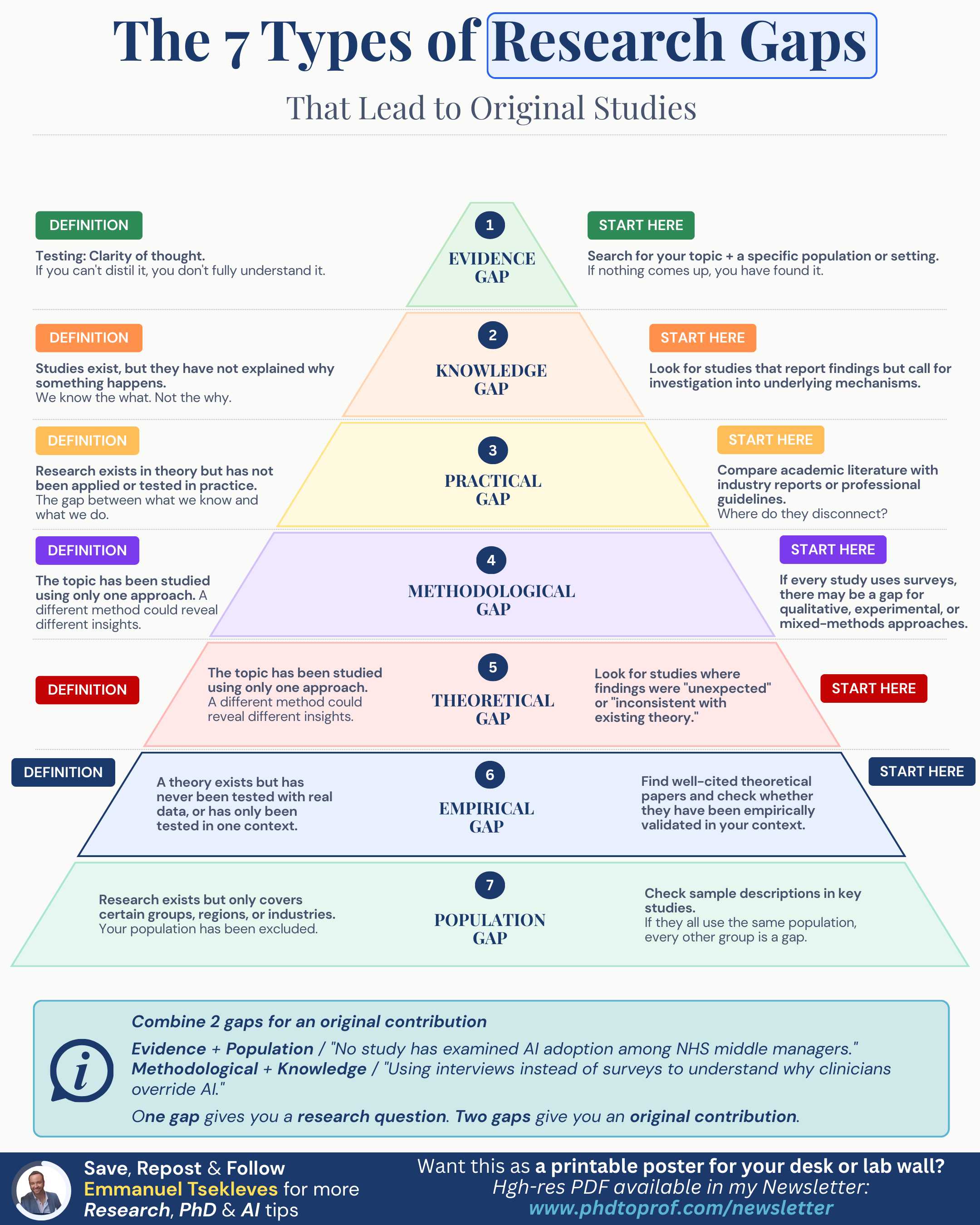
The problem is that nobody teaches you how to spot these holes. Every gap in the literature falls into one of seven types. Once you learn them, you will see them everywhere.
1. Evidence Gap
Nobody has studied this topic in this context at all. The research simply does not exist yet.
Example: Hundreds of studies look at burnout in nurses. But almost none look at burnout in NHS community midwives working in rural areas. That silence is your gap.
2. Knowledge Gap
Studies have reported what happens, but nobody has explained why it happens. The cause or mechanism is still unknown.
Example: We know that part-time PhD students drop out at higher rates than full-time students. But we do not fully understand what drives that difference. Is it time pressure, isolation, or something else?
3. Practical Gap
Researchers have built theories and models, but nobody has tested them in real-world settings. The gap sits between the textbook and the workplace.
Example: A leadership framework developed in American tech companies has never been applied to family-run businesses in South Asia. The theory exists. The real-world test does not.
4. Methodological Gap
The topic has only been studied using one type of method. A different approach could uncover something new.
Example: Every study on student satisfaction at your university uses surveys. Nobody has sat down and interviewed students face to face. That missing method is your gap.
5. Theoretical Gap
The results from recent studies do not fit any existing theory. The current frameworks cannot explain what researchers are finding.
Example: Studies on remote worker productivity during the pandemic produced results that contradicted traditional motivation theories. The old models stopped working. A new framework is needed.
6. Empirical Gap
A well-known theory has never been tested with real-world data, or it has only been tested in one setting.
Example: A widely cited model of digital adoption has only ever been tested with university students in the US. Nobody has tested it with older adults in developing countries. The theory is untested in your context.
7. Population Gap
Research exists, but it only covers certain groups. Entire populations have been left out.
Example: Most research on entrepreneurship focuses on male founders in Western economies. Female entrepreneurs in Sub-Saharan Africa are almost invisible in the literature. That missing group is your gap.
The Secret: Combine Two Gaps for an Original Contribution
One gap gives you a research question. Two gaps give you something examiners call an original contribution.
Population gap plus methodological gap: "Using interviews to explore the experience of female founders in Sub-Saharan Africa."
Evidence gap plus theoretical gap: "Building a new framework to explain a phenomenon nobody has studied yet."
The strongest PhD proposals I have seen always combine at least two gap types.
How to Spot Your Gap Today
Open the five most cited papers in your area. Go straight to the conclusion and limitations section.
Look for phrases like "further research is needed," "this study was limited to," or "remains unclear."
Each one of those phrases is pointing directly at a gap. Your job is to name which of the seven types it belongs to.
Key Takeaways:
- Every research gap falls into one of seven types. Name yours and your whole thesis gets direction.
- The strongest research questions combine two or more gap types. That is what makes your work original.
- Your gap is already hiding in the limitations sections of the papers you have read.
→ Your Action Plan for This Week
- Open your five most important papers and read the conclusion of each one.
- Write down every limitation the authors mention.
- Label each limitation with one of the 7 gap types.
- Try combining two gaps into one research question.
Need personalised support? Check my Premium 1:1 PhD Mentorship Programme and PhD Thesis Review Service.
⭐ BONUS RESOURCE ⭐
I have turned this 7-type framework into a visual poster you can print and pin above your desk.
It maps all seven gap types with definitions, starter questions, and examples of how to combine them.
📥 Download the high-resolution PDF poster here.
This is the kind of resource that will be part of our upcoming premium newsletter for subscribers who want deeper tools and visual guides. For now, it is yours at no cost.
For now, it is yours at no cost.
Well, that’s it for today.
Until next week,
Prof. Emmanuel Tsekleves
Whenever you're ready, there are 3 ways I can help you:
1. Get free actionable tips on how to complete your PhD on time and use AI responsibly in research by following me on X, LinkedIn, Instagram and BlueSky
2. Join my Premium 1:1 PhD/DBA Mentorship Program. I provide exclusive, results-driven support for professionals who need fast-track guidance on proposals and thesis completion. Visit my website to learn more about this premium consultancy and book a discovery call.
3. Submit your thesis with confidence through my PhD/DBA Thesis Review Service. As an external examiner for 40+ PhDs, I review your work the way examiners do and give you two rounds of detailed feedback. Fill out the discovery form on my website to get started.
Responses