
Today, I'm sharing the decision framework and step-by-step process that helped me successfully publish both types of reviews, opening doors to collaborations and establishing my credibility in my field.
19 November 2025
Read time: 3 minutes
Supporting our sponsors directly helps me continue delivering valuable content for FREE to you each week. Your clicks make a difference! Thank you. Emmanuel
Stop Wasting Months on Chaotic Literature Reviews
This is the mistake most PhD students make.
They read extensively but organize poorly. Highlight without extracting. Take notes without themes. Then spend another 6 months trying to make sense of it all.
The reading isn't the bottleneck. The organization is. Moara transforms chaotic reading into structured synthesis.
Whether you're conducting systematic reviews, writing thesis chapters, or preparing grant proposals, Moara's guided workflows help you:
✅ Screen papers systematically with AI-powered triage
✅ Extract evidence with thematic tagging while you read
✅ Build structured evidence tables automatically
✅ Generate professionally formatted narrative reviews
👉 Try for free: https://www.moara.io/
Literature reviews are essential for establishing your expertise and identifying research gaps...
...but most researchers don't realize there are two fundamentally different types with completely different purposes and methods.
Choosing the wrong type wastes months of work and often leads to rejection. What if you could know exactly which review type serves your goals and how to execute it properly?
Today, I'm sharing the decision framework and step-by-step process that helped me successfully publish both types of reviews, opening doors to collaborations and establishing my credibility in my field.

During my second PhD year, I spent four months writing what I thought was a comprehensive literature review, only to have it rejected from three journals.
The problem?
I'd created a hybrid that wasn't systematic enough to be a systematic review but was too structured to work as a narrative review.
Neither type of journal wanted it.
This painful experience forced me to understand the fundamental differences between these review types and when each serves specific purposes.
Once I learned to choose and execute the right type strategically, I published successful reviews of both kinds that significantly advanced my career.
Understanding the Two Types: Purpose and Use
The first step is knowing what each review type actually accomplishes.
Narrative reviews: These reviews tell a story about your topic, synthesizing existing knowledge to provide context, identify themes, and highlight gaps.
They're selective rather than comprehensive, focusing on the most important or illustrative studies.
Narrative reviews establish your expertise and help readers understand the current state of knowledge.
Systematic reviews: These reviews attempt to find and evaluate ALL existing research on a specific, narrow question using transparent, replicable methods.
They follow strict protocols for searching, selecting, and analyzing studies.
Systematic reviews are considered higher-level evidence and often inform clinical practice or policy decisions.
When to Choose Narrative Reviews
Narrative reviews work best in specific situations and career moments.
Choose narrative when:
- You want to establish expertise in a field.
- You're identifying gaps to justify your own research.
- You're synthesizing ideas across different subfields.
- You need flexibility to include diverse types of evidence.
- You're introducing a new research area in your dissertation or paper.
Career timing: Narrative reviews work well early in your career to demonstrate broad knowledge and as introductory sections for grant proposals or dissertations.
When to Choose Systematic Reviews
Systematic reviews require more time and rigor but carry more weight in certain contexts.
Choose systematic when:
- You need to answer a specific, focused question.
- You want to establish authority on a fairly narrow topic.
- You have 6-12 months to dedicate to the review process.
- You want your review published as a standalone paper in high-impact journals.
- You're in a field that values evidence synthesis like medicine, psychology, or education.
Career timing: Systematic reviews work well mid-career when you have enough expertise to evaluate studies critically and can dedicate substantial time to the rigorous process.
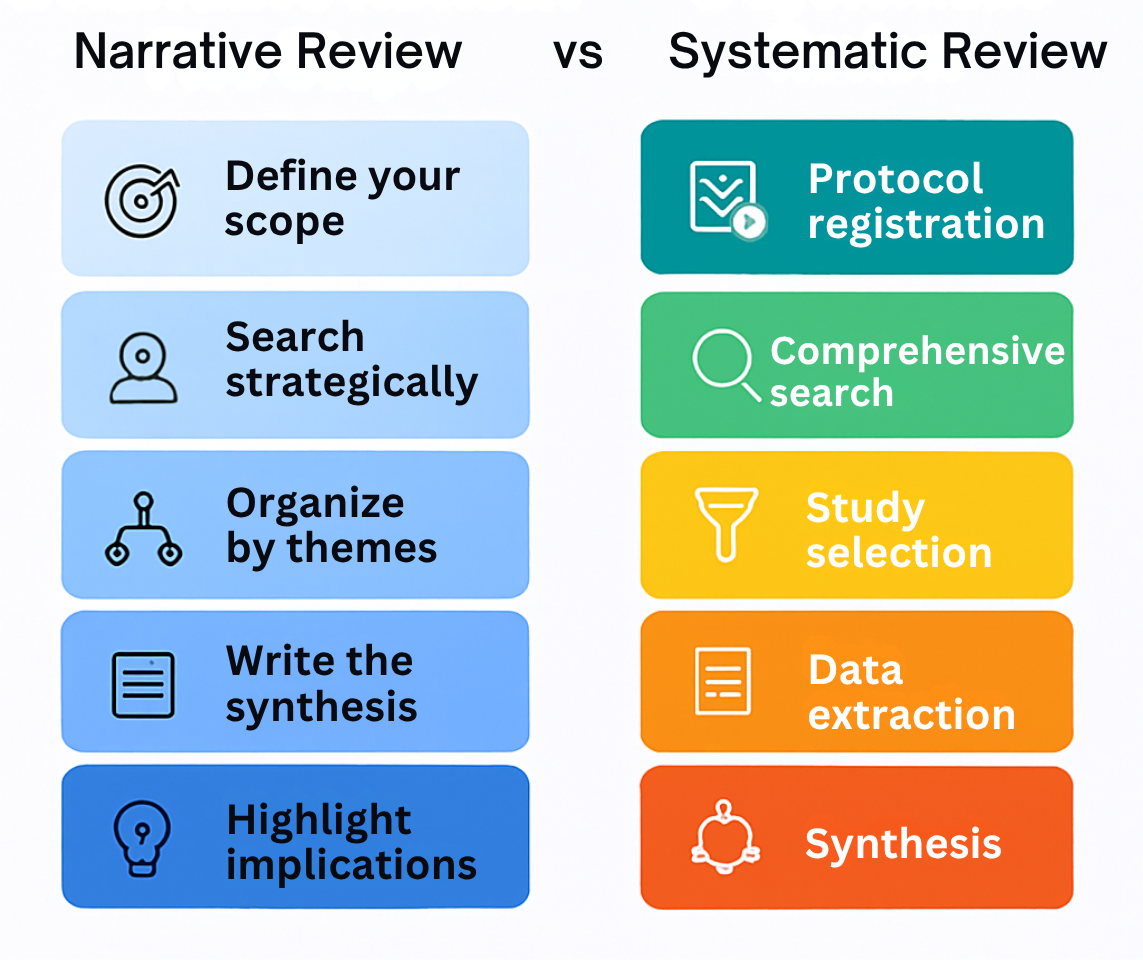
How to Create a Narrative Review: Five Steps
Narrative reviews follow a looser structure but still require systematic thinking.
Step 1 - Define your scope: Choose a focused topic and decide what themes or questions you'll address. Be selective about what you'll include and exclude.
Step 2 - Search strategically: Use databases and citations from key papers to find important studies. You don't need to find everything, just representative and influential work.
Step 3 - Organize by themes: Group studies into logical categories based on theories, methods, findings, or time periods. Look for patterns, contradictions, and gaps.
Step 4 - Write the synthesis: Tell a coherent story about what's known, what's debated, and what's missing. Use your voice to interpret and connect ideas.
Step 5 - Highlight implications: End with clear statements about what this synthesis means for future research or practice.
How to Create a Systematic Review: Six Steps
Systematic reviews require following established protocols like PRISMA guidelines.
Step 1 - Write your protocol: Before searching, document your exact research question, search strategy, inclusion criteria, and analysis methods. Some journals require protocol registration.
Step 2 - Conduct comprehensive searches: Search multiple databases using carefully defined search terms. Document every database, search string, and date searched.
Step 3 - Screen studies systematically: Two reviewers independently evaluate each study against your inclusion criteria. Resolve disagreements through discussion or a third reviewer.
Step 4 - Extract data consistently: Use standardized forms to extract the same information from every included study. Have a second person verify accuracy.
Step 5 - Assess quality: Evaluate each study's methodological quality using established tools. Report quality scores for all included studies.
Step 6 - Synthesize findings: Present results in tables and figures showing what all the studies found. Use meta-analysis if appropriate or narrative synthesis if studies are too different to combine statistically.
Time and Resource Requirements
Understanding the investment helps you choose wisely.
Narrative reviews: Typically require 2-4 months of part-time work. Can be done solo. Minimal cost beyond database access.
Systematic reviews: Require 6-12 months of dedicated work. Should involve at least two reviewers. May require paying for additional database access or statistical software.
Key Takeaways:
- Choose narrative reviews for broad topics that establish context and expertise in your field
- Choose systematic reviews for focused questions requiring comprehensive, rigorous evidence synthesis
- Follow established protocols for systematic reviews like PRISMA to ensure methodological rigor and publishability
→ Your Action Plan for This Week
- Identify which type of review would best serve your current research or career goals
- If choosing systematic, review PRISMA guidelines and create a preliminary protocol
- If choosing narrative, outline 3-5 themes you want to address in your synthesis
Which type of review are you planning to write? Reply and share your topic and goals!
Well, that’s it for today.
See you next week.
Whenever you're ready, there are 3 ways I can help you:
1. Get free actionable tips on how to complet your PhD and secure a tenure-track job in academia by following me on X, LinkedIn me Instagram and BlueSky
2. Join my Premium 1:1 PhD Mentorship Program. I provide exclusive, results-driven support for professionals who need fast-track guidance on proposals and thesis completion. DM or email me to learn more about this premium consultancy for serious professionals ready to succeed quickly.
3. Take my proven Academic Job Accelerator Program that has helped hundreds of researchers secure academic positions, and start with my free training videos to learn the exact strategies hiring committees respond to.
Responses