
Today, I'm sharing these data-driven insights to help you choose strategically, not emotionally.
2 July 2025
Read time: 3 minutes
Supporting our sponsors directly helps us continue delivering valuable content for FREE to you each week — your clicks make a difference!
My FREE Academic Job Strategy Startup Guide
Master the proven STEPS Framework - the systematic 5-step application process that transforms your academic job search from random applications with 2-3% success rates to strategic targeting with 15-20% success rates.
Learn the insider secrets from 25+ hiring committees, discover why most academic applications fail, and get the complete roadmap from application materials mastery to interview excellence - all based on real market intelligence.
This comprehensive 18-page guide includes the STEPS methodology, research statement frameworks, strategic networking protocols, and interview preparation strategies - completely FREE for a limited time only.
Most PhD students pick postdocs based on interesting research or famous advisors, then wonder why they struggle to land faculty positions years later.
The uncomfortable truth?
Many postdoc positions actually hurt your chances of getting a faculty job, despite looking impressive on paper.
After analyzing placement data from over 200 postdocs across different fields and tracking their career outcomes, I've discovered five clear patterns that separate career-advancing postdocs from career dead ends.
Today, I'm sharing these data-driven insights to help you choose strategically, not emotionally.

When I finished my PhD, I nearly accepted a postdoc at a prestigious lab because the research looked exciting and the professor was well-known.
Fortunately, a mentor suggested I dig deeper into the data first.
What I found shocked me: only 15% of that lab's postdocs had landed faculty jobs in the past five years, despite the lab's stellar reputation.
This discovery led me to systematically analyse postdoc outcomes across multiple institutions and fields.
The patterns I found completely changed how I evaluated opportunities and ultimately led me to a postdoc that set me up perfectly for my current faculty position.
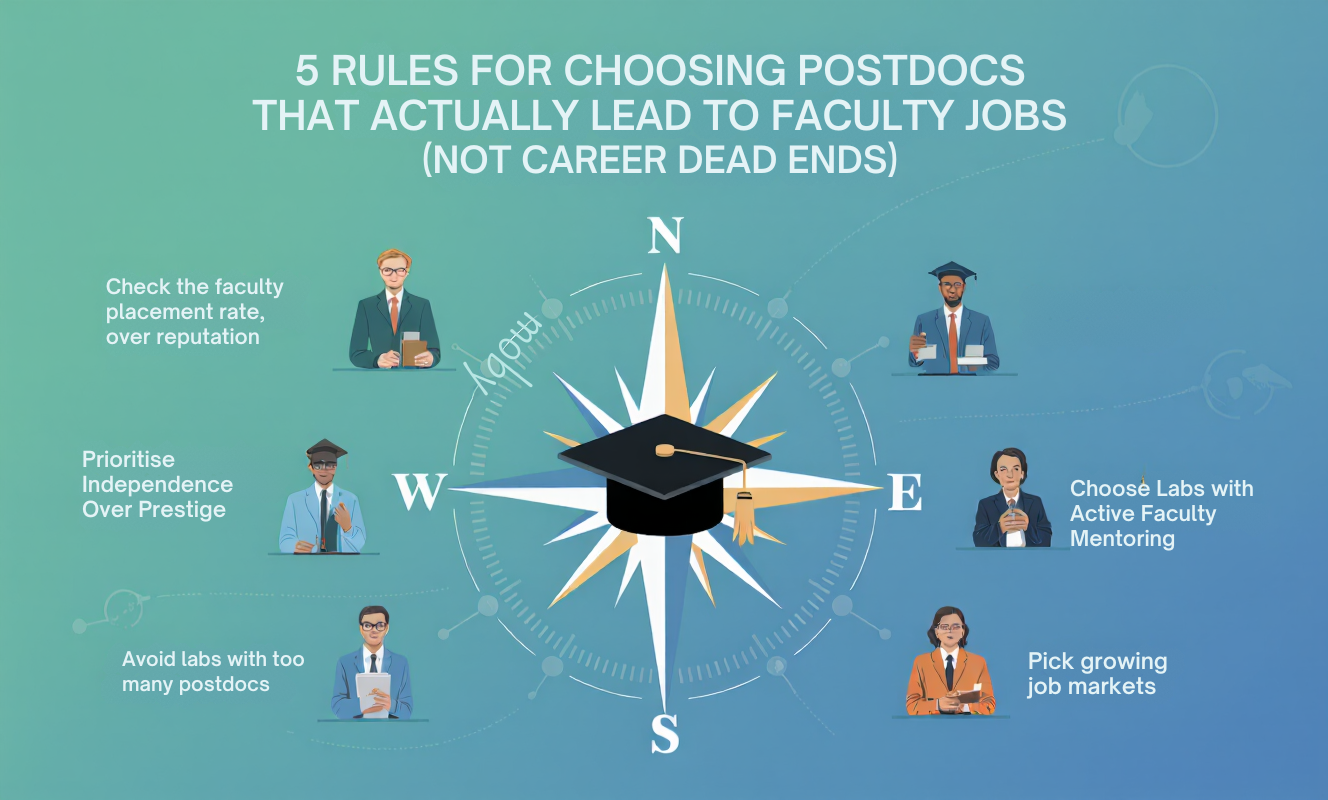
Rule #1: Check the Faculty Placement Rate, Not the Lab's Reputation
A famous lab means nothing if their postdocs don't get faculty jobs.
The most important number is simple: what percentage of recent postdocs are now faculty members?
How to evaluate: Ask directly for placement data from the last five years.
Calculate the percentage who landed tenure-track positions within three years of finishing their postdoc.
Good labs place 40% or more.
Excellent labs place 60% or more.
If they can't or won't provide this data, that's a red flag.
Look specifically at postdocs who finished 2-3 years ago, not recent graduates who might still be job hunting.
Rule #2: Prioritise Independence Over Prestige
Labs that treat postdocs like senior graduate students produce candidates who can't compete for faculty positions requiring independence.
How to evaluate: Ask specific questions about project ownership.
- Will you lead your own research project or work on the PI's existing grants?
- Can you write your own grant applications?
- Will you supervise students?
- Will you have your own research budget?
The best postdocs give you experience running independent projects that you can build on as faculty.
Avoid positions where you'll just be an expensive technician.
Rule #3: Choose Labs with Active Faculty Mentoring
Many famous professors are too busy to provide the career guidance that postdocs desperately need.
How to evaluate: Ask current postdocs about their mentoring experience.
- How often do they meet with the PI one-on-one?
- Does the PI help with job applications and provide career advice?
- Do they get introduced to other faculty in their field?
The best postdoc advisors actively help their trainees build networks, improve applications, and navigate the job market.
They see postdoc success as part of their job.
Rule #4: Avoid Labs with Too Many Postdocs
Labs with five or more postdocs often can't provide individual attention and create internal competition that hurts everyone.
How to evaluate: Count the current postdocs and ask about typical lab size.
Ideal labs have 2-4 postdocs who can collaborate without competing directly for the same resources and attention.
Large postdoc groups often signal that the PI uses postdocs as cheap labor rather than investing in their career development.
Rule #5: Pick Fields with Growing Job Markets
Some research areas are expanding while others are shrinking.
Your postdoc choice should position you in a growing field.
How to evaluate: Look at faculty job postings in your target area over the past three years.
Are there more or fewer positions?
Check recent PhD graduation numbers in your field.
If programs are producing more PhDs than there are jobs, competition will be brutal.
Also, explore interdisciplinary postdocs that position you for multiple types of faculty positions.
Key Takeaways:
- Focus on placement data, not lab prestige - Ask for specific numbers on recent postdoc job outcomes
- Choose positions that offer real independence - Avoid labs that treat postdocs like senior graduate students
- Pick fields with growing job markets - Position yourself where opportunities are expanding, not shrinking
-
→ Your Action Plan for This Week
- Research placement data for any labs you're considering for postdoc positions
- Create a list of questions about independence and mentoring to ask during postdoc interviews
- Analyze job market trends in your target research areas using recent faculty job postings
Well, that’s it for today.
See you next week.
Whenever you're ready, there are 3 ways I can help you:
1. Get free actionable tips on how to secure a tenure-track job in academia by following me on X, LinkedIn me Instagram and BlueSky
2. Take my proven Academic Job Accelerator Program that has helped hundreds of researchers secure academic positions to learn the exact strategies hiring committees respond to.
3. If you're ready to take your PhD application journey to the next level, join my PhD Application and Scholarship Masterclass waitlist. Click the link below to learn more and secure your spot.
Responses