

Today, I'm sharing the exact step-by-step process that helped me reduce my literature review time from four months to just one month without sacrificing quality or violating any ethical standards.
15 October 2025
Read time: 3 minutes
Supporting our sponsors directly helps me continue delivering valuable content for FREE to you each week. Your clicks make a difference! Thank you. Emmanuel
Develop Research-Backed PhD Hypotheses in Minutes Instead of Months with Liner
Stop the weeks-long cycle of hypothesis drafts and supervisor rejections. Liner analyzes published research to generate evidence-based hypothesis variations with supporting citations, then evaluates them against key research criteria before your supervisor does.
Get three literature-backed variations instantly, enhance your hypothesis with cross-disciplinary insights, check theoretical foundations, and receive systematic scoring across clarity, novelty, feasibility, significance, impact, and timeliness.
Use AI to build hypothesis defense while you focus on original research contributions and methodology design. Start with Liner free at
Literature reviews are the most time-consuming part of academic research.
Most PhD students and researchers spend months reading hundreds of papers, taking notes, and trying to synthesize findings, often feeling overwhelmed and behind schedule.
What if AI could help you complete thorough, high-quality literature reviews in a fraction of the time while maintaining complete academic integrity?
Today, I'm sharing the exact step-by-step process that helped me reduce my literature review time from four months to just one month without sacrificing quality or violating any ethical standards.

Last year, I started a new research project that required reviewing over 150 papers on a complex topic.
Using my traditional methods, I estimated this would take at least 2-3 months of full-time work.
I was dreading the process when I decided to experiment with AI-assisted literature review techniques.
The results amazed me.
I completed a comprehensive, high-quality review in just three weeks, while maintaining complete academic integrity and transparency about my AI use.
Since then, I've refined this process and taught it to dozens of students who have all dramatically accelerated their literature review timelines.
Step #1: Use AI for Initial Search and Filtering
Instead of manually searching databases and reading abstracts one by one, use AI tools to help identify relevant papers quickly.
How to do it:
- Start with traditional database searches to get an initial pool of papers. Export the titles and abstracts to a spreadsheet.
- Use dedicated AI tools to help you quickly scan these abstracts and identify which papers are most relevant to your specific research questions.
- Create clear criteria for relevance before you start, then ask AI to flag papers that meet these criteria.
Always verify AI recommendations by reading the actual abstracts yourself.
Step #2: Create AI-Assisted Paper Summaries
Reading 150 full papers takes forever. Use AI to create initial summaries that help you prioritize which papers need full reading.
How to do it: For papers you've identified as potentially relevant:
- Use AI tools to generate structured summaries focusing on methodology, key findings, and limitations.
- Create a standard summary template so all papers are analyzed consistently.
- Read the AI-generated summaries critically and verify claims by spot-checking against the original papers.
- Use these summaries to decide which papers require full reading and which can be deprioritised.
Step #3: Build AI-Enhanced Synthesis Tables
Instead of manually creating comparison tables, use AI to help organize findings across multiple studies.
How to do it: Feed AI tools information from your paper summaries and ask them to create comparison tables organized by themes, methodologies, or findings. Use these AI-generated tables as starting points that you then verify and refine.
Always check the AI-organized information against original papers to ensure accuracy. Add your own interpretations and insights that AI cannot provide.
Step #4: Identify Gaps and Patterns with AI Assistance
AI can help you spot patterns across large numbers of papers that might take humans much longer to recognize.
How to do it: Once you have summaries of relevant papers:
- Use AI to help identify common themes, contradictory findings, and potential research gaps.
- Ask specific questions like "What methodologies are most commonly used?" or "Where do these studies disagree?"
- Verify any patterns AI identifies by checking multiple papers yourself.
Use AI-identified patterns as starting points for your own deeper analysis.
Step #5: Generate Initial Literature Review Outlines and Key Points
Use AI to help create structured outlines with key points in bullet format, which you then expand and develop with your own writing.
How to do it:
- Provide AI with your verified summaries and synthesis tables, then ask it to create an organized outline for your literature review sections.
- Request bullet points highlighting the main arguments, findings, and connections you should cover in each section.
- Use these AI-generated outlines and bullet points as organizational scaffolding only.
- You write all the actual content yourself, using the outline to structure your thoughts.
This approach keeps your original voice and interpretation while benefiting from AI's organizational assistance.
Step #6: Maintain Complete Transparency and Documentation
The key to ethical AI use in literature reviews is documenting exactly how you used AI tools.
How to do it:
- Keep a detailed log of which AI tools you used for which tasks.
- In your methods section, clearly describe your AI-assisted process, including how you verified AI output and maintained quality control.
Be prepared to explain your process to reviewers and provide additional documentation if requested.
Frame your AI use as a tool for efficiency that enhanced rather than replaced your expertise.
Quality Control: The Non-Negotiable Verification Steps
AI assistance only works if you maintain rigorous quality control throughout the process.
How to implement:
- For every AI-generated summary, spot-check at least 25% against original papers.
- For any AI-identified patterns, verify them by reading multiple relevant papers yourself.
- For any AI-generated outline, ensure it accurately represents the literature and add your own critical interpretation.
Never skip verification steps even when pressed for time. Your reputation depends on accuracy, not speed.
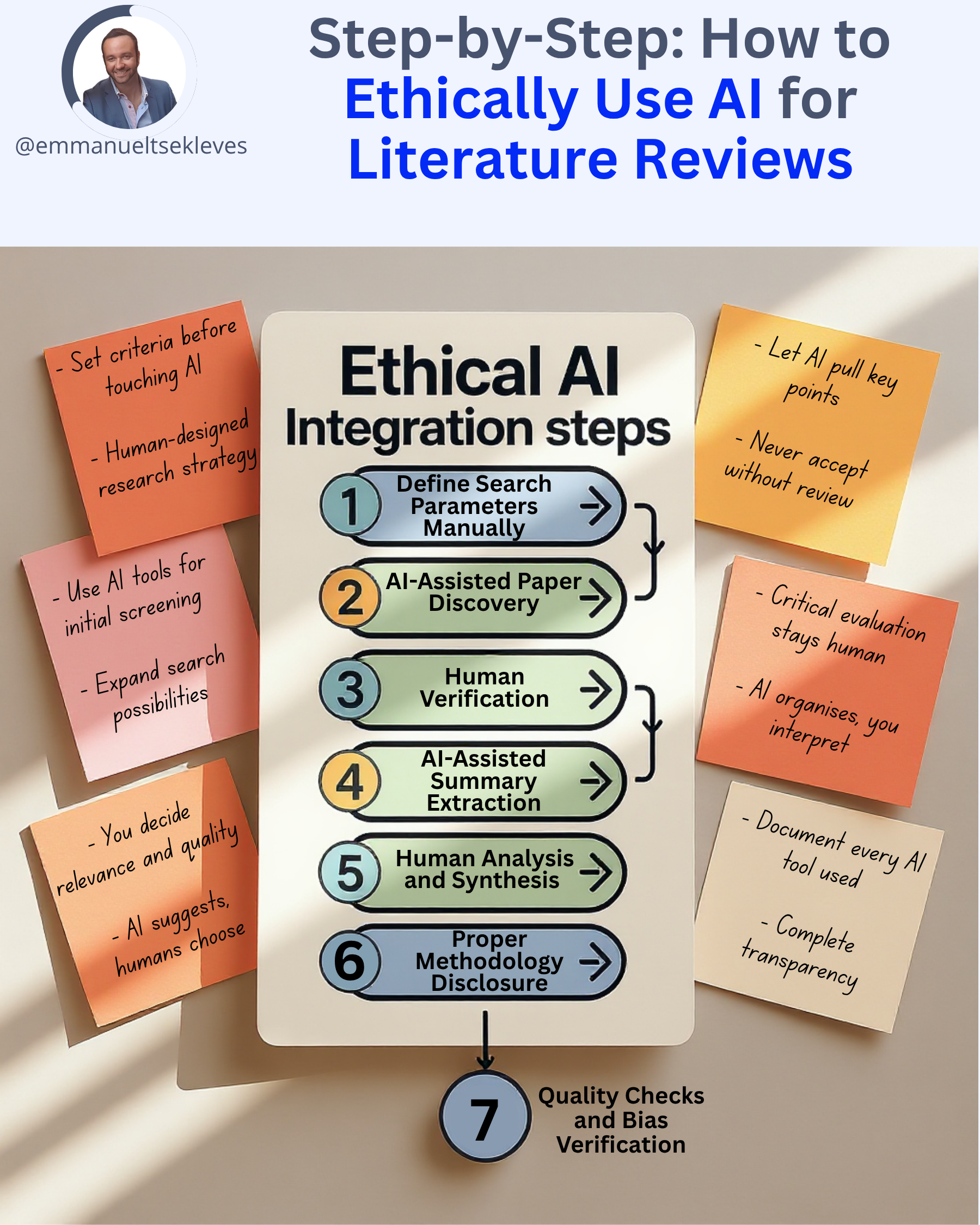
Key Takeaways:
- Use AI for initial filtering and organization but always verify recommendations by reading original sources yourself
- Let AI help with outlines and structure but write all actual content yourself with your own analysis and interpretation
- Document your process completely to maintain transparency and academic integrity
→ Your Action Plan for This Week
- Choose one AI tool to experiment with for literature review assistance
- Create a verification checklist to ensure you're checking AI output against original sources
- Start documenting your AI-assisted process for transparency in your methods section
What part of literature reviews takes you the most time? Reply and share your biggest challenge!
Well, that’s it for today.
See you next week.
Whenever you're ready, there are 3 ways I can help you:
1. Get free actionable tips on how to complet your PhD and secure a tenure-track job in academia by following me on X, LinkedIn me Instagram and BlueSky
2. Take my proven Academic Job Accelerator Program that has helped hundreds of researchers secure academic positions, and start with my free training videos to learn the exact strategies hiring committees respond to.
3. Join my Premium 1:1 PhD Mentorship Program. I provide exclusive, results-driven support for professionals who need fast-track guidance on proposals and thesis completion. DM or email me to learn more about this premium consultancy for serious professionals ready to succeed quickly.

Responses