#150 - How to Turn Your PhD Thesis into Research Papers: The 2+2 Publication Strategy

Today I am giving you the strategy a mentor showed me after my postdoc that changed everything.
27 May 2026
Read time: 4 minutes
Supporting our sponsors directly helps me continue delivering valuable content for FREE to you each week. Your clicks make a difference! Thank you. Emmanuel
Before we start: am I right about this?
I've spent the past few weeks talking to people doing a doctorate alongside a serious job. Different countries, different institutions, PhDs and DBAs and EdDs. The same thing kept coming up.
You get through the taught part. Then the cohort goes quiet and you're on your own for the hardest stretch: the research. The people around you don't quite get it. University support is built for full-time students half your age. And the live sessions always land in the middle of your working day.
One person called it "feeling abandoned." Another said it was like a breakup.
I'm wondering whether there's something worth building for that gap. Not another forum that goes quiet, but structure: a standing rhythm, practical sessions in the evenings and at weekends, and peers who actually get it.
Before I go further, I want to know if I'm right, or imagining a problem that isn't there.
If you've done a doctorate while working, or you're in it now, tell me. Hit reply with the hardest part for you once the taught phase ended, or take the two-minute anonymous survey.
Honest answers help more than kind ones. Thank you.
Now, this week's issue.
P.S. I'm live in the comments under every LinkedIn post on Mon, Tue, Thu and Sat from 2:34pm GMT. Drop by if you want to dig into the topic, ask a question, or just say hello.
#171 - Why This Method and Not Another: The One-Sentence Answer
#170 - How to Make Your Thesis and Papers Argue: The Verb Swap
#169 - The 2 Parts of a Literature Review AI Cannot Write for You: The Position Test
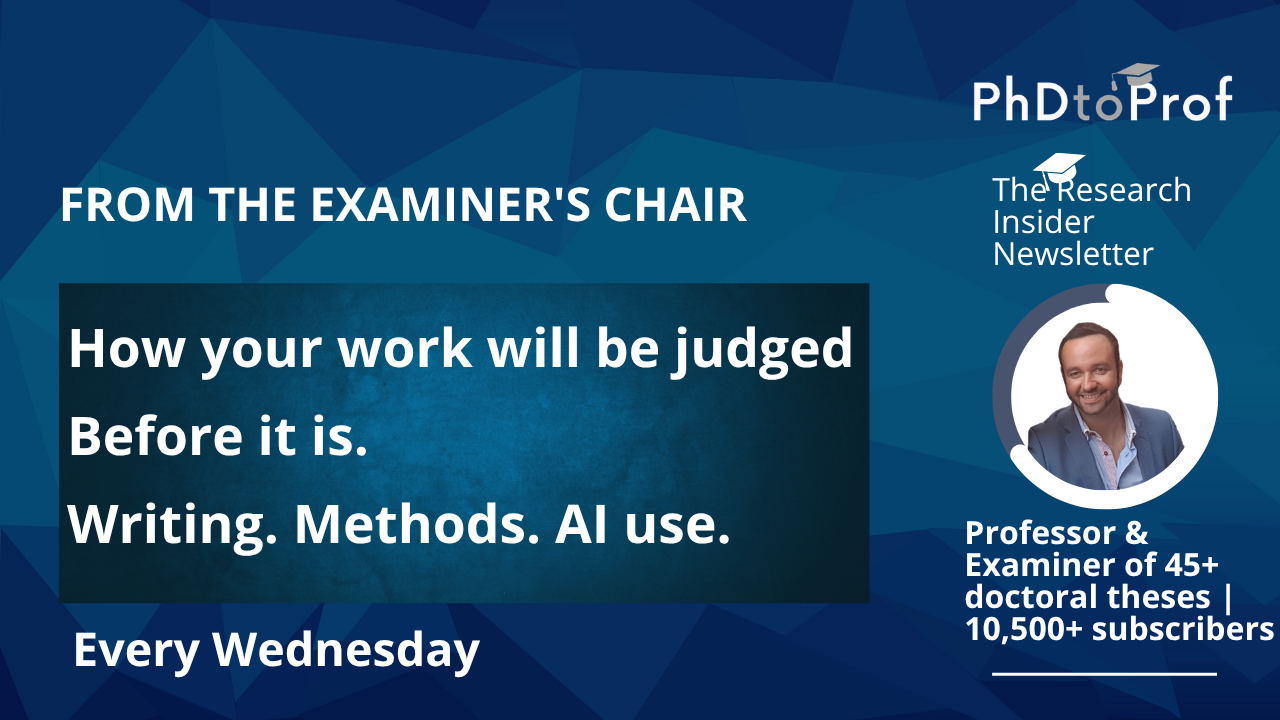
The Research Insider
What an examiner actually saw this week. A short letter from the other side of the viva table. I was a lost PhD student once, in my office at 2am, surrounded by papers nobody had taught me how to read. I got through it. Then I sat on the examiner's side of the table more than forty-five times, and learned the thing nobody had told me. Whether you pass comfortably rarely comes down to how good your research is. It comes down to whether your thesis shows the examiner what they're looking for, and most capable people were never shown that. That's all this letter does. Three weeks out of four it's short, about four hundred words. One real thing I read, details changed: a sentence that doesn't say what it thinks it says, a method that won't survive the first question, a passage where the writer's own voice has quietly disappeared. What I saw when I read it cold, the fix, and a test you can run on your own work tonight. That last one is newer, and it's where most of the worry is now. The question I get asked is whether a detection tool will flag them. The question that decides anything is whether an examiner will believe the thinking is theirs, and those aren't the same question. I train universities on this, and I've sat on the faculty side when a tool flagged an honest candidate, so I know how that conversation goes and what evidence actually helps. The fourth week is longer. Once a month I read every page people send me for Pass or Revise, my live session where three of them get read out loud. Then I write up what I found across the whole pile, including what it made me change in the way I teach. Free, and one ask a month at most. 45+ doctoral theses examined across 15+ universities. 25+ PhDs supervised to completion. 35+ working professionals mentored through a doctorate alongside a career. 240,000 researchers follow my work on LinkedIn. Free, and one ask a month at most.
Join The FREE Challenge
Enter your details below to join the challenge.