
Today I am giving you the three signals that tell you the reading has done its job, so you can stop waiting for a feeling of readiness that rarely arrives and start writing instead.
3 June 2026
Read time: 3 minutes
Supporting our sponsors directly helps me continue delivering valuable content for FREE to you each week. Your clicks make a difference! Thank you. Emmanuel
Before we start: free live session the week after next.
If your literature review feels like a vortex right now, you are not alone. Every week I hear from doctoral researchers who are drowning in papers, reading everything they can find, and still not sure when they have read enough.
So I am running a free LinkedIn Live session on it.
How to Do Your Literature Review and Stop Drowning in Papers Tuesday 24 June 2025 | 5:00 PM BST
I will walk through a practical, repeatable method for tackling the literature review: how to use your research question as your compass, how to identify the core areas of your topic, how to search and read strategically rather than endlessly, and how to know when it is time to stop reading and start writing.
The first half is a focused walkthrough. The second half is yours: bring your questions and we will work through the real challenges you are facing.
This is for anyone doing a PhD, DBA or professional doctorate. Open to everyone. Just come along.
Register here: How to Do Your Literature Review and Stop Drowning in Papers
Share the link with anyone in your network who would find it useful.
Now, this week's issue.
P.S. I'm live in the comments under every LinkedIn post on Mon, Tue, Thu and Sat from 2:34pm GMT. Drop by if you want to dig into the topic, ask a question, or just say hello.
I spent an extra eight months reading for my PhD before I let myself write a single word.
I told myself it was rigour and I told my supervisor I needed to be thorough.
I told myself that one more paper, one more book, one more search would give me the clarity I was missing.
It was not rigour, to be honest, it was fear.
Writing meant committing to a position, and committing to a position meant someone could disagree with it.
Reading felt safe, whereas writing felt exposed.
I eventually started writing, but those eight months cost me.
I finished late, I was exhausted, and most of what I read in those final months never made it into the thesis anyway.
Every mentee I work with hits this same wall.
They have been reading for months, sometimes over a year, and they cannot bring themselves to stop.
They keep searching, keep downloading, keep highlighting, since it feels like progress even though the thesis has not moved forward by a single page.
Today I am giving you the three signals that tell you the reading has done its job, so you can stop waiting for a feeling of readiness that rarely arrives and start writing instead.
You do not stop reading when you have read everything. You stop when new papers stop changing your argument.
Why Reading Feels Like Progress, But Is Not
Reading is comfortable.
You open a paper, you learn something, you add it to your notes, and you feel like you have done useful work. And early on, that is true.
Every paper genuinely does teach you something new.
Every search opens a door you did not know was there.
But at some point, and this happens to everyone, the returns start to drop.
You are still reading at the same pace, still downloading papers, still filling your reference manager, but the papers are telling you things you already know.
You are reading to confirm, not to discover.
The field has already given you what you need, and you have not noticed because the habit of reading has become the habit of avoiding the next step.
The tricky part for me is that this change happens gradually.
There is no single moment where a bell rings and you think "right, I have read enough."
It creeps up on you, and if you are not watching for it, you will stay in the literature for months longer than you need to.
I see it in mentees before they see it in themselves.
They come to a session and describe a paper they read that week, and I can tell from the way they describe it that it did not change anything.
It just confirmed what they already knew.
That is the first signal.
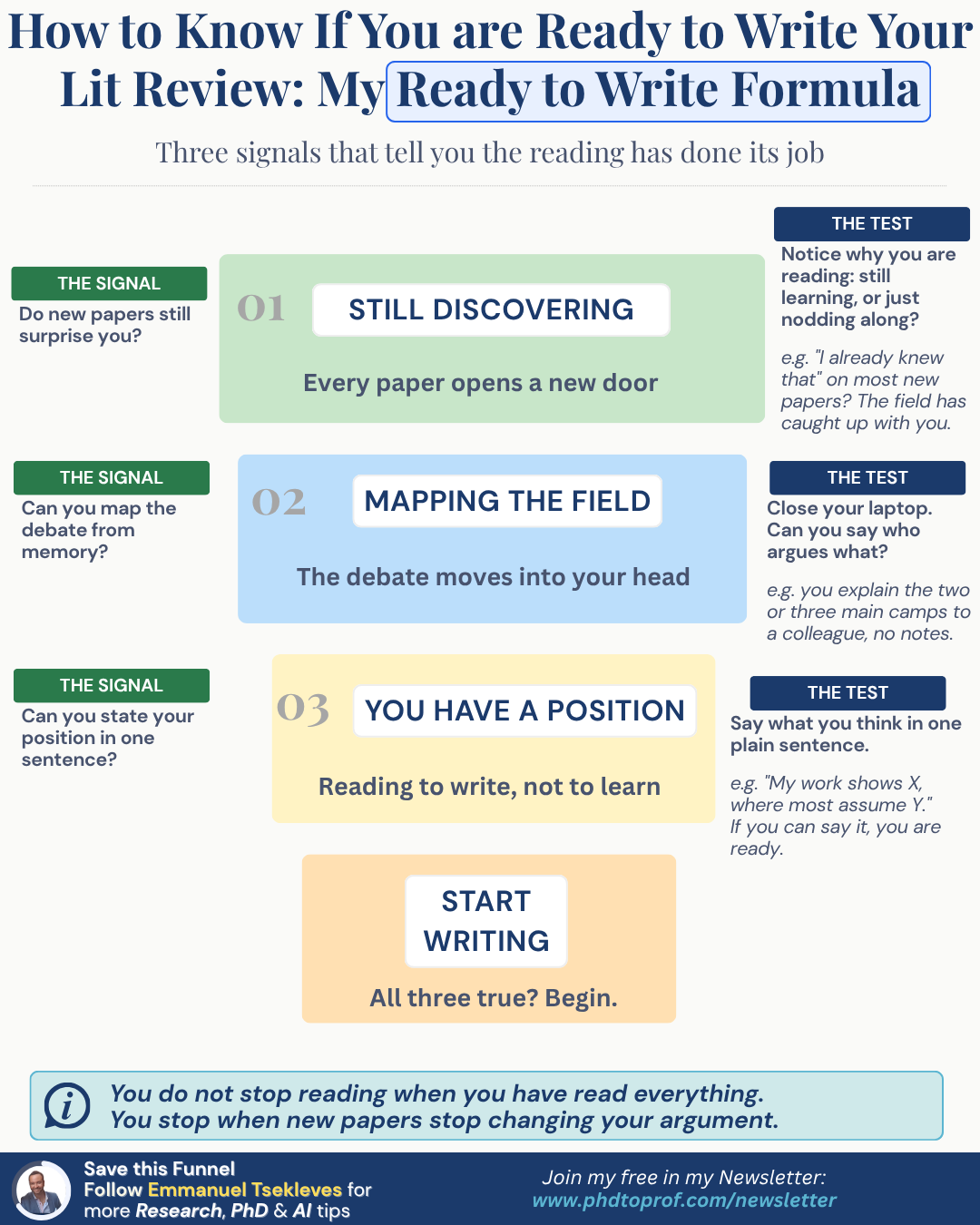
The Three Signals That Tell You the Reading Has Done Its Job
I give every mentee the same framework now, because the question "have I read enough?" is impossible to answer with a number.
- There is no magic count of papers.
- There is no target number of sources.
What matters is what the reading has done to your thinking, and these three signals tell you when that work is finished.
Signal 1: New papers stop surprising you.
In the early months, every paper opens a new direction.
- You find a study you had not seen before and it reshapes how you think about your question.
- You discover a framework that changes your approach.
- You read a finding that contradicts something you assumed.
Then one week, you notice something different.
- You open a new paper, you read the abstract, and you already know what it is going to say.
- You read the findings and they confirm what you expected.
- You check the references and you have already read most of them.
When that starts happening consistently, the field has caught up with you.
Or more accurately, you have caught up with the field.
The surprises have dried up, and that means the landscape is now in your head rather than scattered across your folders.
The test: Next time you sit down to read, ask yourself honestly: am I still learning, or am I just nodding along?
If you catch yourself thinking "I already knew that" about most of what you read in a week, the reading has done its job for that section.
Signal 2: You can map the debate from memory.
Try this right now.
- Close your laptop.
- Get a blank piece of paper.
- Sketch the main positions in your research area without opening a single file.
- Can you name the two or three main camps?
- Can you explain it to someone outside your field in plain language?
- Can you say who argues what, where they disagree, and what the unresolved tensions are?
If you can do this, the literature has moved from your reference manager into your head.
That is exactly where it needs to be before you start writing.
Your literature review is not a list of what you read.
It is a map of the debate, and if you can draw that map from memory, you are ready to write it.
The test: Explain the main debate in your field to a friend or a partner who knows nothing about your research.
If you can lay out who thinks what, where they agree, where they clash, and where the gap sits, all without checking your notes, you know the field well enough to write about it.
Signal 3: You have a position.
This is the one that matters most, and it is the one most candidates reach last.
This is not a summary of what everyone else thinks.
Not even a description of the different views, but a position of your own.
Something you believe based on your reading that you could state in one sentence and defend if someone pushed back on it.
Something like: "The existing frameworks for leadership development in SMEs are built on evidence from large organisations, and that mismatch is causing real problems that nobody is addressing."
That is a position. It came from the reading, but it belongs to you.
It is yours to argue for, and it is what your thesis will ultimately prove.
When you reach this point, you are no longer reading to learn.
You are reading to write. And that is when you should start.
The test: Say what you think in one plain sentence. Not what the literature says.
What you think. If you can say "My work shows X, where most people assume Y" and mean it, you are ready to begin.
What to Do When All Three Are True
If all three signals are present, the reading has done its job.
So staying in the literature any longer is not thoroughness.
It really is avoidance wearing a lab coat.
I know that is a hard thing to hear, because I needed someone to say it to me and nobody did.
I stayed in the reading phase of my PhD for months after I was ready to write, and every one of those extra months was time I could have spent actually building the thesis.
Here is what I tell my mentees when they reach this point: start writing the section you know best.
- Do not wait for the perfect opening sentence.
- Do not try to begin with the introduction.
- Pick the section where your thinking is clearest, probably the part of the literature review where you feel most confident, and start writing it as if you are explaining it to a colleague.
The writing will feel rough at first and that is normal.
But the moment you have a page of your own words in front of you, the dynamic changes.
You are no longer a reader collecting material.
You are a writer building an argument.
And that change is what moves your thesis from "in progress" to actually progressing.
One More Thing Nobody Tells You
You do not stop reading entirely when you start writing.
You keep reading, but the purpose changes.
You see, before writing, you read to understand the field.
After you start writing, you read to fill specific gaps in your argument.
You notice a claim that needs a supporting source, so you search for it.
You realise your discussion needs a counterargument, so you look for one.
The reading becomes targeted instead of open-ended, and that is how it should work for the rest of the thesis.
The reading never truly stops.
But the aimless, open-ended reading that fills your first year must stop at some point, and these three signals tell you when.
Key Takeaways
- If new papers have stopped surprising you, you can map the debate from memory, and you have a position you can state in one sentence, the reading has done its job.
- Waiting to feel ready is not a strategy. That feeling almost never arrives. Watch for the three signals instead.
- When you start writing, the reading does not stop. It changes purpose. You go from reading to learn to reading to fill gaps in your argument.
→ Your Action Plan for This Week
- Try the memory test right now. Close everything, get a blank page, and sketch the main debate in your field. If you can do it, signal two is done.
- Write your position in one sentence. Not what the literature says. What you think and why. If you can do it, signal three is done.
- If all three signals are true, pick the section of your literature review where your thinking is clearest and write 500 words today. Not perfect words. Just words. The thesis starts moving the moment you do.
- If the signals are not all there yet, do not panic. Go back to the one that is missing and focus your reading there. That is targeted reading, not avoidance.
You do not stop reading when you have read everything. You stop when new papers stop changing your argument.
Need personalised support? Ask about our Premium 1:1 PhD Mentorship Programme and PhD Thesis Review Service.
⭐ BONUS RESOURCE ⭐
I have turned the Ready to Write Formula into a one-page self-assessment you can print and work through. It walks you through each of the three signals with the test for each one, plus a decision box at the bottom: all three true means start writing, one or more missing means keep reading with a specific focus. Pin it above your desk and check it every Friday.
📥 Download the Ready to Write Self-Assessment here
This is the kind of resource that will be part of our upcoming premium newsletter for subscribers who want deeper tools and frameworks.
For now, they are yours at no cost.
Well, that’s it for today.
Until next week,
Prof. Emmanuel Tsekleves
Whenever you're ready, there are 3 ways I can help you:
1. Get free actionable tips on how to complete your PhD on time and use AI responsibly in research by following me on X, LinkedIn, Instagram
2. Join my Premium 1:1 PhD/DBA Mentorship Program. I provide exclusive, results-driven support for professionals who need fast-track guidance on proposals and thesis completion. Visit my website to learn more about this premium consultancy and book a discovery call.
3. Submit your thesis with confidence through my PhD/DBA Thesis Review Service. As an external examiner for 40+ PhDs, I review your work the way examiners do and give you two rounds of detailed feedback. Fill out the discovery form on my website to get started.
Responses