
Today, I am showing you why this happens, what is actually missing once the taught phase ends, and what I have been building to fix it.
8 July 2026
Read time: 3 minutes
Before we start: free live session this Wednesday.
Most doctoral researchers are using AI somewhere in their work but have no idea whether it could come back to hurt them in a viva.
I see this from the side of the exam table where the questions get asked.
In this session I will show you a simple way to sort any AI use into safe, conditional, and dangerous, so you know exactly where the line is before it matters.
Wednesday 15 July, 5:00 PM BST. Register here: AI in Your Doctorate: Where to Draw the Line
The taught phase of my PhD ended on a Friday.
On Monday, I sat at my desk with a blank screen, a vague research question, and nobody to talk to.
The cohort I had spent a year with disappeared overnight.
That was over twenty years ago, and I still remember exactly how it felt.
For the next eighteen months, I worked almost entirely alone.
My supervisor met me once a month, gave me feedback I did not fully understand, and sent me away to figure it out.
"This needs more depth" was his favourite phrase.
He never once showed me what depth actually looked like.
I know now that I was not the only one.
I have mentored over thirty-five working professionals through their doctorates since, and every single one has described the same feeling.
Twenty years later, the problem has not changed.
Today, I am showing you why this happens, what is actually missing once the taught phase ends, and what I have been building to fix it.
If you feel like you are doing this completely on your own, you are not imagining it.
And it does not have to be this way.
What Happens When the Structure Disappears
During the taught phase, there are:
- deadlines,
- classes,
- and people around you going through the same thing.
Then it ends.
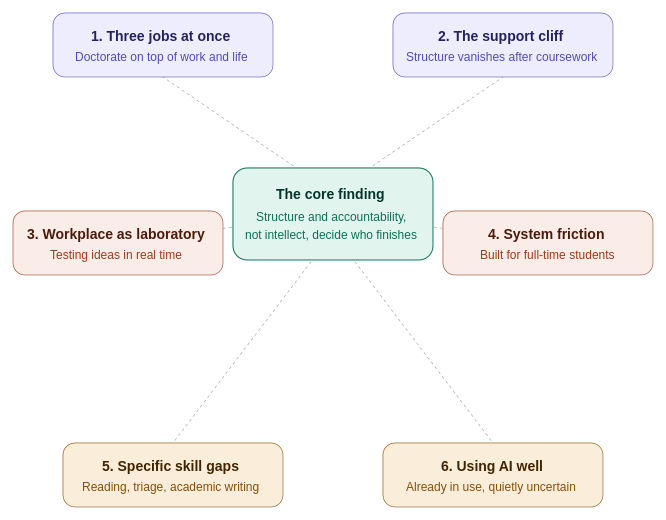
Suddenly you are on your own with a supervisor you see once a month and three to five years of unstructured time stretching out ahead of you.
If you are doing this part-time alongside a demanding job, it is worse.
You have maybe ten hours a week, and every one has to count.
But nobody teaches you the skills you actually need:
- how to design a methodology that holds together,
- how to write like a researcher instead of writing a work report,
- how to write a literature review that is analytical rather than descriptive.
Your supervisor assumes you know these things.
You do not. Nobody does at the start.
The Supervision Problem Nobody Talks About
I want to be careful here because I am not saying your supervisor is bad.
Most supervisors are good researchers who care.
But supervision was designed for full-time students who are on campus every day with forty hours a week to figure things out.
That is not you.
When your supervisor says "this needs more meat" or "be more critical," you need someone to show you what that looks like.
Side by side. Before and after.
Not just name the problem but translate it into something you can fix tonight in the two hours you have.
What I Kept Hearing
Over the past few months, I have been talking to doctoral researchers at every stage, across different countries, different institutions, PhDs and DBAs and EdDs.
The same things kept coming up.
"The cohort went quiet after year one and I have been on my own ever since."
"My supervisor tells me what is wrong but never shows me how to fix it."
"I feel like I am wasting the little time I have because I am guessing at everything."
One person called it "feeling abandoned."
Another said it was like a breakup.
These are not weak researchers.
They are directors, senior managers, consultants.
But a doctorate strips that confidence away because the rules are different and no one explains the new ones.
The Thing I Have Been Building
I am building a group mentoring programme called DocUP: the Doctoral Circle.
It is designed for working professionals doing a part-time doctorate, and it is built around the three things that go missing once the taught phase ends:
- skills,
- structure,
- and people who get it.
It works alongside your supervisor and your university.
It does not replace them. It fills the gap they leave.
Live masterclasses on the skills nobody teaches you: literature review, methodology, analytical writing, AI in research.
Live Q&A sessions where you bring your actual questions and get them answered by someone who has examined more than forty-five theses.
Working sessions (I call these writing retreats) where you get live feedback on your writing. Not generic advice. Feedback on the paragraph you are stuck on right now.
And a group of working professionals doing exactly what you are doing.
People who understand what it means to fit a doctorate around a career, a family, and a life that does not pause.
This Is Not Open Yet
The founding group opens once.
The waitlist is the only way in, and the only place the founder rate will be offered before it closes.
Just your name on the list so you hear from me before the doors open.
Join the waitlist here: https://www.phdtoprof.com/waitlist
One question to sit with:
are you getting the support this stage of your doctorate actually needs, yes or no?
If no, put your name on the list.
I will be in touch personally before anything opens.
Key Takeaways
- The isolation after the taught phase ends is the part nobody warns you about, and it ends more doctorates than the research does.
-
The supervision gap is not about bad supervisors. It is about a system designed for full-time students that does not work for professionals fitting a doctorate around a career.
-
Structure, skills, and a group of peers who understand your situation are the three things that are missing. DocUP is built to provide all three.
→ Your Action Plan for This Week
-
Ask yourself honestly: when was the last time you talked to someone who understood what you are going through with your doctorate? Not your supervisor. Not your partner. Someone doing the same thing, at the same stage, with the same pressures.
If the answer is "I cannot remember," that is the problem this programme is designed to solve.
Put your name on the waitlist.
Until next week,
Prof. Emmanuel Tsekleves
Responses