
Today, I am showing you how to turn your library of papers into your research assistant.
1 July 2026
Read time: 3 minutes
This week's issue is brought to you with Consensus. The AI research assistant that lets you search 200 million papers with evidence-based answers. If you use Zotero, you can connect your library and ask it the questions I walk through below. Try it free at consensus.app
"I have got 300 papers in Zotero and I still cannot find my research gap."
A mentee said that to me last month. And honestly, I felt it in my chest, because I did the exact same thing throughout my whole PhD.
I collected papers like they were going out of fashion.
I tagged them, sorted them into colour-coded folders, highlighted the good bits. My library looked beautiful.
But when my supervisor asked me where the gap was, I had nothing. I could not see the wood for the trees.
The problem was not that I had not read enough.
It was that I was looking at 300 papers one at a time, trying to hold the whole field in my head at once.
That does not work. No human brain can do it.
The patterns are in there, but you cannot see them through the sheer volume of it.
Your reference library is not a cupboard to store papers in. It is a dataset you can ask questions.
What I Wish Someone Had Told Me
Here is what nobody told you until years after your PhD: you can connect your Zotero library to a tool like Consensus and actually talk to your papers as a collection.
Not one at a time. All of them at once.
The first time I tried it with a mentee's library, we both just sat there staring at the screen.
Patterns she had been trying to find for months showed up in minutes.
The themes she thought her collection was about turned out to be different from what was actually in there.
A third of her papers were about carer burden, not patient experience. She had been drifting towards her real research question without even knowing it.
That became her study. And she found it by asking her own library a question she had never thought to ask.
The Four Questions That Change Everything
These are the four I now run with many mentees. They work with any reference library connected to Consensus and can be used with other tools.
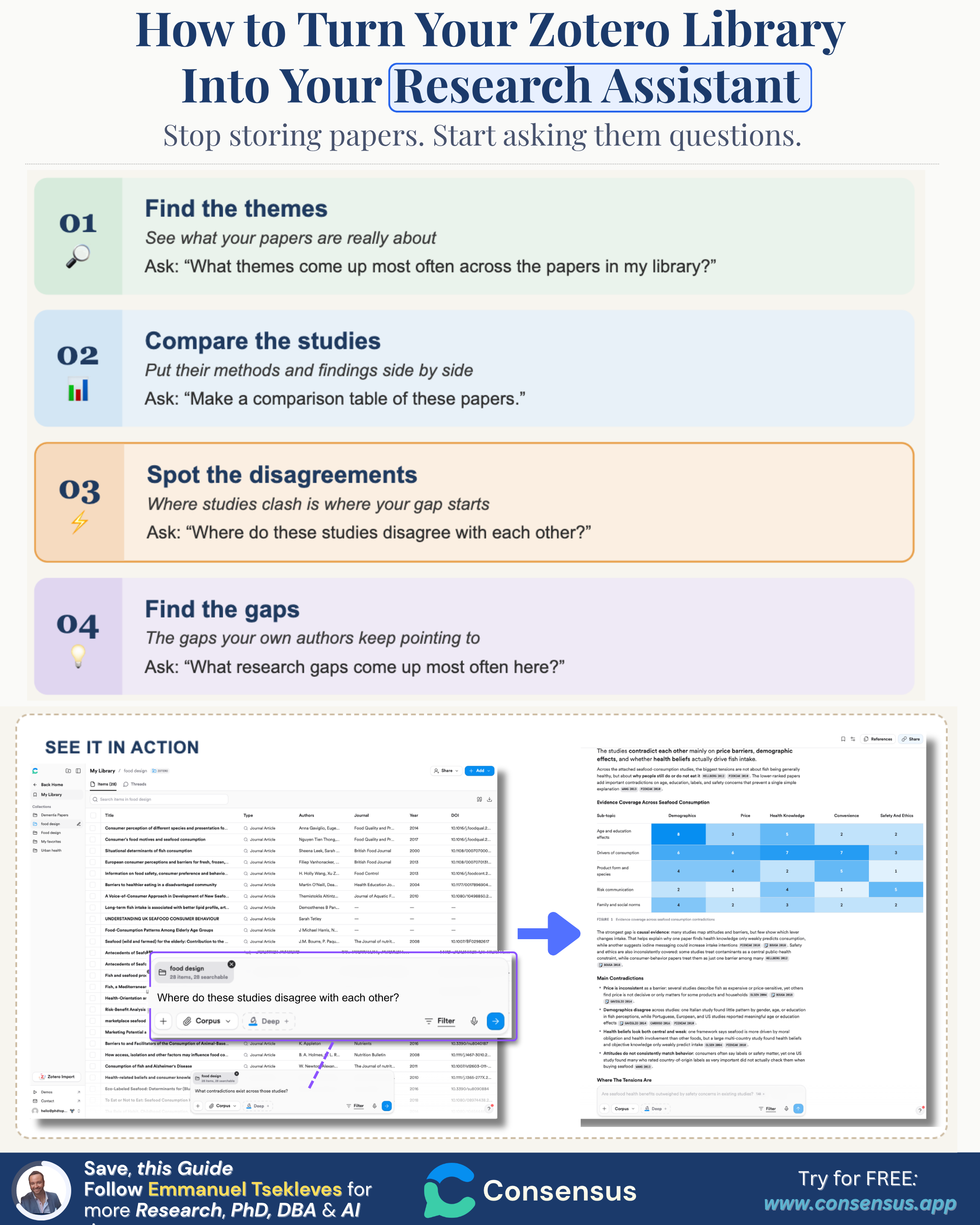
One: what themes come up most across my papers?
You think you know what your collection is about since you chose every paper.
But when you see the themes mapped across the whole set, the answer often surprises you.
What your library is actually about and what you thought it was about are not always the same thing.
That difference between the two is where interesting research questions live.
Two: can you compare these studies side by side?
Method, sample, population, key finding, limitations.
All in one table, across twenty papers, in minutes.
This used to take me days with a spreadsheet.
Now the table builds itself, and the groupings become your literature review structure.
The differences become your discussion points.
Three: where do these studies disagree with each other?
This is the one I wish I had asked years ago.
Two papers that agree are background.
Two that disagree are the start of something to say.
When you ask your library where the contradictions are, you are asking it to show you where the field has not settled.
Those contradictions are where your argument comes from.
Four: what research gaps come up most often?
You are not asking the tool to invent a gap.
You are asking it to find the gaps your own authors named.
Most papers have a limitations section where the authors say what should come next.
Across 200 papers, those suggestions form a pattern.
- The same missing population keeps appearing.
- The same untested context.
- The same call for future research.
Those gaps were sitting in your library the whole time. You just could not see them one paper at a time.
The Part That Is Still Yours
I want to be clear about this.
The tool finds the patterns, but YOU decide what they mean.
It can show you that twelve papers point to the same gap, but it cannot tell you whether that gap is worth three years of your life.
The reading is yours. The thinking is yours. The gap is yours to claim.
What changes is that you are no longer trying to hold everything in your head at once.
You are asking smart questions of a dataset you already built. And the answers were there all along.
Key Takeaways
- Your reference library is a dataset, not a filing cabinet. The moment you start asking it questions, patterns emerge that you cannot see one paper at a time.
- Four questions unlock the most value: what are the themes, how do the studies compare, where do they disagree, and what gaps do the authors keep naming.
- The tool finds the patterns. You decide what they mean.
→ Your Action Plan for This Week
-
Connect your Zotero library to Consensus and ask it the first question: what themes appear most often across my papers? See if the answer matches what you thought.
-
Then ask where the studies disagree. That is where your argument starts.
⭐ BONUS RESOURCE ⭐
Want the exact prompts I used for each of the four questions, with examples showing what comes back and how to use it? I have put the whole workflow into a step-by-step guide you can follow along with your own library.
📥 Grab it here
Until next week,
Prof. Emmanuel Tsekleves
P.S. — I'm building something for working professionals doing a part-time PhD or DBA — group mentoring for the parts your supervisor doesn't have time for. It's not open yet, but I'm keeping a list of people who want first access (and the founding rate) when it is. If that's you: Join the waitlist →
Responses