
Today, I'm sharing the exact decision-making framework I use to evaluate every AI tool before implementation.
23 July 2025
Read time: 3 minutes
Supporting our sponsors directly helps me continue delivering valuable content for FREE to you each week. Your clicks make a difference! Thank you. Emmanuel
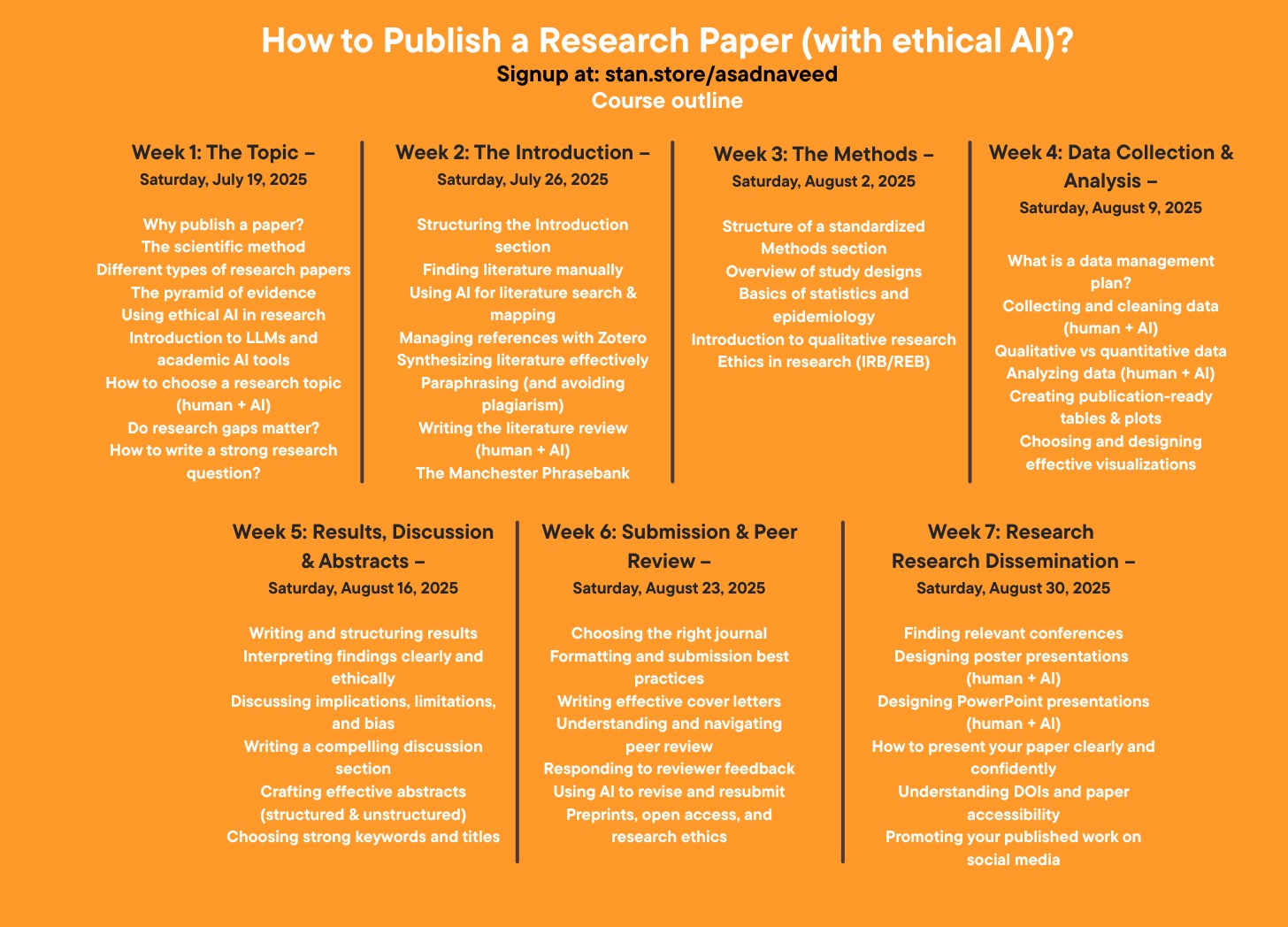
How to Publish a Research Paper (with ethical) AI - by Asad Naveed
Get 30% off with my code et30 - available here.
FREE Webinar: Academic Job Breakthrough Masterclass - Monday 5th August
Stop getting rejected! I'm revealing the insider system that helps researchers land positions 3x faster (even after multiple rejections).
FREE webinar: After reviewing 400+ applications on 25+ hiring committees, I'm sharing the 75-second reality + 5-STEPS framework that transforms 2% success rates into 25%.
Limited spots -> Registre for free here.
AI tools are everywhere in academia now, but most researchers are using them without proper evaluation first.
Some discover too late that their chosen AI tool violates journal policies, compromises data security, or produces unreliable results that damage their credibility.
What if you could avoid these costly mistakes with a simple seven-question audit?
Today, I'm sharing the exact decision-making framework I use to evaluate every AI tool before implementation.
This systematic approach has helped me safely integrate AI into my research while avoiding the pitfalls that have derailed other academic careers.

Last year, I watched a colleague's paper get rejected because they used an AI tool that violated the journal's disclosure requirements.
Another researcher I know had to completely redo six months of analysis after discovering their AI tool was producing biased results they hadn't caught.
These incidents taught me that enthusiasm for AI tools isn't enough.
You need a systematic way to evaluate each tool before you use it.
Since developing this seven-question audit, I've safely adopted multiple AI tools that have genuinely improved my research while avoiding several that could have caused problems.
Question #1: Does This Tool Meet My Institution's AI Policies?
Many universities now have specific rules about AI use that most researchers haven't read or don't understand.
How to evaluate:
- Check your institution's research office website for AI policies.
- Look for guidelines about data privacy, student work, and disclosure requirements.
- If you can't find clear policies, contact your research office directly before using any AI tool.
Some institutions prohibit using AI tools that send data to external servers or require special approval for AI use in certain types of research.
Question #2: What Data Privacy and Security Risks Exist?
Many AI tools store or analyse your data on external servers, potentially exposing sensitive research information.
How to evaluate:
- Read the tool's privacy policy carefully.
- Find out where your data will be stored, who can access it, and how long it's kept.
- Check if the tool meets your field's data security requirements, especially for human subjects research or proprietary data.
Never input confidential research data, unpublished results, or personally identifiable information into AI tools unless you're certain about their security measures.
Question #3: Do Target Journals Allow This Type of AI Use?
Journal policies on AI vary widely and change frequently. What's acceptable to one journal might be prohibited by another.
How to evaluate:
- Check the submission guidelines of journals where you plan to publish.
- Look specifically for AI use policies and disclosure requirements.
- Keep detailed records of how you use AI tools so you can provide required disclosures accurately.
When in doubt, contact the journal editor directly with specific questions about your intended AI use.
Question #4: Can I Verify and Validate the AI Output?
AI tools sometimes produce confident-sounding results that are completely wrong. You need the expertise to catch these errors.
How to evaluate:
- Test the tool with data or questions where you already know the correct answer.
- Check if you have the knowledge and resources to verify everything the AI produces.
- If you can't independently validate the output, don't use that tool for that purpose.
AI tools can perpetuate biases present in their training data, leading to skewed results, so be aware.
Question #5: Will This Tool Actually Improve My Research Quality?
Not every AI application genuinely enhances research. Some might slow you down or reduce the quality of your work.
How to evaluate:
- Start with small, low-stakes projects to test whether the tool genuinely helps.
- Measure whether it saves time, improves accuracy, or enhances creativity.
- Be honest about whether the tool is solving a real problem or just seems exciting to use.
- Evaluate whether the time spent learning and using the tool is worth the benefits it provides.
Question #6: How Will I Document and Disclose This AI Use?
Transparency about AI use is crucial for maintaining research integrity and meeting publication requirements.
How to evaluate:
- Determine exactly what documentation you'll need to keep about your AI use.
- Plan how you'll describe the AI's role in your methods section or acknowledgments.
- Decide what information about the AI tool you'll need to provide to readers.
- Create a standard template for documenting AI use consistently across all your projects.
Question #7: What Happens If This Tool Stops Working or Changes?
Many AI tools are new and unstable. Your research shouldn't depend entirely on tools that might disappear or change significantly.
How to evaluate:
- Reflect on whether you could complete your research if the AI tool became unavailable.
- Plan backup approaches for critical tasks.
- Avoid becoming so dependent on AI tools that you lose the ability to do the work manually if needed.
- Keep copies of important AI-generated content in case the tool or service becomes inaccessible later.
.
Key Takeaways:
- Check institutional and journal policies first before using any AI tool to avoid compliance problems
- Test tools thoroughly with known data to understand their limitations and accuracy before relying on them
- Plan your documentation strategy from the beginning to ensure proper transparency and disclosure
-
→ Your Action Plan for This Week
- Research your institution's current AI policies and save them for future reference
- Create a standard template for documenting AI tool use in your research projects
- Test one AI tool you're considering with data where you know the correct answer
What AI tool are you most uncertain about using in your research? Reply and share your specific concerns!
Well, that’s it for today.
See you next week.
Whenever you're ready, there are 3 ways I can help you:
1. Get free actionable tips on how to secure a tenure-track job in academia by following me on X, LinkedIn me Instagram and BlueSky
2. Take my proven Academic Job Accelerator Program that has helped hundreds of researchers secure academic positions, and start with my free training videos to learn the exact strategies hiring committees respond to.
3. If you're ready to take your PhD application journey to the next level, join my PhD Application and Scholarship Masterclass. Click the link below to learn more and secure your spot.


Responses