

Today, I am showing you how to select the most appropriate Literature Review Type for your PhD, DBA or research.
10 June 2026
Read time: 3 minutes
Before we start: free live session the week after next.
If your literature review feels like a vortex right now, you are not alone. Every week I hear from doctoral researchers who are drowning in papers, reading everything they can find, and still not sure when they have read enough.
So I am running a free LinkedIn Live session on it.
How to Do Your Literature Review and Stop Drowning in Papers Tuesday 24 June 2025 | 5:00 PM BST
I will walk through a practical, repeatable method for tackling the literature review: how to use your research question as your compass, how to identify the core areas of your topic, how to search and read strategically rather than endlessly, and how to know when it is time to stop reading and start writing.
The first half is a focused walkthrough. The second half is yours: bring your questions and we will work through the real challenges you are facing.
This is for anyone doing a PhD, DBA or professional doctorate. Open to everyone. Just come along.
Register here: How to Do Your Literature Review and Stop Drowning in Papers
Share the link with anyone in your network who would find it useful.
Now, this week's issue.
P.S. I'm live in the comments under every LinkedIn post on Mon, Tue, Thu and Sat from 2:34pm GMT. Drop by if you want to dig into the topic, ask a question, or just say hello.
I spent three months writing the wrong type of literature review for my PhD.
Nobody told me there were five types to choose from.
I did not know either. I just started writing what I thought a literature review was supposed to look like:
a long summary of everything I had read, organised by theme, ending with a gap.
It was not bad work. It was the wrong work.
My supervisor eventually opened a methods book in front of me and pointed to a table I had never seen.
Five review types, each with a different purpose, a different method, and a different standard of rigour.
I had written a narrative review and called it a systematic one.
I had no protocol. No search strategy I could reproduce.
No clear method at all. Just a well-organised summary with the word "systematic" in the title.
That cost me three months of rewriting.
Most of the candidates I mentor are doing the same thing right now.
They treat "literature review" as a single task when it is actually five separate tasks, each with its own rules.
Choosing the wrong one does not just waste time. It changes the outcome of the chapter.
Here is the decision that most people skip entirely, and how to make it before you write a single section.
The Five Types, and When Each One Belongs.
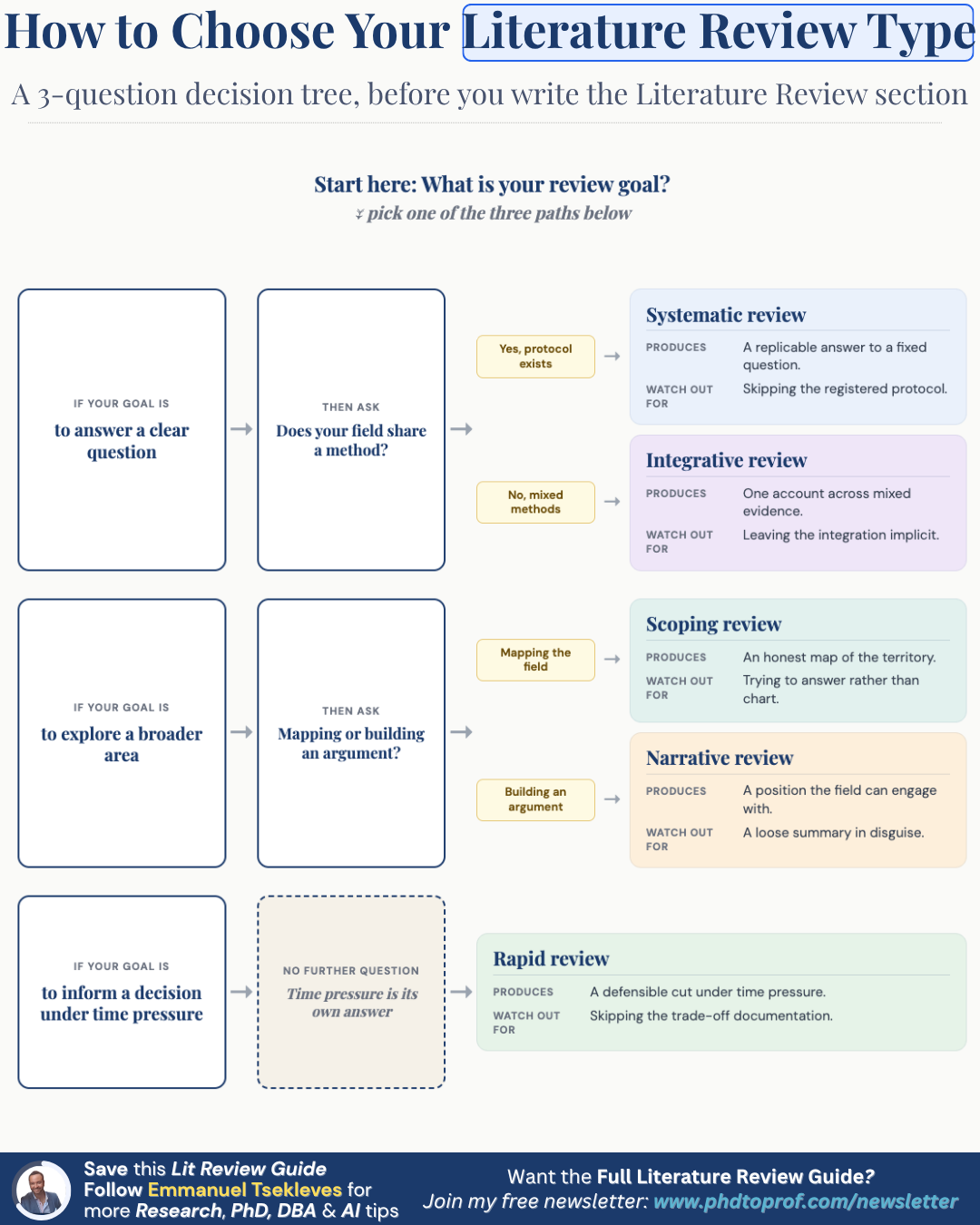
The Five Types, and When Each One Belongs
One: the systematic review.
Use this when you have a clear, answerable question and the field already shares a method for answering it.
A systematic review follows a registered protocol. You define your search terms, your databases, your inclusion criteria, and your quality assessment before you start.
The whole point is that someone else could run the same search and reach the same conclusion.
This is the gold standard for health sciences, clinical research, and any field where replicability matters.
But it only works when your question is narrow enough to fit a protocol.
If your question is broad or exploratory, a systematic review will force you into a shape your research does not fit.
Watch out for: calling your review systematic when it has no protocol.
Examiners spot this immediately.
If you did not register or publish your search strategy before you started, it is not a systematic review no matter what you call it.
Two: the scoping review.
Use this when the question is broader and the field is still mapping itself.
A scoping review charts the territory. It shows where the literature clusters, where the gaps sit, and what types of evidence exist.
It does not try to answer a question. It tries to draw a map.
This works well early in a doctorate when you are still figuring out where your study fits.
It is also strong for DBA candidates whose fields cross multiple disciplines.
Watch out for: trying to answer a question when your job is to chart.
A scoping review that draws conclusions is doing the wrong job.
Three: the narrative review.
Use this when you need to build an argument, not summarise a literature. Done well, the narrative review is the most powerful of the five.
Done badly, it is what most candidates end up writing without realising.
A strong narrative review takes a position.
It groups the literature by theme, shows where researchers agree, where they disagree, and where nobody has looked yet.
It ends with a gap that points straight at the research question. That is an argument, not a summary.
Watch out for: a loose summary wearing the label of a narrative review.
If your chapter lists what people found without building towards a point, it is not a narrative review. It is a reading list with paragraphs.
Four: the integrative review.
Use this when your field has no shared method and you need to bring qualitative, quantitative, and theoretical evidence into one account.
This is the hardest type to do well. I have read very few that worked.
Those that did made their integration explicit on every page.
Watch out for: leaving the integration implicit.
If the reader cannot see how you moved between different types of evidence and why, the review falls apart.
Five: the rapid review.
Use this when time is genuinely constrained.
A rapid review is a defensible cut of the systematic review's method, transparent about what it traded for speed.
Common in policy work, rare in doctoral research, but legitimate when the trade-offs are named upfront.
Watch out for: skipping the documentation of what you cut and why. A rapid review without a trade-off statement is just a rushed review.
How to Choose
Start with your goal, not your field.
- If your goal is to answer a clear question and your field shares a method: systematic review.
- If the question is clear but the field uses mixed methods: integrative review.
- If your goal is to explore a broader area and you are mapping the territory: scoping review.
- If you are building an argument: narrative review.
- If your goal is to inform a decision under time pressure: rapid review.
- That is three questions. Your goal, your field's methods, and whether you are mapping or arguing. Answer those and the review type chooses itself.
Now, choosing the right review type is easy to read on a page and hard to judge about your own work.
I have examined more than forty-five theses, and the literature review is the chapter that most often needs rewriting because the review type was wrong from the start.
Most candidates I see end up with a narrative review wearing the label of a systematic one, and they do not realise until an examiner tells them.
If you are stuck here and you want someone to look at your chapter the way an examiner will, that is what my 1:1 mentoring is for.
One question to sit with: did you choose your review type on purpose, or by default? If it was by default, reply to this email with the word "stuck" and I will send you the next step.
Key Takeaways
-
A literature review is not a summary of what you read. It is an argument with a method, and the method has a name.
-
There are five types: systematic, scoping, narrative, integrative, and rapid. Each has its own purpose and its own standard of rigour.
-
Most candidates end up with a narrative review wearing the label of a systematic one. Decide which type your project needs before you write a single section.
→ Your Action Plan for This Week
-
Open your literature review chapter and ask: what type of review did I actually write? Does the label match what is on the page?
-
If you called it systematic but have no protocol, rename it or build one.
-
If you are not sure which type fits, answer the three questions: what is my goal, does my field share a method, and am I mapping or arguing?
-
Write the name of your review type at the top of your chapter. If you cannot name it, you have not chosen it yet.
⭐ BONUS RESOURCE ⭐
I have turned the decision tree into a one-page printable flowchart with all five review types, the three decision questions, and a "produces / watch out for" summary for each type. Pin it above your desk and use it before you start your next literature review chapter.
📥 Download the Literature Review Type Decision Flowchart here
This is the kind of resource that will be part of our upcoming premium newsletter for subscribers who want deeper tools and frameworks.
For now, they are yours at no cost.
Until next week,
Prof. Emmanuel Tsekleves
If your literature review needs direction, my Premium 1:1 PhD/DBA Mentorship Programme gives you a standing rhythm with someone who has examined more than forty-five theses and knows what examiners look for in every chapter. Find out more at www.phdtoprof.com


Responses