
Today, I'm sharing my insider guide to decoding these hidden signals so you can tailor your application to what search committees are really seeking – not just what they publicly state.
30 April 2025
Read time: 3 minutes
Supporting our sponsors directly helps us continue delivering valuable content for FREE to you each week — your clicks make a difference!
SciSummary
Tired of spending hours summarising papers and searching for research gaps in your literature reviews? Let SciSummary do the heavy lifting!Try SciSummary for free and convert your papers to podcasts.Use my exclusive code PHDTOPROF25 for 25% off and transform your research process today: https://scisummary.com/
Anara AI
Transform your literature review process with Anara AI - a powerful tool that helps researchers uncover key insights and research gaps in minutes rather than months.
Upload papers, ask targeted questions, and get immediate analytical summaries that highlight connections and opportunities in your field.
Try it free at anara.com or use my code EMMANUEL20 for 20% off.
Ever feel like faculty job ads are written in a secret language?
You're not wrong.
After reviewing hundreds of academic job postings and interviewing dozens of search committee members, I've discovered that many of the most important selection criteria never actually appear in the official announcement.
Today, I'm sharing my insider guide to decoding these hidden signals so you can tailor your application to what search committees are really seeking – not just what they publicly state.

When I applied for my first faculty positions, I took job ads at face value and wondered why I wasn't getting interviews despite meeting all stated qualifications.
Only after serving on search committees did I understand that position announcements contain subtle clues about what departments truly want in a candidate.
Hidden Signal #1: The "Preferred" Qualifications List
When a job ad distinguishes between "required" and "preferred" qualifications, most candidates focus entirely on the required list. Big mistake.
What it really means: The preferred list often contains the actual deciding factors for making the shortlist.
Search committees include legally necessary "required" qualifications, but will almost exclusively interview candidates who meet the "preferred" criteria.
Action strategy: Address every preferred qualification explicitly in your cover letter.
Use the exact terminology from the ad to ensure your application isn't filtered out.
Hidden Signal #2: Unusual Emphasis on Collegiality
When ads prominently mention "collegiality" or being a "good departmental citizen," this isn't just boilerplate language.
What it really means: The department likely experienced conflict with a previous faculty member and is specifically screening for personality fit.
They're concerned about bringing in someone who won't work well with the existing team.
Action strategy: Include specific examples of successful collaborations in your materials.
Have your reference letters address your interpersonal skills and teamwork abilities.
Hidden Signal #3: Teaching Specific Courses
When ads list particular courses they want the new hire to teach, pay attention to which courses are mentioned first.
What it really means: The first-mentioned courses are likely the department's immediate teaching needs that current faculty don't want to cover.
Your willingness and ability to teach these specific courses could be the deciding factor.
Action strategy: Explicitly state your enthusiasm and preparation for teaching those specific courses.
Provide concrete examples of relevant experience or course plans.
Hidden Signal #4: Research Area Breadth vs. Specificity
Compare how broadly or narrowly they define the research specialty.
What it really means: Broadly defined areas ("social psychology," "modern European history") suggest they're casting a wide net and will likely prioritize publication record over exact specialty.
Narrowly defined areas ("behavioral neuroscience focusing on addiction," "19th century French literature specializing in Flaubert") indicate they need someone to fill a specific departmental gap.
Action strategy: For broad searches, emphasize publication quality and quantity. For narrow searches, explicitly connect your work to their specific need.
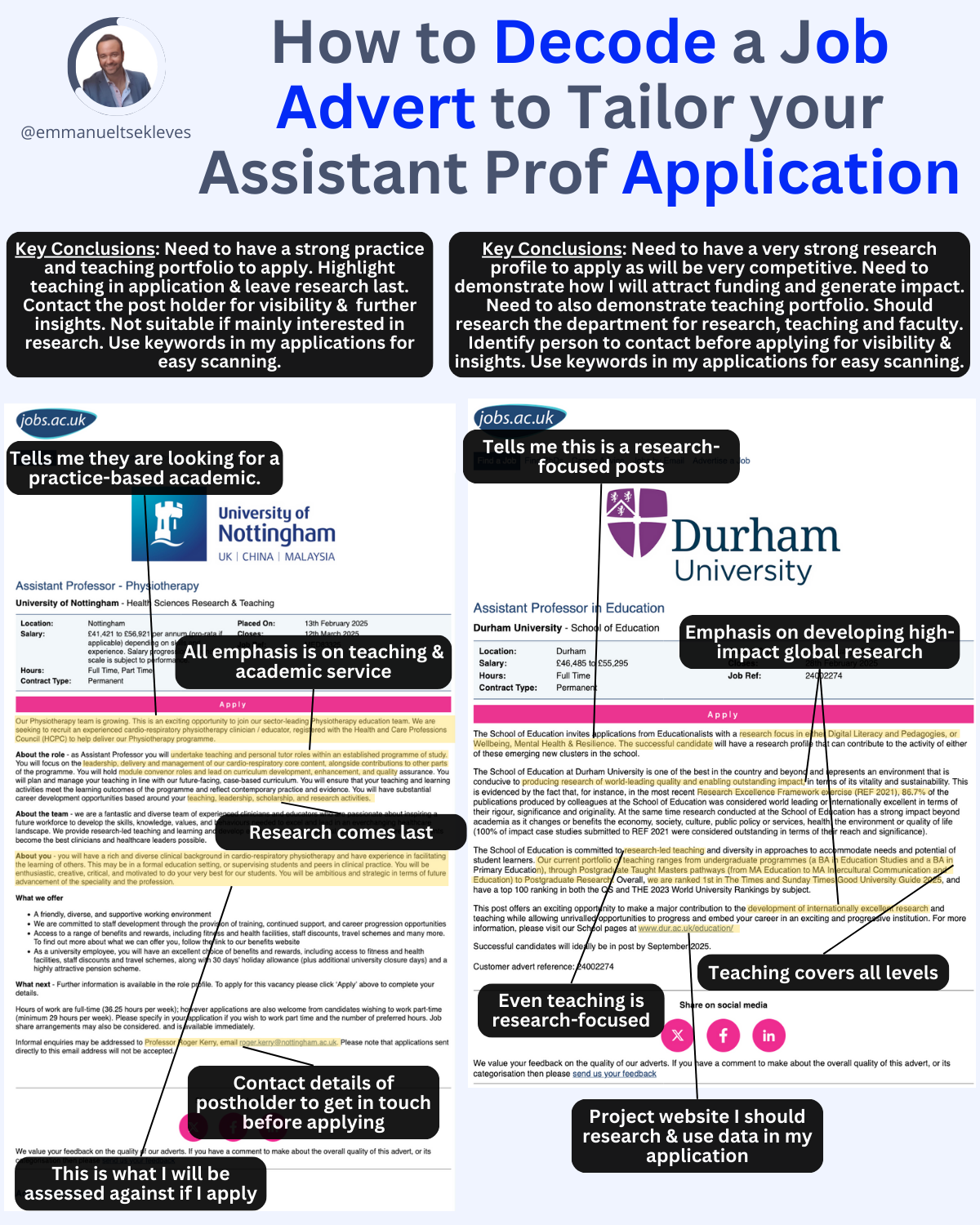
Key Takeaways:
- Prioritize the "preferred" qualifications - These often contain the real selection criteria that will determine who makes the shortlist.
- Look for urgent departmental needs - Whether it's teaching specific courses or filling research gaps, identify what problem they're trying to solve with this hire.
- Read between the lines on culture clues - Repeated mentions of collegiality, work ethic, or mentorship signal specific departmental values or past challenges.
-
→ Your Action Plan for This Week
This week, find one active job posting that interests you and analyze it using these decoding strategies:
- Highlight the "preferred" qualifications & note how you'll address each one
- Identify which courses they need covered most urgently
- Determine if they're seeking a specialist or generalist
- Look for signs of previous departmental challenges
Well, that’s it for today.
See you next week.
Whenever you're ready, there are 3 ways I can help you:
1. Get free actionable tips on how to secure a tenure-track job in academia by following me on X, LinkedIn and Instagram.
2. Take my Academic Job Seekers Assessment quiz to receive personalised recommendations & discover my 6P Academic Job Accelerator Program.
3. If you're ready to take your PhD application journey to the next level, join my PhD Application and Scholarship Masterclass waitlist. Click the link below to learn more and secure your spot.



Responses