Today, I'm sharing five proven mental frameworks that helped me make this transition successfully
28 May 2025
Read time: 3 minutes
Supporting our sponsors directly helps us continue delivering valuable content for FREE to you each week — your clicks make a difference!
FREE Webinar: Academic Hiring Commitee Secrets Revealed - Wed 4th June
I'm revealing hiring committee secrets most researchers never learn.
FREE webinar next Wednesday: 'What Hiring Committees Actually Do With Your Application.'
After reviewing 400+ applications, I'm sharing the 75-second reality.
Limited spots -> Registre for free here.
The jump from PhD student to postdoc researcher can feel like being pushed into the deep end.
Suddenly, you're expected to work more independently, develop your own research ideas, and build your academic identity—all while adjusting to a new lab or university.
Many new postdocs feel caught between worlds: no longer a student, but not yet a professor.
Today, I'm sharing five proven mental frameworks that helped me make this transition successfully,
frameworks I've since taught to dozens of new postdocs who were struggling to find their footing.

When I started my first postdoc position, I felt completely lost.
My PhD advisor had closely guided my research, but my postdoc supervisor expected me to work independently from day one.
I spent months feeling like an imposter, worried I'd made a terrible career mistake.
The turning point came when I started meeting with other postdocs across departments.
We discovered we were all facing similar challenges, but using different strategies to overcome them.
From these conversations, I developed five mental frameworks that transformed my postdoc experience.
Framework #1: The 80/20 Independence Rule
Many new postdocs swing between total dependence on their supervisor and complete independence.
The best approach is somewhere in between.
How it works: Spend 80% of your time on projects aligned with your lab's goals, and 20% exploring your own research questions.
This balance gives you freedom to develop your identity while still contributing to your lab's mission.
Framework #2: The Expertise Inventory
Many postdocs feel like beginners again in a new lab.
The expertise inventory helps you recognize the valuable skills you already have.
How it works: Make a list of all the skills and knowledge you gained during your PhD.
Then identify which of these are valuable in your new position and which new skills you need to develop.
Framework #3: The Collaboration Mindset
The relationship with your postdoc supervisor should be more collaborative than your PhD relationship was.
How it works: Instead of thinking of your supervisor as an advisor, approach them as a senior collaborator.
Bring solutions, not just problems, and propose specific projects rather than asking what you should do.
Framework #4: The Three-Year Vision
Many postdocs drift without clear goals. A three-year vision creates direction and purpose.
How it works: Write down exactly where you want to be in three years:
- what papers you'll have published,
- what skills you'll have developed,
- and what position you'll be ready for.
Framework #5: The Network Expansion Plan
Your professional network needs to grow beyond your PhD connections.
How it works: Set a goal to build relationships with three new types of contacts:
- peers outside your lab,
- potential collaborators in adjacent fields,
- and senior researchers who might become future references.
Key Takeaways:
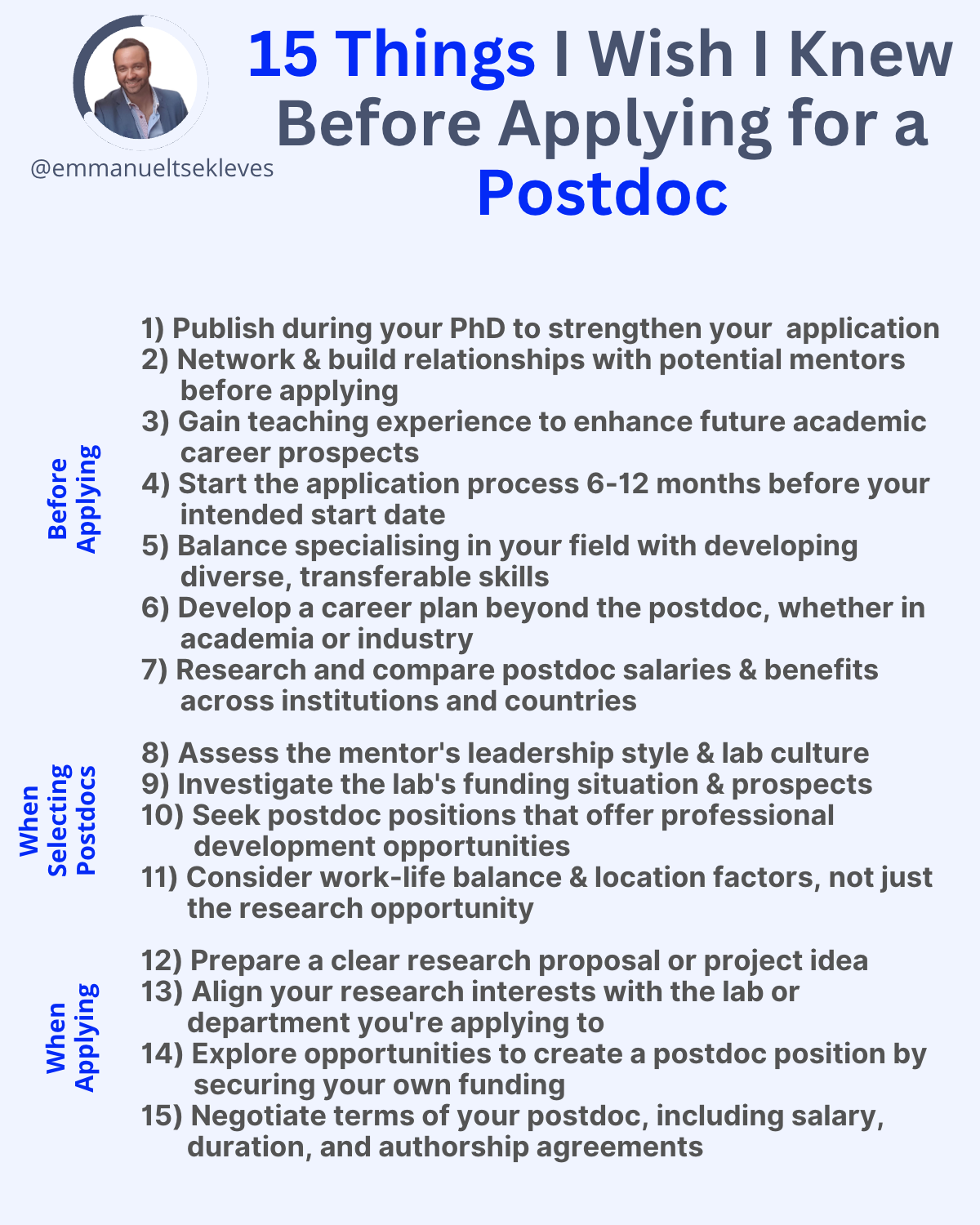
- Balance independence with alignment - Use the 80/20 rule to develop your research identity while contributing to lab goals.
- Recognize your existing expertise - Create an inventory of your skills to build confidence in your new role.
- See yourself as a collaborator, not a student - Approach your supervisor with solutions and ideas, not just questions.
-
→ Your Action Plan for This Week
This week:
- Create your Expertise Inventory by listing all skills you gained during your PhD
- Schedule a meeting with your supervisor to propose one new research idea (practice the collaboration mindset)
- Draft the first version of your Three-Year Vision to guide your decisions
Ready to transform get your next postdoc job?
Check out my Academic Job Accelerator program, where I provide step-by-step guidance on creating application materials that actually get interviews.
Early bird pricing ends 30th May!
Well, that’s it for today.
See you next week.
Whenever you're ready, there are 3 ways I can help you:
1. Get free actionable tips on how to secure a tenure-track job in academia by following me on X, LinkedIn me Instagram and BlueSky
2. Take my proven 6P Academic Job Accelerator Program that has helped hundreds of researchers secure academic positions, or start with my free training videos to learn the exact strategies hiring committees respond to.
3. If you're ready to take your PhD application journey to the next level, join my PhD Application and Scholarship Masterclass waitlist. Click the link below to learn more and secure your spot.
Responses