
Today, I'm sharing the exact system that helped three of my part-time students complete their PhDs in 5-6 years while working full-time jobs, a strategy built on focused micro-sessions and ruthless prioritisation.
7 January 2026
Read time: 3 minutes
Supporting our sponsors directly helps me continue delivering valuable content for FREE to you each week. Your clicks make a difference! Thank you. Emmanuel
You're Not Failing. The System Wasn't Built for You.
33% of PhD/DBA students drop out. Most are working professionals like you.
You don't have 40 hours a week. You have 10, scattered across nights and weekends.
Your supervisor gives great academic feedback. But they don't understand work-life-PhD balance.
Premium PhD/DBA Mentoring: built specifically for mid-senior professionals completing their doctorate on time.
→ 30+ PhDs/DBAs mentored to success
→ From lost PhD student to Professor by 40
→ I understand the juggle because I lived it via my mentees
👉 Learn more here.
Most PhD students who work full-time jobs or have significant family responsibilities think they can't make meaningful progress with just a few hours per week.
They watch full-time students race ahead and assume part-time doctoral work means taking twice as long to finish.
What if there was a specific strategy that let you make genuine progress in just 5-10 hours per week by working smarter instead of longer?
Today, I'm sharing the exact system that helped three of my part-time students complete their PhDs in 5-6 years while working full-time jobs, a strategy built on focused micro-sessions and ruthless prioritisation.

Five years ago, one of my students was trying to complete her PhD while working a demanding full-time job and raising two young children.
She had maybe 5-7 hours per week for dissertation work and felt hopeless about ever finishing.
Traditional PhD advice about "deep work days" and "writing retreats" felt completely irrelevant to her reality.
We developed a completely different approach based on her actual constraints.
By focusing on micro-sessions, strategic task design, and relentless prioritization, she completed her PhD in six years.
More importantly, she maintained her mental health, kept her job, and stayed present for her family throughout the process.
Strategy #1: Design Tasks for 30-60 Minute Sessions
Stop trying to squeeze "deep work" into your schedule.
Instead, break every PhD task into chunks you can complete in single sessions.
How to implement: Each Sunday, break your week's PhD work into specific 30-60 minute tasks.
Instead of "work on literature review," create tasks like "read and summarize three papers on X topic" or "write 300 words on theoretical framework."
When you sit down for your limited PhD time, you know exactly what to accomplish and can finish something meaningful in one session.
Strategy #2: Use the "PhD Power Hour" Time Blocking Method
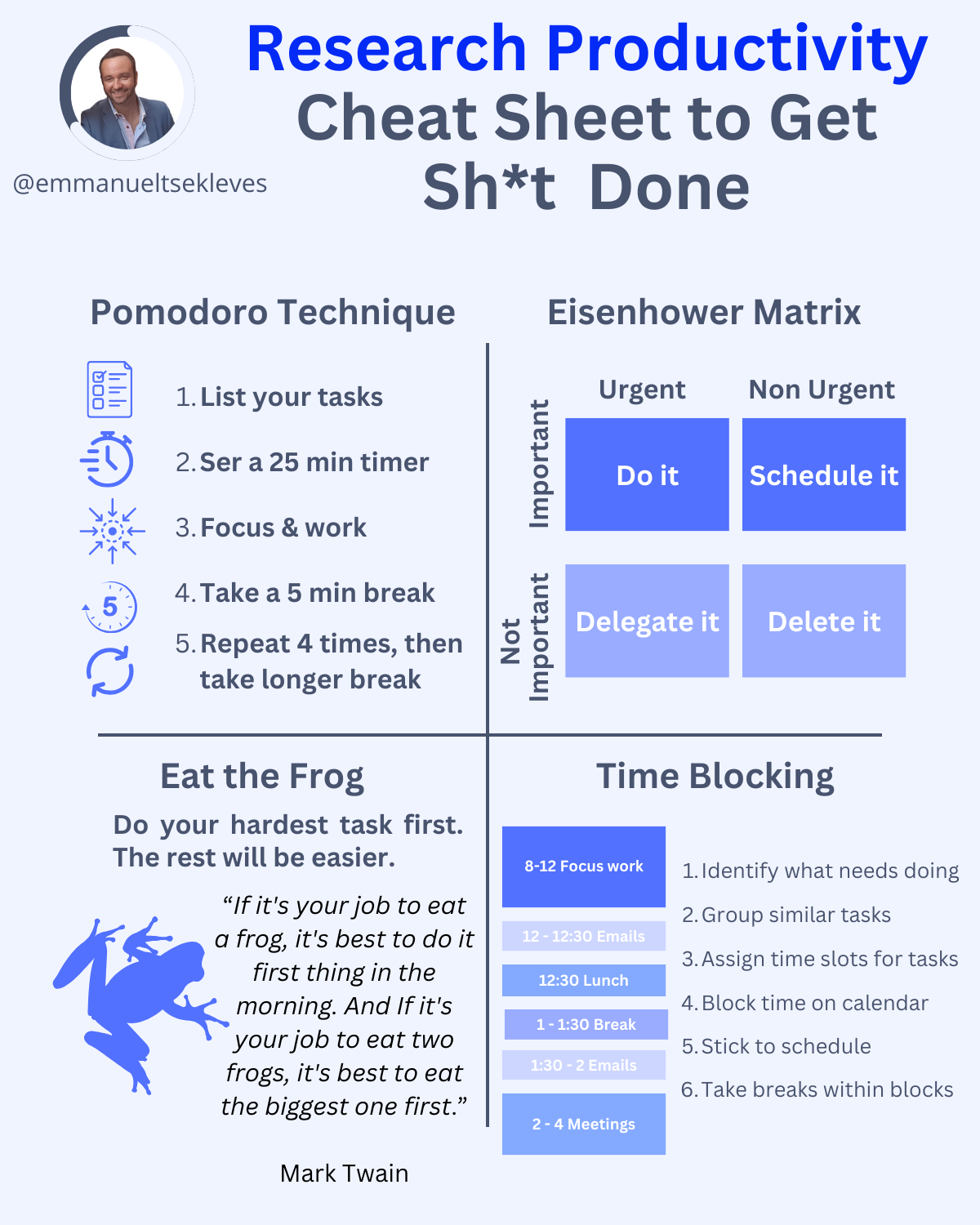
Protect your limited PhD time fiercely by scheduling it like unmovable appointments.
How to implement:
- Block specific one-hour time slots in your calendar each week dedicated only to PhD work.
- Treat these blocks as seriously as doctor appointments or work meetings.
Most successful part-time students schedule 5-7 one-hour blocks weekly at consistent times.
Early mornings before work, lunch breaks, and evening hours after kids sleep are common PhD power hours.
Find what works for your life and protect those times ruthlessly.
Strategy #3: Leverage "Dead Time" for Low-Intensity Tasks
Use commute time, waiting rooms, and lunch breaks for tasks that don't require deep focus.
How to implement: Keep a list of "mobile-friendly" PhD tasks:
- reading papers on your phone,
- listening to recorded lectures,
- reviewing flashcards,
- editing previously written text,
- or organizing references.
Do these tasks during moments that would otherwise be wasted.
Even 15-minute blocks add up when used strategically throughout your week.
Strategy #4: Apply the "One Big Thing" Weekly Focus
Part-time students who try to advance multiple dissertation chapters simultaneously make minimal progress on everything.
Focus creates completion.
How to implement: Each week, choose ONE major dissertation component to advance:
- literature review,
- methodology chapter, data collection,
- analysis, or a specific results section.
Dedicate all your PhD hours that week to this single focus.
This approach produces completed chapters rather than partially finished everything.
Strategy #5: Create Forcing Functions Through External Deadlines
Without external pressure, part-time work expands infinitely.
Create artificial deadlines that force completion.
How to implement:
- Schedule regular meetings with your advisor every 2-3 weeks where you must show specific progress.
- Join or create a writing accountability group that meets weekly.
- Register for conferences 6-9 months in advance, forcing you to complete work for presentation.
External commitments create the urgency that limited time alone doesn't provide.
The Weekend Intensive Strategy
While weekdays might offer only 1-2 hour blocks, weekends can provide longer sessions if strategically planned.
How to implement:
- Dedicate one 3-4 hour block on weekends to intensive PhD work.
- Use this time for tasks requiring sustained focus: complex analysis, difficult writing, or comprehensive editing.
- Protect this time by negotiating with family, trading childcare with partners, or using it before others wake up.
One quality weekend session can advance your work more than several fragmented weekday hours.
The Energy Management Framework
Limited time means you must work during your highest-energy periods, not just whenever time is available.
How to implement:
- Track your energy levels for two weeks to identify when you're most mentally sharp.
- Schedule your hardest PhD tasks during these peak periods and save easier tasks for low-energy times.
Working tired on complex tasks wastes your precious limited time.
The Progress Tracking System
Part-time progress feels invisible without systematic tracking that shows accumulation over time.
How to implement:
- Keep a simple spreadsheet tracking hours worked and tasks completed each week.
- Celebrate mini-milestones like "completed 10 paper summaries" or "wrote 2,000 words this month."
- Review monthly to see patterns and adjust your strategy.
Visible progress prevents the discouragement that makes part-time students quit.
Setting Realistic Completion Timelines
Part-time PhDs take longer than full-time programs, but strategic work prevents them from dragging on forever.
How to plan: With 5-10 focused hours weekly, expect your PhD to take 5-7 years rather than 3-4.
This isn't failure, it's reality.
Plan major milestones (proposal defense, data collection completion, first draft) accordingly.
Realistic timelines prevent the guilt and frustration that come from comparing yourself to full-time students.
Key Takeaways:
- Break all work into 30-60 minute tasks that you can complete in single sessions rather than requiring long blocks
- Focus on one major component weekly instead of trying to advance everything simultaneously
- Create external deadlines through meetings and commitments to force completion of work
→ Your Action Plan for This Week
- Identify and block 5-7 one-hour "PhD power hours" in your weekly schedule
- Break your current dissertation work into specific 30-60 minute tasks
- Set up one external accountability system (advisor meeting, writing group, or conference deadline)
How many hours per week can you realistically dedicate to your PhD? Reply and share your biggest time management challenge!
PhD while working full-time? Your supervisor doesn't understand your reality.
I've mentored 30+ working professionals to successful completion. I know exactly where you're losing time. Premium 1:1 mentorship for dedicated professionals with limited research hours.
Check here for details and to register your interest.
Well, that’s it for today.
See you next week.
Whenever you're ready, there are 3 ways I can help you:
1. Get free actionable tips on how to complet your PhD and secure a tenure-track job in academia by following me on X, LinkedIn me Instagram and BlueSky
2. Join my Premium 1:1 PhD Mentorship Program. I provide exclusive, results-driven support for professionals who need fast-track guidance on proposals and thesis completion. DM or email me to learn more about this premium consultancy for serious professionals ready to succeed quickly.
Responses