
Today, I'm sharing the exact documentation system that has helped dozens of my students and postdocs navigate AI disclosure requirements successfully across different journals, funding agencies, and conferences.
3 December 2025
Read time: 3 minutes
Supporting our sponsors directly helps me continue delivering valuable content for FREE to you each week. Your clicks make a difference! Thank you. Emmanuel
Fix Your Academic English Before Reviewers Reject Your Paper
My PhD student's paper got rejected, not for weak research, but for non-native English. Professional editors: £800. University services: 6-week wait. She had 3 weeks.
Inkwell helped her fix it in 5 days, and get accepted. Unlike other AI tools, Inkwell doesn't just correct your writing. It teaches you WHY each change matters. You learn academic English while you edit.
Whether you're preparing conference papers, writing your thesis, or submitting to journals — Inkwell helps international researchers write with confidence.
👉 Try risk-free (first month, no limitations): https://inkwell.net/
Students and faculty get 50% off permanently. 👉 Check eligibility: https://lnkd.in/eTGU_Hti
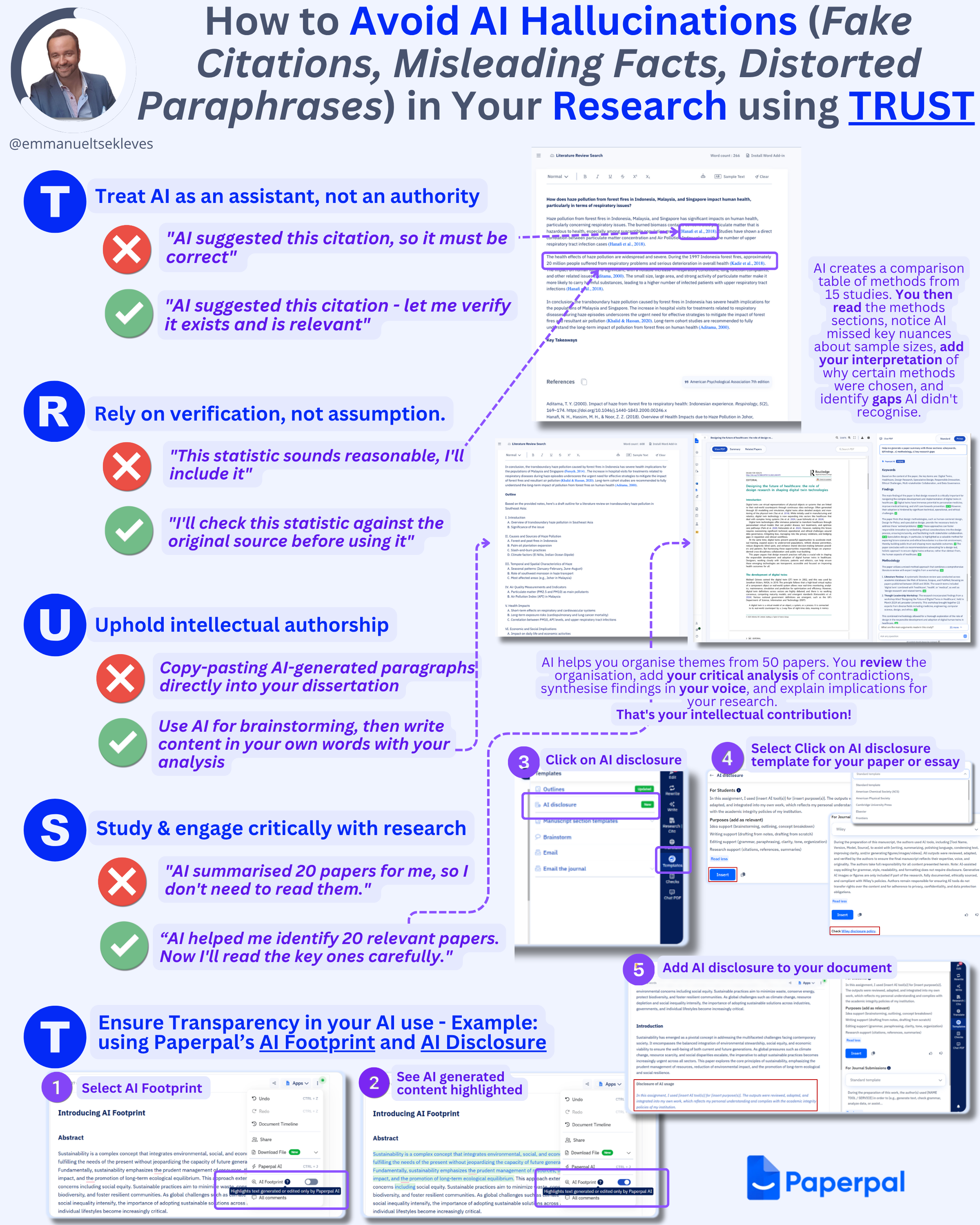
AI is transforming research, but most academics have no idea how to properly document and disclose their AI use in papers, grants, and presentations.
Some researchers hide their AI use out of fear, while others provide vague disclosures that raise more questions than they answer.
Both approaches can damage your credibility and lead to rejection.
What if you had ready-to-use templates that ensure complete transparency while protecting your reputation?
Today, I'm sharing the exact documentation system that has helped dozens of my students and postdocs navigate AI disclosure requirements successfully across different journals, funding agencies, and conferences.

Last year, one of my colleagues' postdoc had a paper rejected because their AI disclosure was too vague, leaving reviewers uncertain about the extent of AI involvement.
Another colleague faced harsh questions during a grant review because they hadn't documented their AI verification process.
These experiences taught me that good intentions aren't enough when it comes to AI transparency.
I developed a comprehensive documentation protocol with specific templates for different contexts.
Since implementing this system, none of my students or collaborators have faced AI-related complications in peer review or grant evaluation.
The secret is being so thorough and transparent that reviewers have no remaining questions.
The Foundation: Your AI Use Log
Before you can disclose AI use properly, you need detailed records of what you actually did.
What to track: For every research project, maintain a running log that includes:
- the specific AI tool name and version,
- exact dates of use,
- prompts or queries you used,
- specific tasks the AI helped with,
- verification methods for AI output,
- and any problems or limitations you encountered.
How to organize: Create a simple spreadsheet or document for each project.
Update it in real time as you use AI tools rather than trying to remember details months later when writing your paper.
Template #1: Methods Section Disclosure for Papers
Most journals require AI disclosure in your methods section when AI contributed to data analysis, literature review, or other research processes.
Template wording: "We used [specific AI tool name and version] to assist with [specific task, e.g., initial literature search, data organization, code debugging]. All AI-generated output was independently verified by the research team using [specific verification method]. AI was not used for [tasks you completed without AI, e.g., data interpretation, conclusions, manuscript writing]."
When to use: Include this in your methods section whenever AI contributed to any aspect of your research process.
Template #2: Acknowledgments Section for Writing Assistance
When AI helped with writing, editing, or language improvement, disclose it in the acknowledgments section.
Template wording: "We used [specific AI tool] to improve the clarity and grammar of this manuscript. All scientific content, interpretations, and conclusions are solely the authors' own work. The final manuscript was reviewed and approved by all authors."
When to use: Use this when AI helped with editing, grammar checking, or rephrasing sentences but did not generate scientific content.
Template #3: Grant Application AI Disclosure
Funding agencies increasingly ask about AI use in research proposals and preliminary data.
Template wording: "In developing this proposal, we used [specific AI tool] for [specific tasks such as literature search assistance, preliminary data visualization]. All scientific rationale, hypotheses, and proposed methods are original work by the research team. We have implemented verification protocols including [specific measures] to ensure accuracy and eliminate bias in any AI-assisted work."
When to use: Include a dedicated section on AI use in your research plan or methods section of grant applications.
Template #4: Conference Presentation Disclosure
Conference presentations require clear disclosure when AI contributed to the research or presentation materials.
Template wording: Add a slide at the end of your presentation stating: "AI Tools Used: [tool names] for [specific tasks]. All findings and conclusions represent original analysis by the research team. Questions about our AI verification process are welcome."
When to use: Include this disclosure slide in any conference presentation where AI contributed to the research or slide preparation.
Template #5: Supplementary Materials Documentation
For comprehensive transparency, create detailed supplementary documentation of your AI use.
Template structure: Include sections covering: AI tools used (with version numbers and dates), specific tasks performed by AI, verification and quality control methods, limitations discovered during AI use, and any instances where you chose not to use AI output.
When to use: Provide this as supplementary material when submitting to journals that encourage or require detailed AI documentation.
The Pre-Submission Checklist
Before submitting any work, verify your AI disclosure is complete.
Questions to answer:
- Can readers understand exactly which AI tools you used?
- Is it clear what tasks AI performed versus what you did yourself?
- Have you explained how you verified AI output?
- Did you disclose AI use in all required sections (methods, acknowledgments, etc.)?
- Would reviewers have any remaining questions about your AI use?
If you can't answer yes to all these questions, revise your disclosure before submission.
Adapting Templates to Your Field and Journal
Different fields and journals have varying AI disclosure requirements.
How to customize:
- Check your target journal's author guidelines for specific AI disclosure requirements.
- Review recently published papers in that journal to see how others disclosed AI use.
- When in doubt, provide more detail rather than less.
- Contact the editor directly if requirements are unclear.
Remember that disclosure standards are evolving rapidly, so check current requirements for each submission.
Key Takeaways:
- Maintain detailed real-time logs of your AI use rather than trying to remember details when writing papers
- Use specific, detailed disclosure language that explains exactly what AI did and how you verified output
- Customize templates for each context including papers, grants, and presentations based on specific requirements
→ Your Action Plan for This Week
- Create an AI use log template and start tracking your current AI-assisted work
- Review one recent paper or grant to ensure your AI disclosure meets current standards
- Adapt these templates to match your field's specific disclosure requirements
Well, that’s it for today.
See you next week.
Whenever you're ready, there are 3 ways I can help you:
1. Get free actionable tips on how to complet your PhD and secure a tenure-track job in academia by following me on X, LinkedIn me Instagram and BlueSky
2. Join my Premium 1:1 PhD Mentorship Program. I provide exclusive, results-driven support for professionals who need fast-track guidance on proposals and thesis completion. DM or email me to learn more about this premium consultancy for serious professionals ready to succeed quickly.
3. Take my proven Academic Job Accelerator Program that has helped hundreds of researchers secure academic positions, and start with my free training videos to learn the exact strategies hiring committees respond to.

Responses